Search
Disclaimer

Clicking the images or links will redirect you to a website hosted by BenchSci that provides third-party scientific content. Neither the content nor the BenchSci technology and processes for selection have been evaluated by us; we are providing them as-is and without warranty of any kind, including for use or application of the Thermo Fisher Scientific products presented.
Bioss
Adenovirus 5 E1A Polyclonal Antibody
{{$productOrderCtrl.translations['antibody.pdp.commerceCard.promotion.promotions']}}
{{$productOrderCtrl.translations['antibody.pdp.commerceCard.promotion.viewpromo']}}
{{$productOrderCtrl.translations['antibody.pdp.commerceCard.promotion.promocode']}}: {{promo.promoCode}} {{promo.promoTitle}} {{promo.promoDescription}}. {{$productOrderCtrl.translations['antibody.pdp.commerceCard.promotion.learnmore']}}
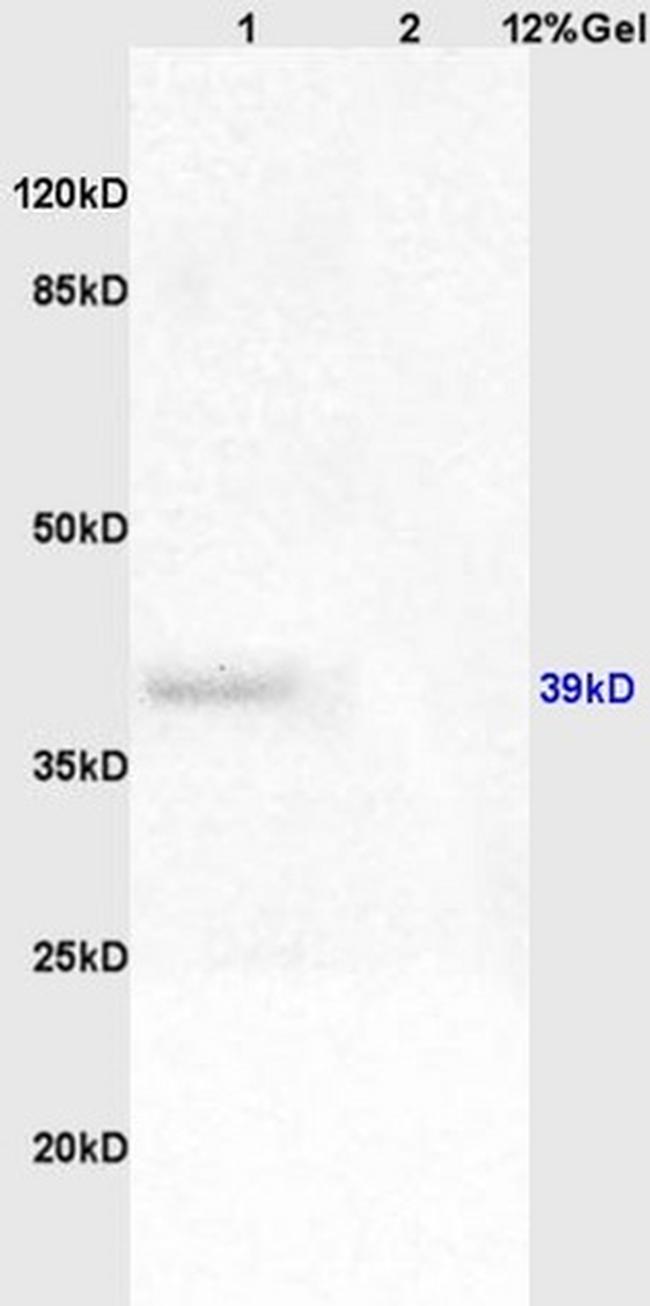
图: 1 / 1
Adenovirus 5 E1A Antibody (BS-6136R) in WB
Lane 1: rat brain lysates Lane 2: rat liver lysates probed with Anti Adenovirus 5 E1A Polyclonal Antibody, Unconjugated (bs-6136R) at 1:200 in 4°C. Followed by conjugation to secondary antibody (bs-0295G-HRP) at 1:3000 90 min in 37°C. Predicted band 32 kD. Observed band size: 32 kD.

产品信息
BS-6136R
应用
建议稀释比
已发表文章
产品规格
种属反应
Virus
宿主/亚型
Rabbit
/ IgG
分类
Polyclonal
类型
Antibody
抗原
KLH conjugated synthetic peptide derived from human Adenovirus 5 E1A.
偶联物
形式
Liquid
浓度
1 mg/mL
纯化类型
Protein A
保存液
0.01M TBS, pH 7.4, with 50% glycerol, 1% BSA
内含物
0.02% ProClin 300
保存条件
-20°C
运输条件
Ambient (domestic); Wet ice (international)
靶标信息
Adenoviruses are DNA viruses generally widespread in nature that are frequently the cause of acute upper respiratory tract infections (i.e. common colds). 49 human adenovirus serotypes have been discovered and divided into six subgroups, A to E, based on observation. They are an important cause of respiratory illness, conjunctivitis, gastroenteritis, and have more recently been recognized as a potential cause of sexually transmitted diseases. Several types have oncogenic potential though most cause self-limiting febrile illnesses characterized by inflammation of conjunctivae and the respiratory tract. The virus can be isolated from the majority of tonsils/adenoids surgically removed, indicating latent infections. It is not known how long the virus can persist in the body, or whether it is capable of reactivation after long periods. In patients experiencing immunosuppression (e.g. AIDS) it can be reactivated, causing disease. Adenovirus vectors, particularly those based on Ad5, have shown great promise for the development of gene therapy protocols and have been used for clinical purpose. The early region (E1A) of the adenovirus genome plays a central role in cellular transformation and regulation of gene expression. The E1A region encodes a series of related proteins (35-46kDa) with multifuctional capabilities and form a specific complex with the retinoblastoma tumor suppressor gene product (Rb protein). The E1A and E1B regions together comprise the transforming region of adenovirus. While expression of E1A alone is sufficient to immortalize primary cells, complete transformation requires the additional expression of the E1B region. Several conserved regions of E1A are similar to portions of other viral oncoproteins like the HPV-16 and HPV-18 E7 and SV40 large T antigen.
仅用于科研。不用于诊断过程。未经明确授权不得转售。
篇参考文献 (0)
您是否在文献中引用过该产品?请点击下方按钮邮件告知我们。

