Search
Disclaimer

Clicking the images or links will redirect you to a website hosted by BenchSci that provides third-party scientific content. Neither the content nor the BenchSci technology and processes for selection have been evaluated by us; we are providing them as-is and without warranty of any kind, including for use or application of the Thermo Fisher Scientific products presented.
Proteintech
Amphiregulin Monoclonal Antibody (1A1G9)
{{$productOrderCtrl.translations['antibody.pdp.commerceCard.promotion.promotions']}}
{{$productOrderCtrl.translations['antibody.pdp.commerceCard.promotion.viewpromo']}}
{{$productOrderCtrl.translations['antibody.pdp.commerceCard.promotion.promocode']}}: {{promo.promoCode}} {{promo.promoTitle}} {{promo.promoDescription}}. {{$productOrderCtrl.translations['antibody.pdp.commerceCard.promotion.learnmore']}}
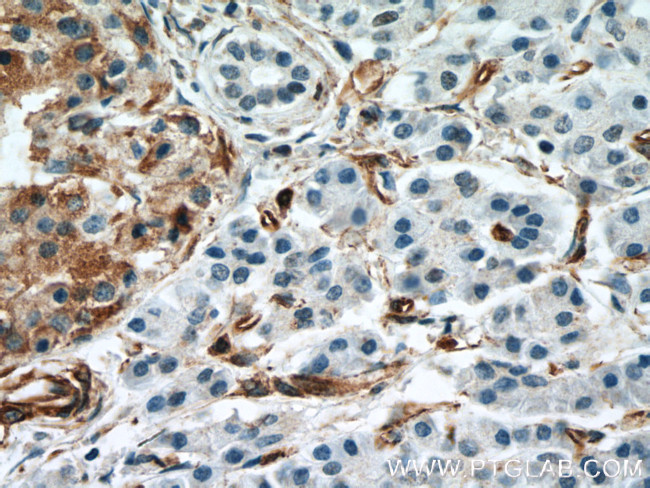
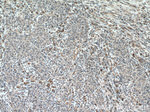
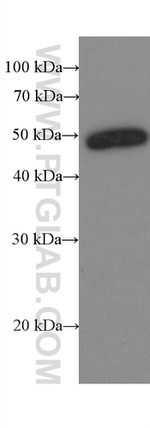
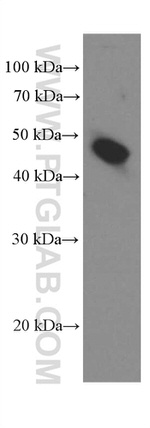
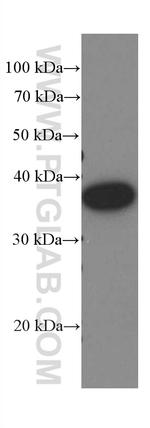


产品信息
66433-1-IG
应用
建议稀释比
已发表文章
产品规格
种属反应
Human,
Rat
宿主/亚型
Mouse
/ IgG1
分类
Monoclonal
类型
Antibody
克隆号
1A1G9
抗原
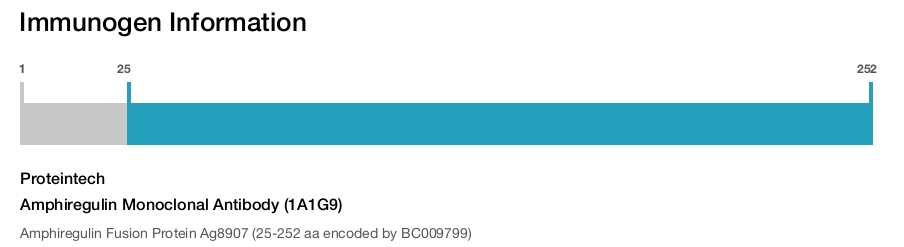
Amphiregulin Fusion Protein Ag8907 (25-252 aa encoded by BC009799)
偶联物
形式
Liquid
浓度
1 mg/mL
纯化类型
Protein A
保存液
PBS, pH 7.3, with 50% glycerol
内含物
0.02% sodium azide
保存条件
-20°C
运输条件
Wet ice (domestic); Dry ice (international)
产品详细信息
Immunogen sequence: AGLDLNDTY SGKREPFSGD HSADGFEVTS RSEMSSGSEI SPVSEMPSSS EPSSGADYDY SEEYDNEPQI PGYIVDDSVR VEQVVKPPQN KTESENTSDK PKRKKKGGKN GKNRRNRKKK NPCNAEFQNF CIHGECKYIE HLEAVTCKCQ QEYFGERCGE KSMKTHSMID SSLSKIALAA IAAFMSAVIL TAVAVITVQL RRQYVRKYEG EAEERKKLRQ ENGNVHAIA (25-252 aa encoded by BC009799)
靶标信息
Amphiregulin (AR) binds to EGF-Receptor (EGFR) with lower affinity than EGF. The mature secreted form AR is an 84-amino acid residue glycosylated polypeptide growth regulator, which is generated by proteolytic processing of a 252-amino acid transmembrane precursor. Seven different polypeptide ligands, which derive from distinct genes, are capable of binding to the extracellular domain of EGFR. These ligands include EGF, TGFalpha, AR, HB-EGF, cripto-1, epiregulin, and betacellulin. All of these growth factors contain a characteristic EGF-like domain which is defined by 6 evenly spaced cysteine residues that generate 3 loops through the formation of disulfide bonds. AR protein has been localized by immunohistochemistry to the epithelium of the colon, stomach, pancreas, breast, and placenta. AR is reportedly overexpressed in human cancers of breast, colon, stomach, and pancreas.
仅用于科研。不用于诊断过程。未经明确授权不得转售。
生物信息学
蛋白别名: Amphiregulin; amphiregulin B; AR; Colorectum cell-derived growth factor; CRDGF; MGC13647; Schwannoma-derived growth factor; SDGF
基因别名: AR; AREG; AREGB; CRDGF; SDGF
UniProt ID: (Human) P15514, (Rat) P24338
Entrez Gene ID: (Human) 374, (Rat) 29183
ER to Golgi vesicle-mediated transport
epidermal growth factor receptor signaling pathway
G-protein coupled receptor signaling pathway
cell-cell signaling
cell proliferation
positive regulation of cell proliferation
glial cell proliferation
neuron projection development
response to estradiol
positive regulation of phosphorylation
response to hydrogen peroxide
response to peptide hormone
negative regulation of osteoblast differentiation
positive regulation of DNA replication
COPII vesicle coating
response to glucocorticoid
response to cAMP
dichotomous subdivision of terminal units involved in mammary gland duct morphogenesis
mammary gland branching involved in thelarche
mammary gland alveolus development
epithelial cell proliferation involved in mammary gland duct elongation
central nervous system development
response to organic cyclic compound

