Search
Disclaimer

Clicking the images or links will redirect you to a website hosted by BenchSci that provides third-party scientific content. Neither the content nor the BenchSci technology and processes for selection have been evaluated by us; we are providing them as-is and without warranty of any kind, including for use or application of the Thermo Fisher Scientific products presented.
Invitrogen
Angiotensin II/III Monoclonal Antibody (Ang II E7)
{{$productOrderCtrl.translations['antibody.pdp.commerceCard.promotion.promotions']}}
{{$productOrderCtrl.translations['antibody.pdp.commerceCard.promotion.viewpromo']}}
{{$productOrderCtrl.translations['antibody.pdp.commerceCard.promotion.promocode']}}: {{promo.promoCode}} {{promo.promoTitle}} {{promo.promoDescription}}. {{$productOrderCtrl.translations['antibody.pdp.commerceCard.promotion.learnmore']}}
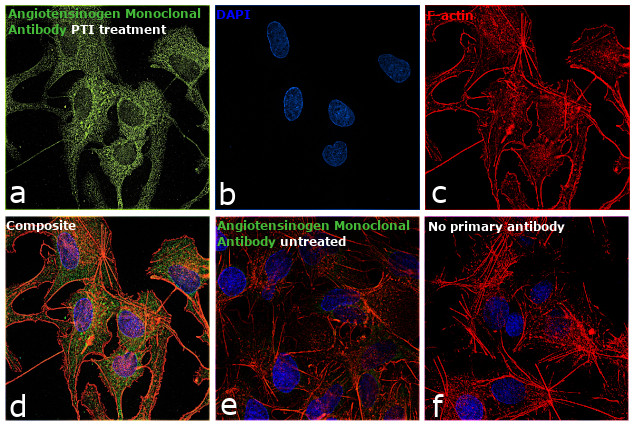
图: 1 / 3
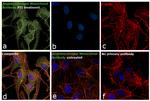
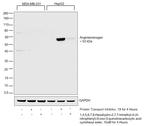
Angiotensin II/III Antibody (MA1-82996) in ICC/IF
Immunofluorescence analysis of Angiotensin II/III was performed using 70% confluent log phase HepG2 cells treated with 1X protein transport inhibitor (Product # 00-4980-03) for 4 hours. The cells were fixed with 4% paraformaldehyde for 10 minutes, permeabilized with 0.1% Triton™ X-100 for 15 minutes, and blocked with 2% BSA for 1 hour at room temperature. cells were labeled with Angiotensin II/III Monoclona... View More


产品信息
MA1-82996
产品规格
宿主/亚型
Mouse
/ IgG2a
分类
Monoclonal
类型
Antibody
克隆号
Ang II E7
抗原
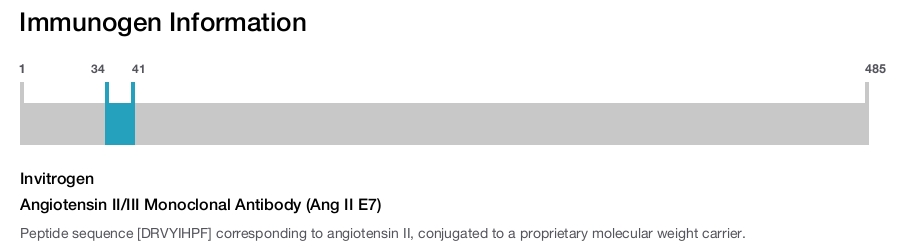
Peptide sequence [DRVYIHPF] corresponding to angiotensin II, conjugated to a proprietary molecular weight carrier.
偶联物
形式
Liquid
浓度
1 mg/mL
保存条件
Store at 4°C short term. For long term storage, store at -20°C, avoiding freeze/thaw cycles.
运输条件
Ambient (domestic); Wet ice (international)
RRID
产品详细信息
Predicted to react with horse, pig, rat and sheep based on sequence homology.
Mouse anti Human angiotensinogen II antibody, clone 13/96/Ang E7 reacts with Angiotensin II and III.Negligible reactivity was observed with Angiotensin I or Angiotensinogen.
靶标信息
The protein encoded by this gene, pre-angiotensinogen or angiotensinogen precursor, is expressed in the liver and is cleaved by the enzyme renin in response to lowered blood pressure. The resulting product, angiotensin I, is then cleaved by angiotensin converting enzyme (ACE) to generate the physiologically active enzyme angiotensin II. The protein is involved in maintaining blood pressure and in the pathogenesis of essential hypertension and preeclampsia. Angiotensin III is formed after a terminal aspartic acid amino acid group is cleaved by aminopeptidase A. Angiotensin III has decreased effect on blood pressure, but maintains angiotensin II's hormonal effects. Mutations in this gene are associated with susceptibility to essential hypertension, and can cause renal tubular dysgenesis, a severe disorder of renal tubular development. Defects in this gene have also been associated with non-familial structural atrial fibrillation, and inflammatory bowel disease.
仅用于科研。不用于诊断过程。未经明确授权不得转售。
篇参考文献 (0)
您是否在文献中引用过该产品?请点击下方按钮邮件告知我们。

