Search
Proteintech
Anosmin-1 Polyclonal Antibody
{{$productOrderCtrl.translations['antibody.pdp.commerceCard.promotion.promotions']}}
{{$productOrderCtrl.translations['antibody.pdp.commerceCard.promotion.viewpromo']}}
{{$productOrderCtrl.translations['antibody.pdp.commerceCard.promotion.promocode']}}: {{promo.promoCode}} {{promo.promoTitle}} {{promo.promoDescription}}. {{$productOrderCtrl.translations['antibody.pdp.commerceCard.promotion.learnmore']}}
Additional Information:
{{banner.description}}
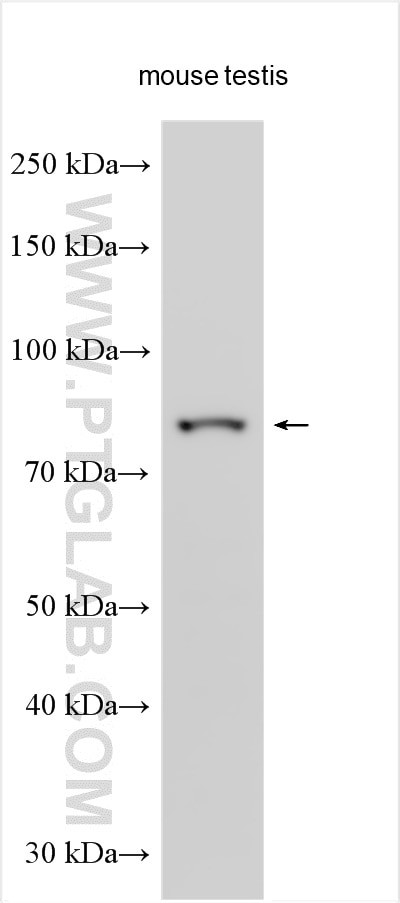

产品信息
26504-1-AP
产品规格
种属反应
Human,
Mouse
宿主/亚型
Rabbit
/ IgG
分类
Polyclonal
类型
Antibody
抗原
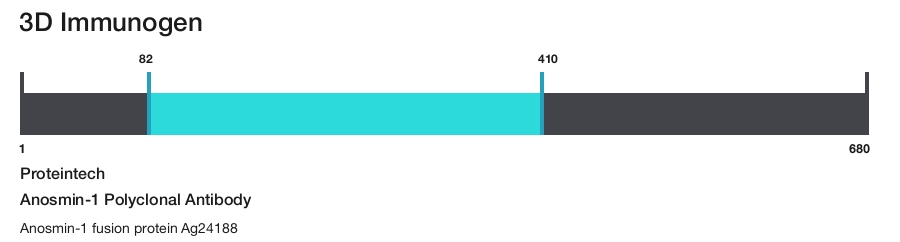
Anosmin-1 fusion protein Ag24188
偶联物
形式
Liquid
浓度
1 mg/mL
规格
150 µg
纯化类型
Antigen affinity chromatography
保存液
PBS, pH 7.3, with 50% glycerol
内含物
0.02% sodium azide
保存条件
-20°C
运输条件
Wet ice
产品详细信息
Immunogen sequence: QCSKCLEPCK ESGDLRKHQC QSFCEPLFPK KSYECLTSCE FLKYILLVKQ GDCPAPEKAS GFAAACVESC EVDNECSGVK KCCSNGCGHT CQVPKTLYKG VPLKPRKELR FTELQSGQLE VKWSSKFNIS IEPVIYVVQR RWNYGIHPSE DDATHWQTVA QTTDERVQLT DIRPSRWYQF RVAAVNVHGT RGFTAPSKHF RSSKDPSAPP APANLRLANS TVNSDGSVTV TIVWDLPEEP DIPVHHYKVF WSWMVSSKSL VPTKKKRRKT TDGFQNSVIL EKLQPDCDYV VELQAITYWG QTRLKSAKVS LHFTSTHATN NKEQLVKTR
靶标信息
KAL1 (Anosmin-1) an extracellular matrix-associated glycosylated protein, have been linked with Kallmann Syndrome (KS), an X-linked genetic disorder characterized by loss of smell caused by abnormal olfactory bulb development and delayed puberty caused by disrupted migration of the gonadotropin-releasing hormone neuron. Anosmin-1 has been shown to directly bind FGFR1 via its N-terminal cysteine-rich domain, whey-acidic protein-like domain, and its first FnIII repeat with the D2 and D3 ectodomains of FGFR1. It is thought that Anosmin-1 can modulate FGFR1 signaling and have opposing effects on the formation and activation of FGF2-FGFR1-heparing complex.
仅用于科研。不用于诊断过程。未经明确授权不得转售。
篇参考文献 (0)
您是否在文献中引用过该产品?请点击下方按钮邮件告知我们。
生物信息学
蛋白别名: Adhesion molecule-like X-linked; anosmin; Anosmin-1; Anosmin1; KAL; KALIG-1; Kallmann syndrome interval gene 1; Kallmann syndrome protein; Kallmann syndrome-1 sequence (anosmin-1); putative adhesion molecule; WAP four-disulfide core domain 19
基因别名: ADMLX; ANOS1; HH1; HHA; KAL; KAL1; KALIG-1; KALIG1; KMS; WFDC19
UniProt ID: (Human) P23352
Entrez Gene ID: (Human) 3730
Disclaimer

Clicking the images or links will redirect you to a website hosted by BenchSci that provides third-party scientific content. Neither the content nor the BenchSci technology and processes for selection have been evaluated by us; we are providing them as-is and without warranty of any kind, including for use or application of the Thermo Fisher Scientific products presented.

