Search
Proteintech
BCRP/ABCG2 Polyclonal Antibody
{{$productOrderCtrl.translations['antibody.pdp.commerceCard.promotion.promotions']}}
{{$productOrderCtrl.translations['antibody.pdp.commerceCard.promotion.viewpromo']}}
{{$productOrderCtrl.translations['antibody.pdp.commerceCard.promotion.promocode']}}: {{promo.promoCode}} {{promo.promoTitle}} {{promo.promoDescription}}. {{$productOrderCtrl.translations['antibody.pdp.commerceCard.promotion.learnmore']}}
Additional Information:
{{banner.description}}
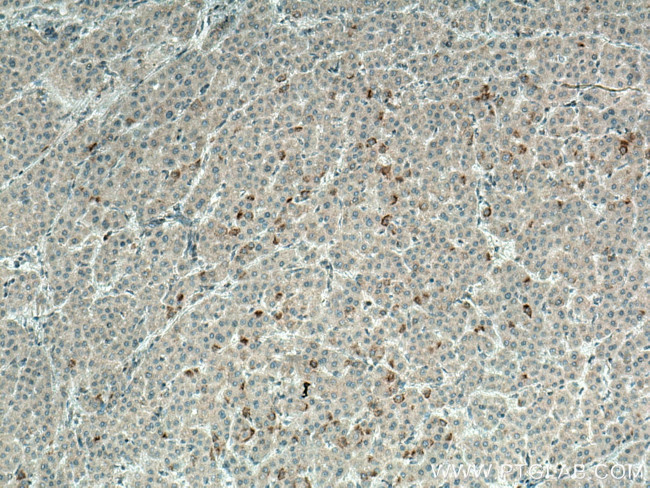

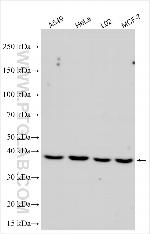


产品信息
27286-1-AP
应用
建议稀释比
已发表文章
产品规格
种属反应
Human,
Mouse
宿主/亚型
Rabbit
/ IgG
分类
Polyclonal
类型
Antibody
抗原
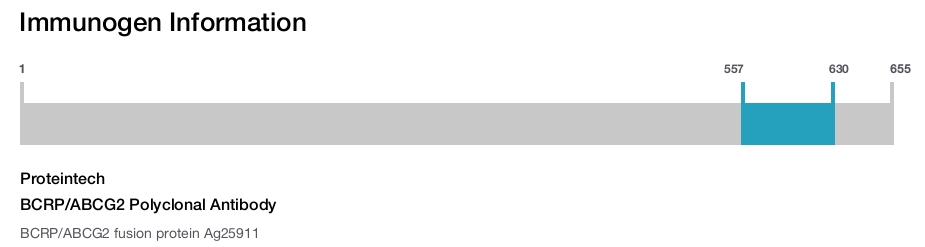
BCRP/ABCG2 fusion protein Ag25911
偶联物
Unconjugated
Unconjugated
Unconjugated
形式
Liquid
浓度
600 µg/mL
规格
90 µg
纯化类型
Affinity chromatography
保存液
PBS, pH 7.3, with 50% glycerol
内含物
0.02% sodium azide
保存条件
-20°C
运输条件
Wet ice
产品详细信息
Sequence of this protein is as follows: NLTTIASWLS WLQYFSIPRY GFTALQHNEF LGQNFCPGLN ATGNNPCNYA TCTGEEYLVK QGIDLSPWGL WKNH
靶标信息
ABCG2, is also known as placenta-specific ABC transporter and breast cancer resistance protein (BCRP1). ABCG2 confers resistance for a variety of chemotherapeutic agents, including anthracyclines, mitoxantrone, bisantrene and topotecan. Under normal conditions, ABCG2 may serve a protective function by removing toxins from the cell, and plays an important role in regulating stem cell differentiation. ABCG2 is responsible for the side population (SP) phenotype and is widely expressed in a large variety of stem cells, making it an important stem cell marker. ABCG2 may have N-linked glycosylation and may dimerize in vivo. ABCG2 is abundantly expressed in placenta, liver, intestine and stem cells.
仅用于科研。不用于诊断过程。未经明确授权不得转售。
篇参考文献 (0)
您是否在文献中引用过该产品?请点击下方按钮邮件告知我们。
生物信息学
蛋白别名: ABC transporter; ABCG2; ATP binding cassette subfamily G member 2 (Junior blood group); ATP-binding cassette sub-family G member 2; ATP-binding cassette transporter; ATP-binding cassette transporter G2; ATP-binding cassette, sub-family G (WHITE), member 2 (Junior blood group); ATPbinding cassette transporter ABCG2; Breast cancer resistance protein; Breast cancer resistance protein 1 homolog; Broad substrate specificity ATP-binding cassette transporter ABCG2; broad substrate specificity ATP-binding cassette transporter ABCG2 isoform 1 (Junior blood group); CD338; CDw338; mitoxantrone resistance protein 1; Mitoxantrone resistance-associated protein; multi drug resistance efflux transport ATP-binding cassette sub-family G (WHITE) member 2; placenta specific MDR protein; Placenta-specific ATP-binding cassette transporter; transporter; unnamed protein product; Urate exporter
基因别名: ABC15; ABCG2; ABCP; AI428558; BCRP; BCRP1; BMDP; CD338; CDw338; CDw388; EST157481; GOUT1; MRX; MXR; MXR-1; MXR1; UAQTL1
UniProt ID: (Human) Q9UNQ0, (Mouse) Q7TMS5
Entrez Gene ID: (Human) 9429, (Mouse) 26357
nucleotide binding
protein binding
ATP binding
organic anion transmembrane transporter activity
xenobiotic-transporting ATPase activity
urate transmembrane transporter activity
biotin transporter activity
efflux transmembrane transporter activity
ATPase activity
riboflavin transporter activity
ATPase activity, coupled to transmembrane movement of substances
identical protein binding
protein homodimerization activity
xenobiotic transporter activity
sphingolipid transporter activity
protein dimerization activity
ABC-type transporter activity
drug transmembrane transporter activity
ATP-binding cassette (ABC) transporter
primary active transporter
transporter
lipid transport
organic anion transport
urate transport
biotin transport
sphingolipid biosynthetic process
riboflavin transport
urate metabolic process
transmembrane transport
transepithelial transport
urate salt excretion
export across plasma membrane
transport across blood-brain barrier
cellular detoxification
drug transport across blood-brain barrier
transport
drug transmembrane transport
drug transport
drug export
embryonic process involved in female pregnancy
Disclaimer

Clicking the images or links will redirect you to a website hosted by BenchSci that provides third-party scientific content. Neither the content nor the BenchSci technology and processes for selection have been evaluated by us; we are providing them as-is and without warranty of any kind, including for use or application of the Thermo Fisher Scientific products presented.

