Search
Proteintech
BHLHE41 Polyclonal Antibody
{{$productOrderCtrl.translations['antibody.pdp.commerceCard.promotion.promotions']}}
{{$productOrderCtrl.translations['antibody.pdp.commerceCard.promotion.viewpromo']}}
{{$productOrderCtrl.translations['antibody.pdp.commerceCard.promotion.promocode']}}: {{promo.promoCode}} {{promo.promoTitle}} {{promo.promoDescription}}. {{$productOrderCtrl.translations['antibody.pdp.commerceCard.promotion.learnmore']}}
Additional Information:
{{banner.description}}
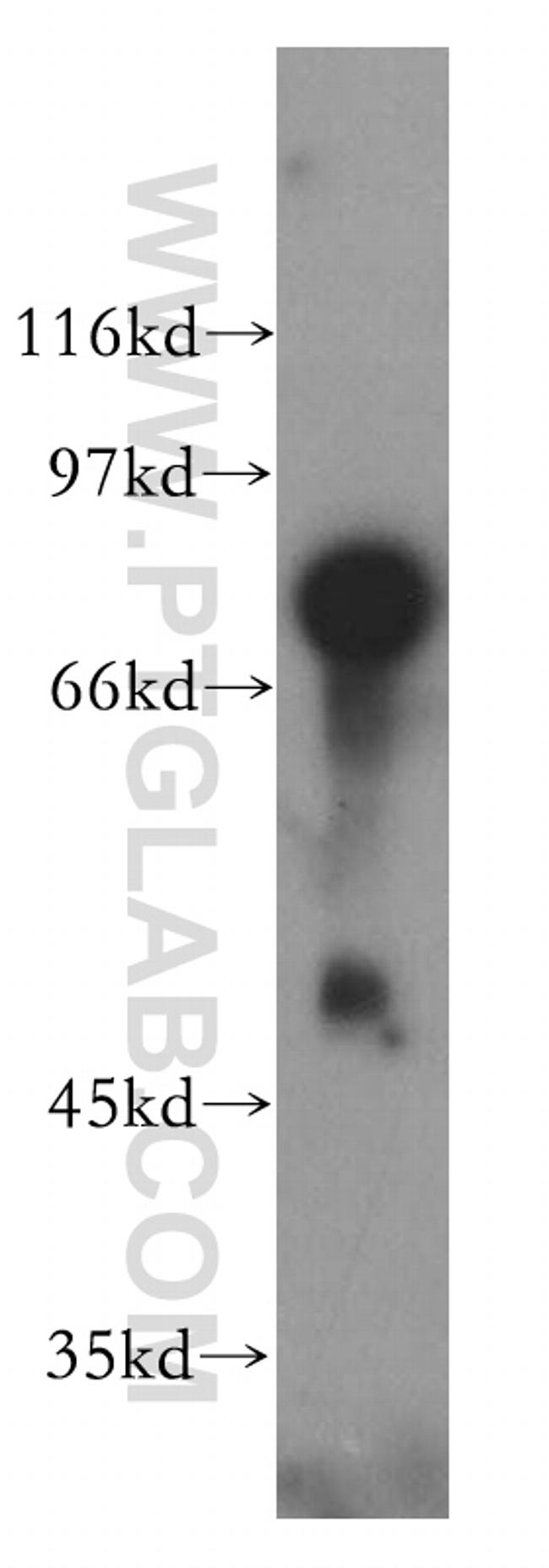
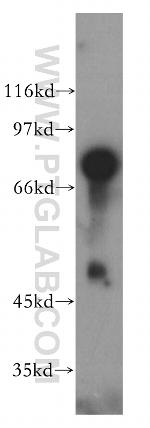
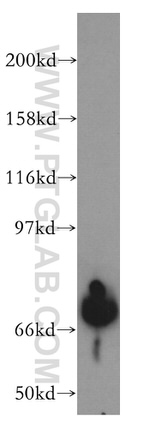
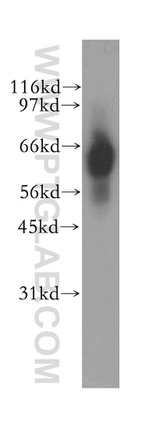


产品信息
12688-1-AP
应用
建议稀释比
已发表文章
产品规格
已发表种属
Human
宿主/亚型
Rabbit
/ IgG
分类
Polyclonal
类型
Antibody
抗原
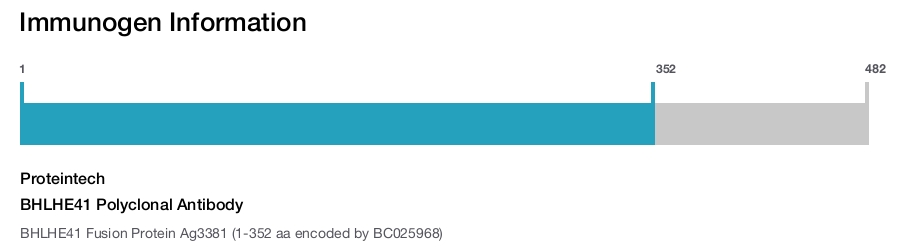
BHLHE41 Fusion Protein Ag3381 (1-352 aa encoded by BC025968)
偶联物
形式
Liquid
浓度
0.16 mg/mL
规格
24 µg
保存条件
-20°C
运输条件
Wet ice (domestic); Dry ice (international)
产品详细信息
Immunogen sequence: MDEGIPHLQ ERQLLEHRDF IGLDYSSLYM CKPKRSMKRD DTKDTYKLPH RLIEKKRRDR INECIAQLKD LLPEHLKLTT LGHLEKAVVL ELTLKHLKAL TALTEQQHQK IIALQNGERS LKSPIQSDLD AFHSGFQTCA KEVLQYLSRF ESWTPREPRC VQLINHLHAV ATQFLPTPQL LTQQVPLSKG TGAPSAAGSA AAPCLERAGQ KLEPLAYCVP VIQRTQPSAE LAAENDTDTD SGYGGEAEAR PDREKGKGAG ASRVTIKQEP PGEDSPAPKR MKLDSRGGGS GGGPGGGAVA AAAALLGPDP AAAAALLRPD AALLSSLVAF GGGGGAPFPQ PAAAAAPFCL PFC (1-352 aa encoded by BC025968)
靶标信息
The BHLHE41 gene encodes a basic helix-loop-helix (bHLH) transcription factor located at the 12p12.1 susceptibility locus. It functions primarily as a nuclear transcriptional repressor, homodimerizing or heterodimerizing with various partners to regulate gene expression. BHLHE41 expression is highly tissue-specific and responsive to environmental cues. Genetic studies have highlighted its role in increasing xenograft tumor growth and its involvement in short sleep phenotypes. A notable mutation in BHLHE41 leads to a phenotype requiring only six hours of sleep, demonstrating its influence on sleep patterns. Moreover, BHLHE41 has been associated with osteoclast differentiation processes, indicating its involvement in cellular development. Its interaction with TFEB target genes suggests a protective role against certain types of cell death, emphasizing its complex role in cellular physiology.
仅用于科研。不用于诊断过程。未经明确授权不得转售。
Disclaimer

Clicking the images or links will redirect you to a website hosted by BenchSci that provides third-party scientific content. Neither the content nor the BenchSci technology and processes for selection have been evaluated by us; we are providing them as-is and without warranty of any kind, including for use or application of the Thermo Fisher Scientific products presented.

