Search
Bioss
BTG1/BTG2 Polyclonal Antibody
{{$productOrderCtrl.translations['antibody.pdp.commerceCard.promotion.promotions']}}
{{$productOrderCtrl.translations['antibody.pdp.commerceCard.promotion.viewpromo']}}
{{$productOrderCtrl.translations['antibody.pdp.commerceCard.promotion.promocode']}}: {{promo.promoCode}} {{promo.promoTitle}} {{promo.promoDescription}}. {{$productOrderCtrl.translations['antibody.pdp.commerceCard.promotion.learnmore']}}
Additional Information:
{{banner.description}}
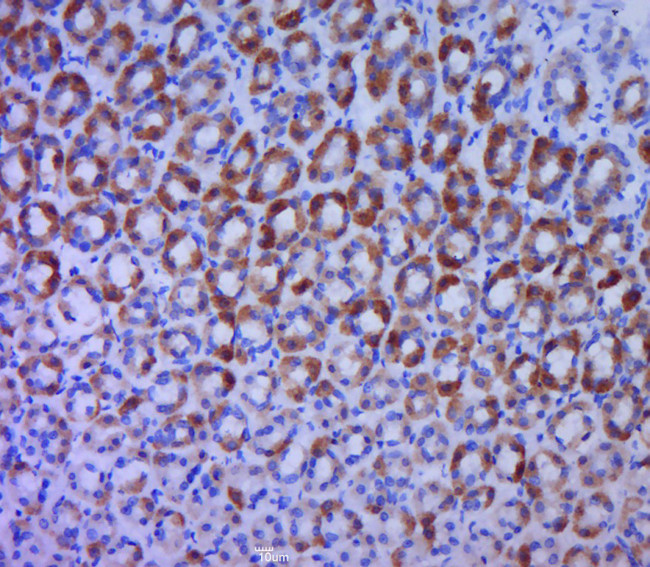
图: 1 / 1
BTG1/BTG2 Antibody (BS-7526R) in IHC (P)
Paraformaldehyde-fixed, paraffin embedded rat stomach; Antigen retrieval by boiling in sodium citrate buffer (pH6.0) for 15min; Block endogenous peroxidase by 3% hydrogen peroxide for 20 minutes; Blocking buffer (normal goat serum) at 37°C for 30min; Antibody incubation with BTG1 Polyclonal Antibody, Unconjugated (bs-7526R) at 1:400 overnight at 4°C, followed by a conjugated secondary for 20 minutes and DAB... View More

产品信息
BS-7526R
应用
建议稀释比
已发表文章
产品规格
种属反应
Human,
Mouse,
Rat
宿主/亚型
Rabbit
/ IgG
分类
Polyclonal
类型
Antibody
抗原
KLH conjugated synthetic peptide derived from human BTG1, amino acids 41-140.
偶联物
Unconjugated
Unconjugated
Unconjugated
形式
Liquid
浓度
1 mg/mL
规格
100 µg
纯化类型
Protein A
保存液
0.01M TBS, pH 7.4, with 50% glycerol, 1% BSA
内含物
0.02% ProClin 300
保存条件
-20°C
运输条件
Ambient (domestic); Wet ice (international)
靶标信息
BTG1 belongs to the BTG family of proteins.FUNCTION: Anti-proliferative protein. Its expression is associated with the early G1 phase of the cell cycle. A chromosomal aberration involving BTG1 may be a cause of a form of B cell chronic lymphocytic leukemia; translocation t(8;12)(q24;q22) with MYC. BTG2 is a member of the BTG/Tob family. This family has structurally related proteins that appear to have antiproliferative properties. BTG2 is involved in the regulation of the G1/S transition of the cell cycle. It modulates transcription regulation mediated by ESR1 (referenced from Entrez Gene). BTG2 expression is induced in vivo during neurogenesis, and the gene is transiently expressed in vitro in rat pheochromocytoma PC12 cells after induction of neuronal differentiation by addition of nerve growth factor (NGF); suggesting that BTG2 is functionally significant during the neuronal differentiation process (PMID: 12360398).
仅用于科研。不用于诊断过程。未经明确授权不得转售。
篇参考文献 (0)
您是否在文献中引用过该产品?请点击下方按钮邮件告知我们。
生物信息学
蛋白别名: Anti-proliferative factor; B-cell translocation gene 1 protein; B-cell translocation gene 1, anti-proliferative; B-cell translocation gene 2; B-cell translocation gene 2, anti-proliferative; BTG; BTG family member 2; BTG1; BTG1/2; cell surface alloantigen; Early induced gene B-cell translocation gene 2; nerve growth factor-inducible anti-proliferative; NGF-inducible anti-proliferative protein PC3; NGF-inducible anti-proliferative putative secreted protein; NGF-inducible PC3; NGF-inducible protein TIS21; pheochromacytoma cell-3; Protein BTG1; Protein BTG2; unnamed protein product
基因别名: AA959598; Agl; AI426953; An; an-1; APRO1; APRO2; AW546738; BTG1; BTG2; PC3; TIS21
UniProt ID: (Human) P62324, (Human) P78543, (Rat) Q63073, (Mouse) P62325, (Rat) P27049, (Mouse) Q04211
Entrez Gene ID: (Human) 694, (Human) 7832, (Rat) 29618, (Mouse) 12226, (Rat) 29619, (Mouse) 12227
negative regulation of transcription from RNA polymerase II promoter
DNA repair
cellular response to DNA damage stimulus
neuroblast proliferation
negative regulation of neuroblast proliferation
negative regulation of cell proliferation
associative learning
response to mechanical stimulus
anterior/posterior pattern specification
negative regulation of translation
dentate gyrus development
central nervous system neuron development
neuron differentiation
neuron projection development
skeletal muscle cell differentiation
negative regulation of apoptotic process
response to peptide hormone
negative regulation of neuron apoptotic process
response to electrical stimulus
positive regulation of nuclear-transcribed mRNA poly(A) tail shortening
neural precursor cell proliferation
cellular response to phorbol 13-acetate 12-myristate
protein methylation
response to oxidative stress
spermatogenesis
spermatid development
positive regulation of endothelial cell differentiation
positive regulation of myoblast differentiation
positive regulation of angiogenesis
positive regulation of fibroblast apoptotic process
positive regulation of catalytic activity
transcription, DNA-templated
response to organic substance
response to organonitrogen compound
response to organic cyclic compound
negative regulation of neural precursor cell proliferation
regulation of transcription, DNA-templated
transcription from RNA polymerase II promoter
cell proliferation
cell migration
negative regulation of cell growth
Disclaimer

Clicking the images or links will redirect you to a website hosted by BenchSci that provides third-party scientific content. Neither the content nor the BenchSci technology and processes for selection have been evaluated by us; we are providing them as-is and without warranty of any kind, including for use or application of the Thermo Fisher Scientific products presented.

