Search
Invitrogen
BZLF1 Polyclonal Antibody
{{$productOrderCtrl.translations['antibody.pdp.commerceCard.promotion.promotions']}}
{{$productOrderCtrl.translations['antibody.pdp.commerceCard.promotion.promocode']}}: {{promo.promoCode}} {{promo.promoTitle}} {{promo.promoDescription}}. {{$productOrderCtrl.translations['antibody.pdp.commerceCard.promotion.learnmore']}}
{{$ctrl.translations['antibody.pdp.skuNotes.additionalInformation']}}:
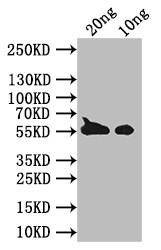
图: 1 / 1
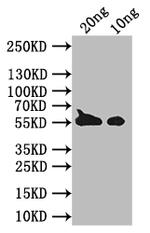
BZLF1 Antibody (PA5-144528) in WB
Western blot analysis of BZLF1 in recombinant protein All lanes: BZLF1 antibody at 1:1000 Secondary Goat polyclonal to rabbit IgG at 1:50,000 dilution Predicted band size: 46 kDa Observed band size: 50 kDa. using a dilution of 1:1,000. Samples were incubated with BZLF1 polyclonal antibody (Product # PA5-144528). Secondary: Goat polyclonal to rabbit IgG at 1:50,000 dilution Predicted band size: 46 kDa Observed band size: 50 kDa. Predicted band size: 46 kDa Observed band size: 50 kDa.
Please note: We are reviewing Western blot images included in the antibody testing data in our catalog, including those provided by third parties. Unless expressly labeled or annotated as “raw-unedited”, Western blot images included in the antibody testing data in our catalog may have been edited, optimized or otherwise adjusted for presentation.

产品信息
PA5-144528
产品规格
种属反应
Virus
宿主/亚型
Rabbit
/ IgG
分类
Polyclonal
类型
Antibody
抗原
Recombinant Epstein-Barr virus BZLF1 protein
偶联物
Unconjugated
Unconjugated
Unconjugated
形式
Liquid
浓度
1 mg/mL
规格
100 µg
纯化类型
Protein G
保存液
PBS, pH 7.4, with 50% glycerol
内含物
0.03% Proclin 300
保存条件
-20°C or -80°C if preferred
运输条件
Ambient (domestic); Wet ice (international)
RRID
靶标信息
Transcription factor that acts as a molecular switch to induce the transition from the latent to the lytic or productive phase of the virus cycle (PubMed:8404860) (Probable). Mediates the switch from the latent to the lytic cycle of infection in cells containing a highly methylated viral genome (PubMed:34893887, PubMed:15361873). Probably binds to silenced chromatin and recruits host chromatin-remodeling enzymes (PubMed:30926617). Regulates this switch by binding to 2 types of ZEBRA response elements (ZREs): the CpG-free AP-1 like elements (latency) and the methylated CpG-containing elements (lytic replication) (PubMed:34893887, PubMed:22022468) (Probable). Activates preferentially the methylated forms of the viral lytic R (BRLF1) and Na (BRRF1) gene promoters, the latters being the first genes activated during Z-mediated reactivation in latently infected cells (PubMed:19325883, PubMed:15361873). BZLF1 and BRLF1 act together to trigger lytic replication (PubMed:10856251, PubMed:15361873). Also binds the lytic origin of replication, oriLyt (PubMed:20808903). Induces G1 cell cycle arrest by stabilizing the host CCAAT/enhancer binding protein CEBPA (PubMed:15078966). This function is important because the lytic cycle preferentially takes place in host cells arrested in G1 (PubMed:15078966).
仅用于科研。不用于诊断过程。未经明确授权不得转售。
篇参考文献 (0)
您是否在文献中引用过该产品?请点击下方按钮邮件告知我们。
生物信息学
蛋白别名: Trans-activator protein BZLF1
Disclaimer

Clicking the images or links will redirect you to a website hosted by BenchSci that provides third-party scientific content. Neither the content nor the BenchSci technology and processes for selection have been evaluated by us; we are providing them as-is and without warranty of any kind, including for use or application of the Thermo Fisher Scientific products presented.

