Search
Disclaimer

Clicking the images or links will redirect you to a website hosted by BenchSci that provides third-party scientific content. Neither the content nor the BenchSci technology and processes for selection have been evaluated by us; we are providing them as-is and without warranty of any kind, including for use or application of the Thermo Fisher Scientific products presented.
Invitrogen
Basiliximab Chimeric Recombinant Rabbit Monoclonal Antibody (Basiliximab)
{{$productOrderCtrl.translations['antibody.pdp.commerceCard.promotion.promotions']}}
{{$productOrderCtrl.translations['antibody.pdp.commerceCard.promotion.viewpromo']}}
{{$productOrderCtrl.translations['antibody.pdp.commerceCard.promotion.promocode']}}: {{promo.promoCode}} {{promo.promoTitle}} {{promo.promoDescription}}. {{$productOrderCtrl.translations['antibody.pdp.commerceCard.promotion.learnmore']}}
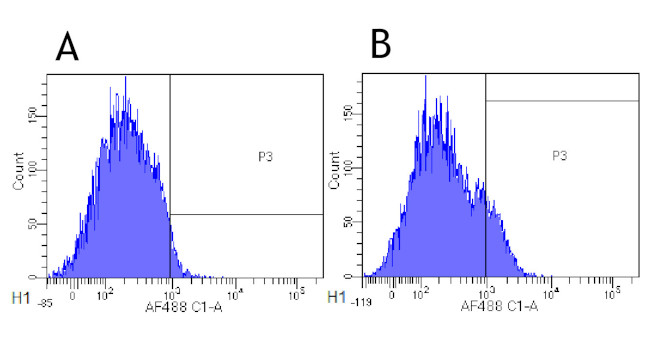
图: 1 / 3
Basiliximab Chimeric Antibody (MA5-47836) in Flow
Flow Cytometry analysis of Basiliximab in Cynomolgus monkey lymphocytes using Basiliximab Chimeric Monoclonal Antibody (Product # MA5-47836). Cells were stained with an isotype control, FITC Chimeric monoclonal antibody (Product # MA5-47752) (panel A), or Basiliximab Chimeric Monoclonal Antibody (panel B) at a concentration of 1 µg/mL for 30 mins at RT. After washing, bound antibody was detected using a AF4... View More


产品信息
MA5-47836
应用
建议稀释比
已发表文章
产品规格
种属反应
Cynomolgus monkey,
Human,
Rhesus monkey
宿主/亚型
Rabbit
/ IgG, kappa
Expression System
HEK293 cells
分类
Recombinant Monoclonal
类型
Antibody
克隆号
Basiliximab
抗原
Basiliximab was prepared by immunizing BALB/c mice with CTC 16 cells.
偶联物
形式
Liquid
浓度
1 mg/mL
纯化类型
Protein A
保存液
PBS
内含物
0.02% ProClin 300
保存条件
Store at 4°C short term. For long term storage, store at -20°C, avoiding freeze/thaw cycles.
运输条件
Ambient (domestic); Wet ice (international)
RRID
产品详细信息
Specificity: Basiliximab recognises the human IL-2R and binds to the epitope (116)ERIYHFV(122) within the extracellular domain of the CD25 subunit-binding is abolished when 2 or more residues within the epitope are mutated. This epitope overlaps with the interaction site of CD25 and IL-2. CD25 is found in the high-affinity IL-2R (alpha-Beta-gamma-c)-T cells only express CD25 upon activation. IL-2 binding to IL-2R on T cells modulates proliferation and differentiation.
靶标信息
A recombinant chimeric (murine/human) monoclonal antibody (IgG1k) that functions as an immunosuppressive agent, specifically binding to and blocking the interleukin-2 receptor a-chain (IL-2R alpha, also known as CD25 antigen) on the surface of activated T-lymphocytes. It is a 144 kDa glycoprotein obtained from fermentation of an established mouse myeloma cell line genetically engineered to express plasmids containing the human heavy and light chain constant region genes and mouse heavy and light chain variable region genes encoding the RFT5 antibody that binds selectively to the IL-2R alpha. Basiliximab binds with high-affinity to the alpha-subunit (CD25) of the high-affinity IL-2 receptor. This inhibits IL-2 binding, which inhibits T-cell activation and prevents the body from mounting an immune response against the foreign kidney.
仅用于科研。不用于诊断过程。未经明确授权不得转售。
篇参考文献 (0)
您是否在文献中引用过该产品?请点击下方按钮邮件告知我们。

