Search
GenScript
C-peptide Monoclonal Antibody (4C2F10)
{{$productOrderCtrl.translations['antibody.pdp.commerceCard.promotion.promotions']}}
{{$productOrderCtrl.translations['antibody.pdp.commerceCard.promotion.viewpromo']}}
{{$productOrderCtrl.translations['antibody.pdp.commerceCard.promotion.promocode']}}: {{promo.promoCode}} {{promo.promoTitle}} {{promo.promoDescription}}. {{$productOrderCtrl.translations['antibody.pdp.commerceCard.promotion.learnmore']}}
Additional Information:
{{banner.description}}
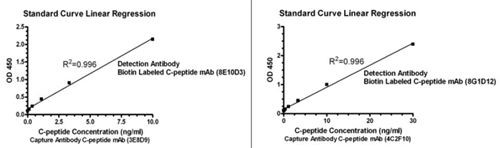
图: 1 / 1
C-peptide Antibody (A01784-1) in ELISA
Antibody pairs analysis of C-peptide monoclonal antibodies by Sandwich ELISA: General procedures: 1. Microplate was coated with a capture antibody against C-peptide, followed by 3 washing cycles. 2. Incubation with C-peptide followed by 3 washing cycles. 3. Incubation with Biotin conjugated detection antibody against C-peptide, followed by 3 washing cycles. 4. Incubation with Streptaidin-HRP, followed by 3 washing cycles. Colorimetric determination of bound peroxidase activity.

产品信息
A01784-1
产品规格
宿主/亚型
Mouse
/ IgG1, kappa
分类
Monoclonal
类型
Antibody
克隆号
4C2F10
抗原
human C-peptide conjugated to KLH.
偶联物
Unconjugated
Unconjugated
Unconjugated
形式
Liquid
浓度
0.5 mg/mL
规格
1 mg
保存条件
-20°C or -80°C if preferred
运输条件
Wet ice
产品详细信息
C-peptide serves as an important linker between A-chain and B-chain of insulin and facilitates the efficient assembly, folding, and processing of insulin in the endoplasmic reticulum. Equimolar amounts of C-peptide and insulin are stored in secretory granules of the pancreatic beta cells and both are eventually released to the portal circulation. The sole interest in C-peptide was as a marker of insulin secretion. Newly diagnosed diabetes patients often get their C-peptide levels measured as a means of distinguishing type 1 and type 2 diabetes. C-peptide is also used for determining the possibility of gastrinomas associated with Multiple Endocrine Neoplasm syndromes (MEN 1). GenScript Human C-Peptide Antibody, mAb, Mouse is produced from the hybridoma resulting from fusion of SP2/0-Ag14 myeloma and B-lymphocytes obtained from mouse immunized with human C-peptide conjugated to KLH.
靶标信息
After removal of the precursor signal peptide, proinsulin is post-translationally cleaved into three peptides: the B chain and A chain peptides, which are covalently linked via two disulfide bonds to form insulin, and C-peptide. Binding of insulin to the insulin receptor (INSR) stimulates glucose uptake. A multitude of mutant alleles with phenotypic effects have been identified.
仅用于科研。不用于诊断过程。未经明确授权不得转售。
篇参考文献 (0)
您是否在文献中引用过该产品?请点击下方按钮邮件告知我们。
Disclaimer

Clicking the images or links will redirect you to a website hosted by BenchSci that provides third-party scientific content. Neither the content nor the BenchSci technology and processes for selection have been evaluated by us; we are providing them as-is and without warranty of any kind, including for use or application of the Thermo Fisher Scientific products presented.

