Search
Abnova
C1QTNF3 Polyclonal Antibody, MaxPab™
{{$productOrderCtrl.translations['antibody.pdp.commerceCard.promotion.promotions']}}
{{$productOrderCtrl.translations['antibody.pdp.commerceCard.promotion.promocode']}}: {{promo.promoCode}} {{promo.promoTitle}} {{promo.promoDescription}}. {{$productOrderCtrl.translations['antibody.pdp.commerceCard.promotion.learnmore']}}
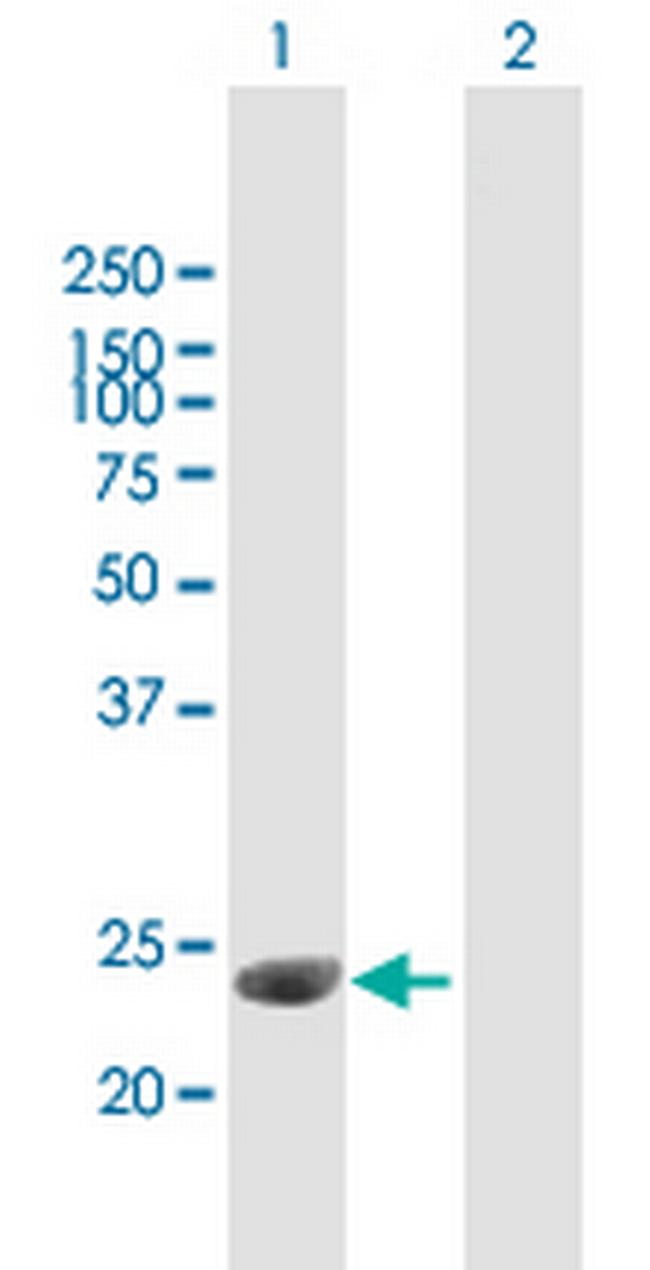
Please note: We are reviewing Western blot images included in the antibody testing data in our catalog, including those provided by third parties. Unless expressly labeled or annotated as “raw-unedited”, Western blot images included in the antibody testing data in our catalog may have been edited, optimized or otherwise adjusted for presentation.

产品信息
H00114899-B01P
产品规格
种属反应
Human
宿主/亚型
Mouse
/ IgG
分类
Polyclonal
类型
Antibody
抗原
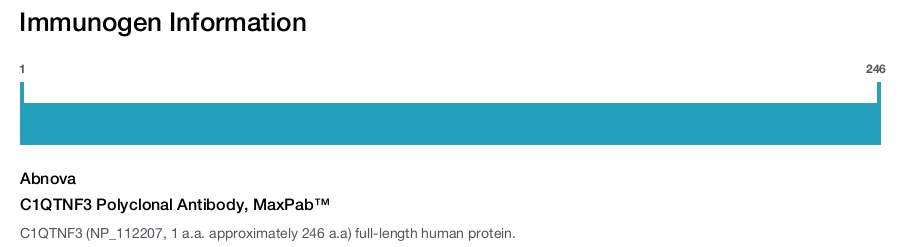
C1QTNF3 (NP_112207, 1 a.a. approximately 246 a.a) full-length human protein.
偶联物
Unconjugated
Unconjugated
Unconjugated
形式
Liquid
浓度
0.35 mg/mL
规格
50 µg
纯化类型
Protein A
保存液
PBS, pH 7.4
内含物
no preservative
保存条件
-20°C, Avoid Freeze/Thaw Cycles
运输条件
Ambient (domestic); Wet ice (international)
产品详细信息
Product may be used with Western Blot (Transfected lysate).
The Isotype of this product is composed of an IgG Mixture.
Immunogen sequence: MLWRQLIYWQ LLALFFLPFC LCQDEYMESP QTGGLPPDCS KCCHGDYSFR GYQGPPGPPG PPGIPGNHGN NGNNGATGHE GAKGEKGDKG DLGPRGERGQ HGPKGEKGYP GIPPELQIAF MASLATHFSN QNSGIIFSSV ETNIGNFFDV MTGRFGAPVS GVYFFTFSMM KHEDVEEVYV YLMHNGNTVF SMYSYEMKGK SDTSSNHAVL KLAKGDEVWL RMGNGALHGD HQRFSTFAGF LLFETK
靶标信息
Adipose tissue of an organism plays a major role in regulating physiologic and pathologic processes such as metabolism and immunity by producing and secreting a variety of bioactive molecules termed adipokines. One highly conserved family of adipokines is adiponectin/ACRP30 and its structural and functional paralogs, the C1q/tumor necrosis factor-alpha-related proteins (CTRPs) 1-7. Unlike adiponectin, which is expressed exclusively by differentiated adipocytes, the CTRPs are expressed in a wide variety of tissues. An analysis of the crystal structure of adiponectin revealed a structural and evolutionary link between TNF and C1q-containing proteins, suggesting that these proteins arose from a common ancestral innate immunity gene. Multiple isoforms of human CTRP3 have been reported. It has been suggested that CTRP3 may play a role in skeletal development.
仅用于科研。不用于诊断过程。未经明确授权不得转售。
篇参考文献 (0)
您是否在文献中引用过该产品?请点击下方按钮邮件告知我们。
生物信息学
蛋白别名: C1q and tumor necrosis factor related protein 3; cartonectin; collagenous repeat-containing sequence 26 kDa protein; collagenous repeat-containing sequence of 26-kDa; secretory protein CORS26; unnamed protein product
基因别名: C1ATNF3; CORCS; CORS; CORS-26; CORS26; CTRP3
UniProt ID: (Human) Q9BXJ4
Entrez Gene ID: (Human) 114899
positive regulation of cytokine production
negative regulation of gene expression
negative regulation of interleukin-6 production
cellular triglyceride homeostasis
fat cell differentiation
negative regulation of gluconeogenesis
chemical homeostasis
negative regulation of inflammatory response
positive regulation of adiponectin secretion
negative regulation of monocyte chemotactic protein-1 production
trans-synaptic signaling, modulating synaptic transmission
maintenance of synapse structure
negative regulation of NIK/NF-kappaB signaling
regulation of intracellular signal transduction
Disclaimer

Clicking the images or links will redirect you to a website hosted by BenchSci that provides third-party scientific content. Neither the content nor the BenchSci technology and processes for selection have been evaluated by us; we are providing them as-is and without warranty of any kind, including for use or application of the Thermo Fisher Scientific products presented.

