Search
Disclaimer

Clicking the images or links will redirect you to a website hosted by BenchSci that provides third-party scientific content. Neither the content nor the BenchSci technology and processes for selection have been evaluated by us; we are providing them as-is and without warranty of any kind, including for use or application of the Thermo Fisher Scientific products presented.
Leinco Technologies
CD183 Monoclonal Antibody (CXCR3-173), Functional Grade, In Vivo GOLD™
{{$productOrderCtrl.translations['antibody.pdp.commerceCard.promotion.promotions']}}
{{$productOrderCtrl.translations['antibody.pdp.commerceCard.promotion.viewpromo']}}
{{$productOrderCtrl.translations['antibody.pdp.commerceCard.promotion.promocode']}}: {{promo.promoCode}} {{promo.promoTitle}} {{promo.promoDescription}}. {{$productOrderCtrl.translations['antibody.pdp.commerceCard.promotion.learnmore']}}
产品信息
C795-100MG
应用
建议稀释比
已发表文章
产品规格
种属反应
Mouse
宿主/亚型
Armenian hamster
/ IgG
分类
Monoclonal
类型
Antibody
克隆号
CXCR3-173
抗原
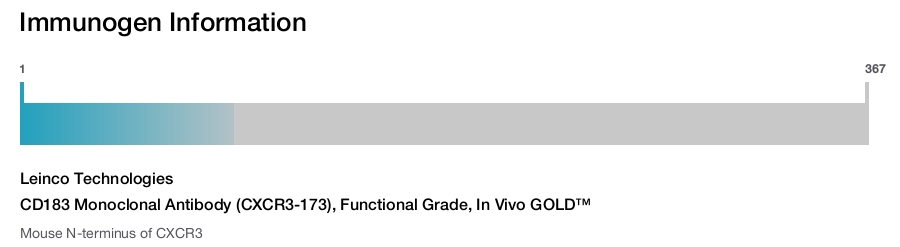
Mouse N-terminus of CXCR3
偶联物
形式
Liquid
浓度
≥5.0 mg/mL
纯化类型
Protein A/G
保存液
PBS, pH 7.2-7.4
内含物
no preservative
保存条件
4°C short term, -80°C long term
运输条件
Ambient (domestic); Wet ice (international)
产品详细信息
Specificity: CXCR3-173 activity is directed against murine CD183 (CXCR3).
Endotoxin Level: <1.0 EU/mg as determined by the LAL method.
Purity: ≥95% monomer by analytical SEC and >95% by SDS Page.
Preparation: Functional grade preclinical antibodies are manufactured in an animal free facility using in vitro cell culture techniques and are purified by a multi-step process including the use of protein A or G to assure extremely low levels of endotoxins, leachable protein A or aggregates.
Storage: Functional grade preclinical antibodies may be stored sterile as received at 2-8C for up to one month. For longer term storage, aseptically aliquot in working volumes without diluting and store at -70C. Avoid Repeated Freeze Thaw Cycles.
靶标信息
CD183, also known as CXCR3, is a seven-transmembrane G protein-coupled chemokine receptor that binds CXCL9 (Mig), CXCL10 (IP-10), and CXCL11 (I-TAC), which are part of the CXC chemokine subfamily. CD183 plays a crucial role in leukocyte traffic, influencing integrin activation, cytoskeletal changes, and chemotactic migration. It is expressed on NK cells, subsets of T lymphocytes, regulatory T cells (Tregs), and is preferentially found on Th1-polarized cells. CD183 is prominently expressed in effector/memory T cells and T cells in inflamed tissues, contributing to CD4 T cell responses to grafts, as evidenced by compromised allograft rejection in CXCR3 knockout mice. Chemokine binding induces rapid, short-lived cellular responses due to receptor internalization, with responsiveness restored after receptor recycling. Inhibition by Bordetella pertussis toxin suggests coupling with Gi subclass G proteins. The production of IP-10, Mig, and I-TAC in inflammatory lesions indicates CD183 role in recruiting inflammatory cells, making it a target for developing antagonists to treat inflammatory diseases. Multiple transcript variants encoding different isoforms of CD183 have been identified.
仅用于科研。不用于诊断过程。未经明确授权不得转售。
篇参考文献 (0)
您是否在文献中引用过该产品?请点击下方按钮邮件告知我们。
生物信息学
蛋白别名: an; C Cmotif chemokine; C X C motif chemokine; C-X-C chemokine receptor type 3; CC motif chemokine; CCmotif chemokine; CD183; CXC; CXC motif chemokine; CXC-R3; Interferon-inducible protein 10 receptor; IP-10 receptor; IP10; IP10 receptor
基因别名: Cd183; Cmkar3; Cxcr3
UniProt ID: (Mouse) O88410
Entrez Gene ID: (Mouse) 12766

