Search
Invitrogen
CD22 (soluble) Polyclonal Antibody, PeproTech®
{{$productOrderCtrl.translations['antibody.pdp.commerceCard.promotion.promotions']}}
{{$productOrderCtrl.translations['antibody.pdp.commerceCard.promotion.promocode']}}: {{promo.promoCode}} {{promo.promoTitle}} {{promo.promoDescription}}. {{$productOrderCtrl.translations['antibody.pdp.commerceCard.promotion.learnmore']}}
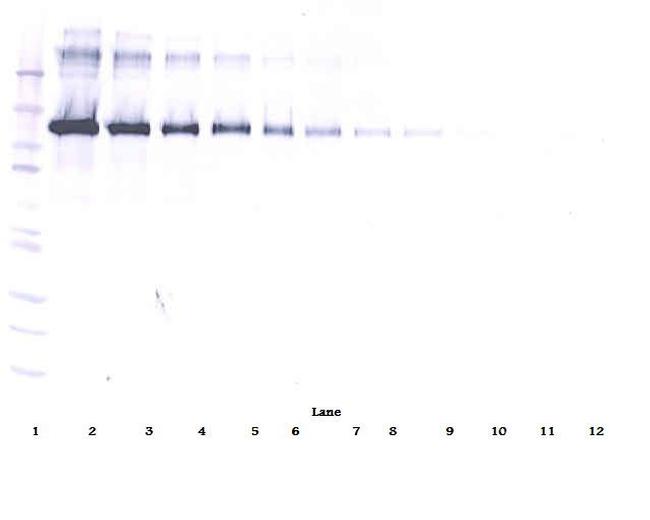
图: 1 / 3
CD22 (soluble) Antibody (500-P227-1MG) in WB
Western Blot: To detect Human sCD22 by Western Blot analysis CD22 (soluble) Polyclonal Antibody (Product # 500-P227-1MG) can be used at a concentration of 0.1-0.2 µg/mL. Used in conjunction with compatible secondary reagents the detection limit for Recombinant Human sCD22 is 1.5-3.0 ng/lane, under either reducing or non-reducing conditions.
Please note: We are reviewing Western blot images included in the antibody testing data in our catalog, including those provided by third parties. Unless expressly labeled or annotated as “raw-unedited”, Western blot images included in the antibody testing data in our catalog may have been edited, optimized or otherwise adjusted for presentation.


产品信息
500-P227-1MG
产品规格
种属反应
Human
宿主/亚型
Rabbit
分类
Polyclonal
类型
Antibody
抗原
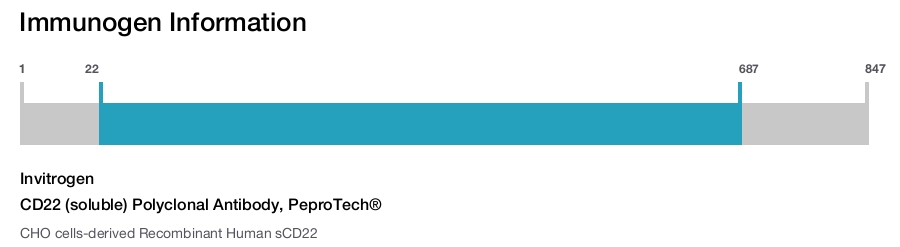
CHO cells-derived Recombinant Human sCD22
偶联物
Unconjugated
Unconjugated
Unconjugated
形式
Lyophilized
浓度
0.1-1.0 mg/mL
规格
1 mg
纯化类型
Antigen affinity chromatography
保存液
PBS
内含物
no preservative
保存条件
-20°C
运输条件
Ambient
RRID
产品详细信息
AA Sequence of recombinant protein: SKWVFEHPET LYAWEGACVW IPCTYRALDG DLESFILFHN PEYNKNTSKF DGTRLYESTK DGKVPSEQKR VQFLGDKNKN CTLSIHPVHL NDSGQLGLRM ESKTEKWMER IHLNVSERPF PPHIQLPPEI QESQEVTLTC LLNFSCYGYP IQLQWLLEGV PMRQAAVTST SLTIKSVFTR SELKFSPQWS HHGKIVTCQL QDADGKFLSN DTVQLNVKHT PKLEIKVTPS DAIVREGDSV TMTCEVSSSN PEYTTVSWLK DGTSLKKQNT FTLNLREVTK DQSGKYCCQV SNDVGPGRSE EVFLQVQYAP EPSTVQILHS PAVEGSQVEF LCMSLANPLP TNYTWYHNGK EMQGRTEEKV HIPKILPWHA GTYSCVAENI LGTGQRGPGA ELDVQYPPKK VTTVIQNPMP IREGDTVTLS CNYNSSNPSV TRYEWKPHGA WEEPSLGVLK IQNVGWDNTT IACARCNSWC SWASPVALNV QYAPRDVRVR KIKPLSEIHS GNSVSLQCDF SSSHPKEVQF FWEKNGRLLG KESQLNFDSI SPEDAGSYSC WVNNSIGQTA SKAWTLEVLY APRRLRVSMS PGDQVMEGKS ATLTCESDAN PPVSHYTWFD WNNQSLPHHS QKLRLEPVKV QHSGAYWCQG TNSVGKGRSP LSTLTVYYSP ETIGRR.
Preparation: Produced from sera of rabbits immunized with highly pure Recombinant Human sCD22. Anti-Human sCD22-specific antibody was purified by affinity chromatography employing an immobilized hHuman sCD22 matrix.
Sandwich ELISA: To detect Human sCD22 by sandwich ELISA (using 100 µL/well antibody solution) a concentration of 0.5-2.0 µg/mL of this antibody is required. This antigen affinity purified antibody, in conjunction with PeproTech Biotinylated Anti-Human sCD22 (500-P227Bt) as a detection antibody, allows the detection of at least 0.2-0.4 ng/well of Recombinant Human sCD22.
Western Blot: To detect Human sCD22 by Western Blot analysis this antibody can be used at a concentration of 0.1-0.2 µg/mL. Used in conjunction with compatible secondary reagents the detection limit for Recombinant Human sCD22 is 1.5-3.0 ng/lane, under either reducing or non-reducing conditions.
靶标信息
CD22, also known as BL-CAM, is a type I transmembrane glycoprotein composed of two polypeptide chains, CD22alpha and CD22beta, with molecular weights of 130 and 140 kDa, respectively. These chains are produced by alternative splicing of the CD22 gene. CD22 is prominently expressed on mature B cells and B cell lymphomas, including hairy cell leukemia, diffuse large B-cell lymphoma, and nodular lymphocyte predominance Hodgkin's lymphoma, but is negative in classical Hodgkin's lymphoma. The extracellular portion of CD22 contains seven Ig-like domains that preferentially bind alpha2,6-linked sialic acid moieties found on epithelial, endothelial, B, and T cells. This binding can be masked by cis interactions with sialic acids on the same cell surface. CD22 expression is limited to late stages of B-cell differentiation, making it useful for phenotyping mature leukemias. Intracellularly, CD22 features six tyrosine residues within immunotyrosine-based inhibitory motifs (ITIM) and activation-like motifs. These residues are phosphorylated upon B-cell receptor engagement, allowing CD22 to regulate B-cell receptor signaling. CD22 participates in positive regulation through interactions with Src family tyrosine kinases and acts as an inhibitory receptor by recruiting cytoplasmic phosphatases via SH2 domains, which block signal transduction through dephosphorylation of signaling molecules. CD22's role in both positive and negative regulation of B-cell signaling, along with its specific expression pattern, makes it a valuable marker for antibody customers interested in B-cell-related research and diagnostics.
仅用于科研。不用于诊断过程。未经明确授权不得转售。
篇参考文献 (0)
您是否在文献中引用过该产品?请点击下方按钮邮件告知我们。
生物信息学
蛋白别名: B-lymphocyte cell adhesion molecule; B-lymphocyte cell adhesion molecule (BL-CAM); BL-CAM; CD22 antigen; FLJ22814; Lectin 2; Leu-14; MGC130020; sialic acid-binding Ig-like lectin 2; Sialic acid-binding Ig-like lectin 2 (Siglec-2); T-cell surface antigen Leu-14; unnamed protein product
基因别名: SIGLEC-2; SIGLEC2
UniProt ID: (Human) P20273
Entrez Gene ID: (Human) 933
negative regulation of immunoglobulin production
negative regulation of immune system process
cell adhesion
negative regulation of signal transduction
regulation of endocytosis
regulation of B cell proliferation
B cell activation
regulation of immune response
negative regulation of calcium-mediated signaling
negative regulation of B cell receptor signaling pathway
Disclaimer

Clicking the images or links will redirect you to a website hosted by BenchSci that provides third-party scientific content. Neither the content nor the BenchSci technology and processes for selection have been evaluated by us; we are providing them as-is and without warranty of any kind, including for use or application of the Thermo Fisher Scientific products presented.

