Search
Proteintech
CD229/SLAMF3 Polyclonal Antibody
{{$productOrderCtrl.translations['antibody.pdp.commerceCard.promotion.promotions']}}
{{$productOrderCtrl.translations['antibody.pdp.commerceCard.promotion.promocode']}}: {{promo.promoCode}} {{promo.promoTitle}} {{promo.promoDescription}}. {{$productOrderCtrl.translations['antibody.pdp.commerceCard.promotion.learnmore']}}
{{$ctrl.translations['antibody.pdp.skuNotes.additionalInformation']}}:
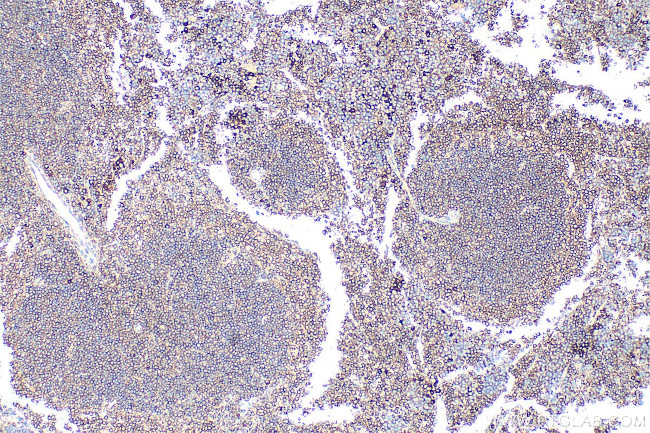
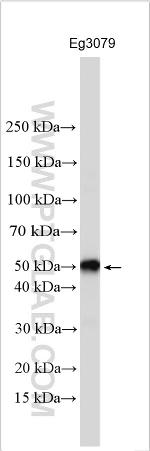
Please note: We are reviewing Western blot images included in the antibody testing data in our catalog, including those provided by third parties. Unless expressly labeled or annotated as “raw-unedited”, Western blot images included in the antibody testing data in our catalog may have been edited, optimized or otherwise adjusted for presentation.


产品信息
32666-1-AP
应用
建议稀释比
已发表文章
产品规格
种属反应
Mouse
宿主/亚型
Rabbit
/ IgG
分类
Polyclonal
类型
Antibody
抗原
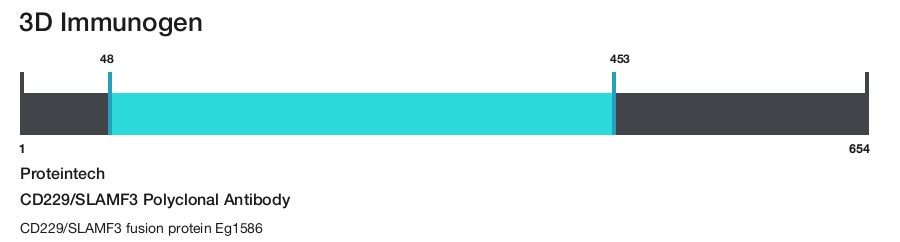
CD229/SLAMF3 fusion protein Eg1586
偶联物
Unconjugated
Unconjugated
Unconjugated
形式
Liquid
浓度
350 µg/mL
规格
52.5 µg
纯化类型
Affinity chromatography
保存液
PBS, pH 7.3, with 50% glycerol
内含物
0.02% sodium azide
保存条件
-20°C
运输条件
Wet ice
产品详细信息
Sequence of this protein is as follows: KETPPTVISG MLGGSVTFSL NISKDAEIEH IIWNCPPKAL ALVFYKKDIT ILDKGYNGRL KVSEDGYSLY MSNLTKSDSG SYHAQINQKN VILTTNKEFT LHIYEKLQKP QIIVESVTPS DTDSCTFTLI CTVKGTKDSV QYSWTREDTH LNTYDGSHTL RVSQSVCDPD LPYTCKAWNP VSQNSSQPVR IWQFCTGASR RKTAAGKTVV GILGEPVTLP LEFRATRATK NVVWVFNTSV ISQERRGAAT ADSRRKPKGS EERRVRTSDQ DQSLKISQLK MEDAGPYHAY VCSEASRDPS VRHFTLLVYK RLEKPSVTKS PVHMMNGICE VVLTCSVDGG GNNVTYTWMP LQNKAVMSQG KSHLNVSWES GEHLPNFTCT AHNPVSNSSS QFSSGTICSG PERNKR
靶标信息
CD229 (Ly9) is a cell surface receptor of the CD150 family, which includes also e.g. CD48 and CD224. Receptors of this family regulate cytokine production and cytotoxicity of lymphocytes and NK cells. High levels of CD229 are found on T and B cells, where its expression increases during their maturation. It is absent on granulocytes, bone marrow-derived dendritic cells, platelets and erythrocytes. CD229 has been also reported on mouse monocytes and NK cells. CD229 interacts homophilically through its N-terminal domain and localizes to the contact site between T cells and antigen presenting B cells during antigen-dependent immune synapse formation.
仅用于科研。不用于诊断过程。未经明确授权不得转售。
篇参考文献 (0)
您是否在文献中引用过该产品?请点击下方按钮邮件告知我们。
生物信息学
蛋白别名: cell surface molecule Ly-9; Ly-9; RP11-312J18.1; signaling lymphocytic activation molecule 3; SLAM family member 3; unnamed protein product
基因别名: CD229; Lgp100; Ly-9; SLAMF3; T100
UniProt ID: (Mouse) Q01965
Entrez Gene ID: (Mouse) 17085
Disclaimer

Clicking the images or links will redirect you to a website hosted by BenchSci that provides third-party scientific content. Neither the content nor the BenchSci technology and processes for selection have been evaluated by us; we are providing them as-is and without warranty of any kind, including for use or application of the Thermo Fisher Scientific products presented.

