Search
Leinco Technologies
CD307e (FcRL5) Monoclonal Antibody (509F6), Functional Grade, In Vivo GOLD™
{{$productOrderCtrl.translations['antibody.pdp.commerceCard.promotion.promotions']}}
{{$productOrderCtrl.translations['antibody.pdp.commerceCard.promotion.promocode']}}: {{promo.promoCode}} {{promo.promoTitle}} {{promo.promoDescription}}. {{$productOrderCtrl.translations['antibody.pdp.commerceCard.promotion.learnmore']}}
{{$ctrl.translations['antibody.pdp.skuNotes.additionalInformation']}}:
产品信息
I-1220-100MG
应用
建议稀释比
已发表文章
产品规格
种属反应
Human
宿主/亚型
Mouse
/ IgG2a, kappa
分类
Monoclonal
类型
Antibody
克隆号
509F6
抗原
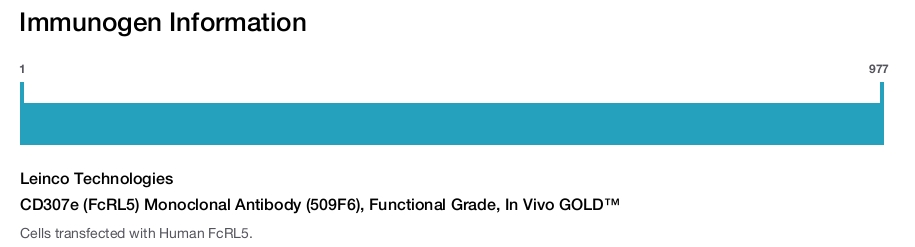
Cells transfected with Human FcRL5.
偶联物
Functional Grade
Functional Grade
Functional Grade
形式
Liquid
浓度
≥5.0 mg/mL
规格
100 mg
纯化类型
Protein A/G
保存液
PBS, pH 7.2-7.4
内含物
no preservative
保存条件
4°C short term, -80°C long term
运输条件
Ambient (domestic); Wet ice (international)
产品详细信息
Specificity: Clone 50946 recognizes human FcRL5 within the first 3 Ig domains. Clone 50946 does not cross-react with FcRL4.
Endotoxin Level: <1.0 EU/mg as determined by the LAL method.
Purity: ≥95% monomer by analytical SEC and >95% by SDS Page.
Preparation: Functional grade preclinical antibodies are manufactured in an animal free facility using in vitro cell culture techniques and are purified by a multi-step process including the use of protein A or G to assure extremely low levels of endotoxins, leachable protein A or aggregates.
Storage: Functional grade preclinical antibodies may be stored sterile as received at 2-8C for up to one month. For longer term storage, aseptically aliquot in working volumes without diluting and store at -80C. Avoid Repeated Freeze Thaw Cycles.
靶标信息
Fc receptor homologs (FcRH5), also known as IRTA2 proteins, are transmembrane proteins with sequence homology to classical Fc receptor families. FcRH5 function as activating or inhibitory receptors on discrete B cell populations and are involved in B-cell development and differentiation in peripheral lymphoid organs. FcRH5 expression is deregulated in multiple myeloma and Burkitt lymphoma cell lines with 1q21 abnormalities. FcRH5 may play a critical role for the pathogenesis of B-cell lymphoma.
仅用于科研。不用于诊断过程。未经明确授权不得转售。
篇参考文献 (0)
您是否在文献中引用过该产品?请点击下方按钮邮件告知我们。
生物信息学
蛋白别名: fc receptor homolog 5; fcR-like protein 5; Ig-like superfamily receptor; immune receptor translocation-associated protein 2; immunoglobulin superfamily receptor translocation associated 2 (IRTA2); immunoglobulin-like domain and ITIM motif-containing receptor; IRTA2a; IRTA2b; IRTA2c; IRTA2d; unnamed protein product
基因别名: BXMAS1; CD307; CD307e; FCRH5; IRTA2; PRO820
UniProt ID: (Human) Q96RD9
Entrez Gene ID: (Human) 83416
Disclaimer

Clicking the images or links will redirect you to a website hosted by BenchSci that provides third-party scientific content. Neither the content nor the BenchSci technology and processes for selection have been evaluated by us; we are providing them as-is and without warranty of any kind, including for use or application of the Thermo Fisher Scientific products presented.

