Search
Disclaimer

Clicking the images or links will redirect you to a website hosted by BenchSci that provides third-party scientific content. Neither the content nor the BenchSci technology and processes for selection have been evaluated by us; we are providing them as-is and without warranty of any kind, including for use or application of the Thermo Fisher Scientific products presented.
Leinco Technologies
CD86 Monoclonal Antibody (GL1), Functional Grade, In Vivo PLATINUM™
{{$productOrderCtrl.translations['antibody.pdp.commerceCard.promotion.promotions']}}
{{$productOrderCtrl.translations['antibody.pdp.commerceCard.promotion.viewpromo']}}
{{$productOrderCtrl.translations['antibody.pdp.commerceCard.promotion.promocode']}}: {{promo.promoCode}} {{promo.promoTitle}} {{promo.promoDescription}}. {{$productOrderCtrl.translations['antibody.pdp.commerceCard.promotion.learnmore']}}

产品信息
C6158-1MG
应用
建议稀释比
已发表文章
产品规格
种属反应
Mouse
宿主/亚型
Rat
/ IgG2a, kappa
分类
Monoclonal
类型
Antibody
克隆号
GL1
抗原
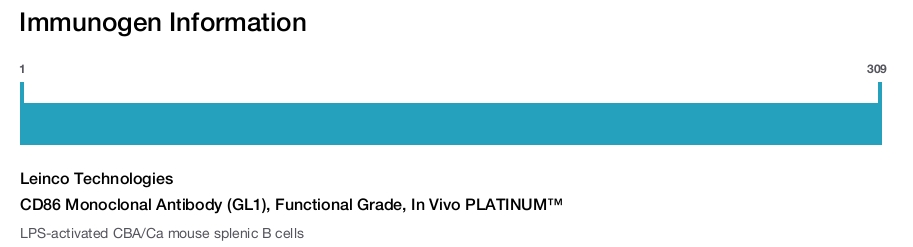
LPS-activated CBA/Ca mouse splenic B cells
偶联物
形式
Liquid
浓度
≥5.0 mg/mL
纯化类型
Protein A/G
保存液
PBS, pH 7.2-7.4
内含物
no preservative
保存条件
4°C short term, -80°C long term
运输条件
Ambient (domestic); Wet ice (international)
产品详细信息
Specificity: Clone GL-1 recognizes an epitope on mouse CD86.
Endotoxin Level: <0.5 EU/mg as determined by the LAL method. Purity: >95% by SDS Page; ≥98% monomer by analytical SEC.
Product Preparation: Functional grade preclinical antibodies are manufactured in an animal free facility using only In vitro protein free cell culture techniques and are purified by a multi-step process including the use of protein A or G to assure extremely low levels of endotoxins, leachable protein A or aggregates. Pathogen Testing: To protect mouse colonies from infection by pathogens and to assure that experimental preclinical data is not affected by such pathogens, all of Leinco Purified Functional PLATINUM™ antibodies are tested and guaranteed to be negative for all pathogens in the IDEXX IMPACT I Mouse Profile.
Storage and Handling: Functional grade preclinical antibodies may be stored sterile as received at 2-8 C for up to one month. For longer term storage, aseptically aliquot in working volumes without diluting and store at -80 C. Avoid Repeated Freeze Thaw Cycles.
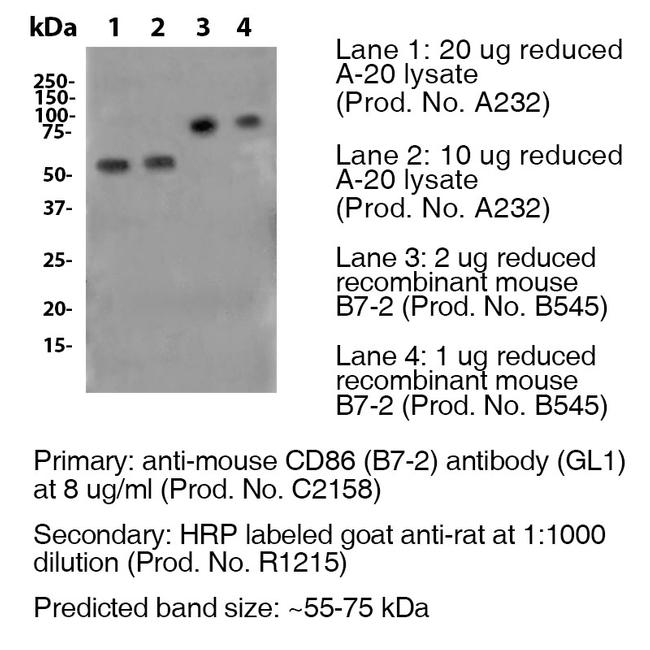
This antibody has been tested in the following applications: Western Blotting, ELISA, Blocking.
靶标信息
CD86, along with CD80, is a member of the B7 family of costimulatory molecules and plays a crucial role in T cell activation and immune response regulation. CD86 is expressed at low levels on B cells, macrophages, and dendritic cells, and its expression is upregulated on B cells through various stimuli, including the BCR complex, CD40, and certain cytokine receptors. As a type I membrane protein and member of the immunoglobulin superfamily, CD86 serves as a ligand for the T cell surface proteins CD28 and CTLA-4 (CD152). The interaction between CD86 and CD28 provides a costimulatory signal essential for T cell activation during antigen presentation, while binding with CTLA-4 negatively regulates T cell activation, diminishing the immune response. This interaction is critical for T-B cell crosstalk, T cell costimulation, autoantibody production, and Th2-mediated Ig production. The kinetics of CD86 upregulation upon stimulation suggest its significant contribution during the primary phase of an immune response. CD86 and CD80 have distinct roles in T helper cell differentiation, and insufficient co-stimulation involving these molecules can induce tolerance. Alternative splicing of CD86 results in two transcript variants encoding different isoforms, with additional variants described but not fully sequenced. Dysfunction in CD86 is associated with diseases such as gallbladder squamous cell carcinoma and myocarditis.
仅用于科研。不用于诊断过程。未经明确授权不得转售。
篇参考文献 (0)
您是否在文献中引用过该产品?请点击下方按钮邮件告知我们。
生物信息学
蛋白别名: Activation B7-2 antigen; B lymphocyte activation antigen B72; CD28 antigen ligand 2; CD86; early T cell costimulatory molecule-1; Early T-cell co-stimulatory molecule 1; Early T-cell costimulatory molecule 1; ETC-1; MGC34413; T-lymphocyte activation antigen CD86
基因别名: B7; B7-2; B7.2; B70; Cd28l2; Cd86; CLS1; ETC-1; Ly-58; Ly58; MB7; MB7-2; TS/A-2
UniProt ID: (Mouse) P42082
Entrez Gene ID: (Mouse) 12524

