Search
Abnova
CDH1/CDH2/CDH3 Recombinant Rabbit Monoclonal Antibody
{{$productOrderCtrl.translations['antibody.pdp.commerceCard.promotion.promotions']}}
{{$productOrderCtrl.translations['antibody.pdp.commerceCard.promotion.viewpromo']}}
{{$productOrderCtrl.translations['antibody.pdp.commerceCard.promotion.promocode']}}: {{promo.promoCode}} {{promo.promoTitle}} {{promo.promoDescription}}. {{$productOrderCtrl.translations['antibody.pdp.commerceCard.promotion.learnmore']}}
Additional Information:
{{banner.description}}
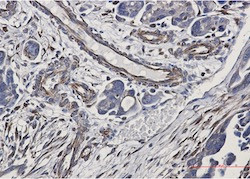
图: 1 / 2
CDH1/CDH2/CDH3 Antibody (RAB02023) in IHC (P)
Immunohistochemical staining (Formalin/PFA-fixed paraffin-embedded sections) of human cholangiocarcinoma with CDH1/CDH2/CDH3 recombinant monoclonal antibody, clone R04-5A8 (Product # RAB02023). High-pressure and temperature Sodium Citrate pH 6.0 was used for antigen retrieval.


产品信息
RAB02023
应用
建议稀释比
已发表文章
产品规格
种属反应
Hamster,
Human,
Mouse,
Rat
宿主/亚型
Rabbit
/ IgG
Expression System
CHO cells
分类
Recombinant Monoclonal
类型
Antibody
抗原
Synthetic peptide corresponding to human CDH1/CDH2/CDH3.
偶联物
Unconjugated
Unconjugated
Unconjugated
形式
Liquid
纯化类型
Affinity chromatography
保存液
50mM tris glycine, pH 7.4, with 0.05% BSA, 150mM NaCl, 40% glycerol
内含物
0.01% sodium azide
保存条件
-20°C, Avoid Freeze/Thaw Cycles
运输条件
Ambient (domestic); Wet ice (international)
靶标信息
E-cadherin, encoded by the CDH1 gene located at chromosome 16q22.1, is a calcium-dependent cell-cell adhesion molecule involved in maintaining cellular adhesion and polarity. It acts as a tumor suppressor by preventing metastasis in carcinogenesis, as its loss or dysfunction is associated with cancer progression. N-cadherin, encoded by the CDH2 gene and known for its role in cardiac regeneration, operates by stabilizing B-catenin and promoting cellular proliferation. It is expressed in diverse tissues, mediating strong adhesion in cardiac tissues and playing roles in neural development. Furthermore, N-cadherin aids in epithelial-mesenchymal transition, contributing to cancer cell migration. P-cadherin, encoded by the CDH3 gene, is primarily expressed in myoepithelial cells and is implicated in cancer through deregulation. It is known for its roles in cellular adhesion, particularly in neural circuit formation, and may serve as a biomarker for certain cancers due to its altered expression profiles in tumors. These three cadherins are calcium-dependent cell adhesion molecules that interact with catenins, forming complexes that help regulate cell signaling and adhesion in various biological contexts.
仅用于科研。不用于诊断过程。未经明确授权不得转售。
篇参考文献 (0)
您是否在文献中引用过该产品?请点击下方按钮邮件告知我们。
Disclaimer

Clicking the images or links will redirect you to a website hosted by BenchSci that provides third-party scientific content. Neither the content nor the BenchSci technology and processes for selection have been evaluated by us; we are providing them as-is and without warranty of any kind, including for use or application of the Thermo Fisher Scientific products presented.

