Search
Rockland
CDK5 Polyclonal Antibody
{{$productOrderCtrl.translations['antibody.pdp.commerceCard.promotion.promotions']}}
{{$productOrderCtrl.translations['antibody.pdp.commerceCard.promotion.viewpromo']}}
{{$productOrderCtrl.translations['antibody.pdp.commerceCard.promotion.promocode']}}: {{promo.promoCode}} {{promo.promoTitle}} {{promo.promoDescription}}. {{$productOrderCtrl.translations['antibody.pdp.commerceCard.promotion.learnmore']}}
Additional Information:
{{banner.description}}
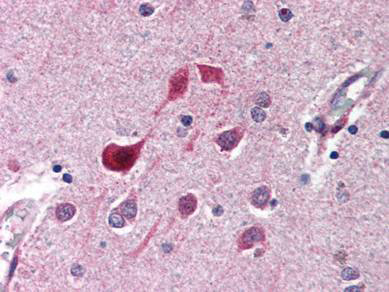
图: 1 / 1
CDK5 Antibody (100-401-163) in IHC (P)
Rocklands anti-CDK5 antibody was diluted 1:500 to detect CDK5 in human brain cortex tissue. Tissue was formalin fixed and paraffin embedded. No pre-treatment of sample was required. The image shows the localization of antibody as the precipitated red signal, with a hematoxylin purple nuclear counter stain.

产品信息
100-401-163
应用
建议稀释比
已发表文章
产品规格
种属反应
Human,
Mouse,
Rat
宿主/亚型
Rabbit
/ IgG
分类
Polyclonal
类型
Antibody
抗原
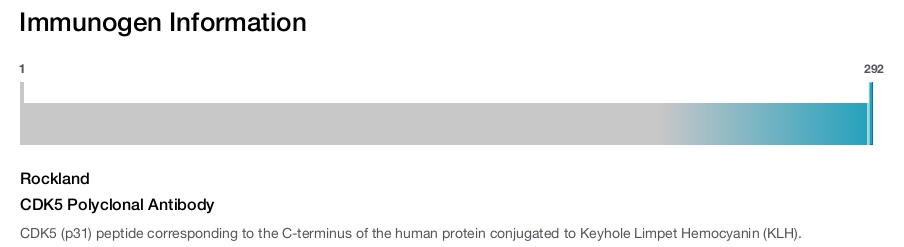
CDK5 (p31) peptide corresponding to the C-terminus of the human protein conjugated to Keyhole Limpet Hemocyanin (KLH).
偶联物
形式
Liquid
浓度
85 mg/mL
规格
8.5 mg
保存液
whole serum
内含物
0.01% sodium azide
保存条件
-20°C, Avoid Freeze/Thaw Cycles
运输条件
Ambient (domestic); Wet ice (international)
产品详细信息
Store vial at -20° C prior to opening. Aliquot contents and freeze at -20° C or below for extended storage. Avoid cycles of freezing and thawing. Centrifuge product if not completely clear after standing at room temperature. This product is stable for several weeks at 4° C as an undiluted liquid. Dilute only prior to immediate use.
Antiserum will specifically react with a 35 kDa cdk5 (p31) protein from human, rat and mouse tissue. No reaction was observed against other related cyclin dependent kinases. Cross reactivity with cdk5 (p31) from other species may also occur.
靶标信息
CDK5 is a member of the Cyclin-Dependent Kinase family that is most abundant in the mammalian brain. Active form of CDK5, which has also been called neuronal cdc2-like kinase, is a heterodimer of CDK5 and a 25 kDa protein which is derived proteolytically from a 35 kDa brain and neuron-specific protein and is essential for the kinase activity of CDK5. CDK5 has emerged as a crucial regulator of neuronal migration in the developing central nervous system. CDK5 phosphorylates a diverse list of substrates, implicating it in the regulation of a range of cellular processes - from adhesion and motility, to synaptic plasticity and drug addiction.
仅用于科研。不用于诊断过程。未经明确授权不得转售。
篇参考文献 (0)
您是否在文献中引用过该产品?请点击下方按钮邮件告知我们。
生物信息学
蛋白别名: CDK5; CDK5 activator 1; CDK5-SV; Cell division protein kinase 5; CR6 protein kinase; Cyclin-dependent kinase 5; Cyclin-dependent-like kinase 5; epididymis secretory sperm binding protein; protein kinase CDK5 splicing; Serine/threonine-protein kinase PSSALRE; Tau protein kinase II catalytic subunit; TPKII catalytic subunit
基因别名: AW048668; CDK5; CDKN5; Crk6; LIS7; PSSALRE
UniProt ID: (Human) Q00535, (Mouse) P49615, (Rat) Q03114
Entrez Gene ID: (Human) 1020, (Mouse) 12568, (Rat) 140908
nucleotide binding
p53 binding
protein kinase activity
protein serine/threonine kinase activity
cyclin-dependent protein serine/threonine kinase activity
ErbB-2 class receptor binding
protein binding
ATP binding
microtubule binding
kinase activity
transferase activity
receptor inhibitor activity
acetylcholine receptor activator activity
ionotropic glutamate receptor binding
ErbB-3 class receptor binding
tau protein binding
tau-protein kinase activity
Hsp90 protein binding
protein serine kinase activity
cytoskeletal protein binding
transferase activity, transferring phosphorus-containing groups
protein kinase binding
ephrin receptor binding
non-receptor serine/threonine protein kinase
microtubule cytoskeleton organization
neuron migration
synaptic transmission, dopaminergic
intracellular protein transport
apoptotic process
cell-matrix adhesion
chemical synaptic transmission
nervous system development
axonogenesis
synapse assembly
skeletal muscle tissue development
motor neuron axon guidance
associative learning
visual learning
Schwann cell development
synaptic vesicle exocytosis
regulation of macroautophagy
cell migration
sensory perception of pain
telencephalon development
cerebellum development
cerebellar cortex development
cerebellar cortex formation
hippocampus development
layer formation in cerebral cortex
central nervous system neuron development
cerebral cortex development
corpus callosum development
actin cytoskeleton organization
neuron differentiation
regulation of cell migration
negative regulation of axon extension
forebrain development
neuron projection development
negative regulation of protein ubiquitination
negative regulation of synaptic plasticity
receptor catabolic process
synaptic transmission, glutamatergic
protein localization to synapse
response to cocaine
regulation of apoptotic process
receptor clustering
positive regulation of neuron apoptotic process
negative regulation of cell cycle
negative regulation of proteolysis
negative regulation of transcription, DNA-templated
positive regulation of calcium ion-dependent exocytosis
negative regulation of protein export from nucleus
behavioral response to cocaine
regulation of synaptic plasticity
synaptic vesicle endocytosis
synaptic vesicle transport
rhythmic process
axon extension
oligodendrocyte differentiation
dendrite morphogenesis
cell division
neuron apoptotic process
establishment of localization in cell
regulation of cell cycle
regulation of synaptic transmission, glutamatergic
regulation of postsynaptic membrane potential
excitatory postsynaptic potential
regulation of dendritic spine morphogenesis
calcium ion import
positive regulation of protein targeting to membrane
positive regulation of presynaptic cytosolic calcium concentration
regulation of cell cycle phase transition
regulation of protein localization to plasma membrane
negative regulation of calcium ion-dependent exocytosis of neurotransmitter
regulation of synaptic vesicle recycling
cellular response to beta-amyloid
protein phosphorylation
exocytosis
nucleocytoplasmic transport
cell cycle
response to wounding
phosphorylation
peptidyl-serine phosphorylation
peptidyl-threonine phosphorylation
cortical actin cytoskeleton organization
positive regulation of protein binding
serine phosphorylation of STAT3 protein
regulated exocytosis
positive regulation of protein kinase activity
protein autophosphorylation
neuron projection morphogenesis
negative regulation of neuron death
positive regulation of receptor activity
central nervous system development
Disclaimer

Clicking the images or links will redirect you to a website hosted by BenchSci that provides third-party scientific content. Neither the content nor the BenchSci technology and processes for selection have been evaluated by us; we are providing them as-is and without warranty of any kind, including for use or application of the Thermo Fisher Scientific products presented.

