Search
Proteintech
COMT Polyclonal Antibody
{{$productOrderCtrl.translations['antibody.pdp.commerceCard.promotion.promotions']}}
{{$productOrderCtrl.translations['antibody.pdp.commerceCard.promotion.promocode']}}: {{promo.promoCode}} {{promo.promoTitle}} {{promo.promoDescription}}. {{$productOrderCtrl.translations['antibody.pdp.commerceCard.promotion.learnmore']}}
{{$ctrl.translations['antibody.pdp.skuNotes.additionalInformation']}}:
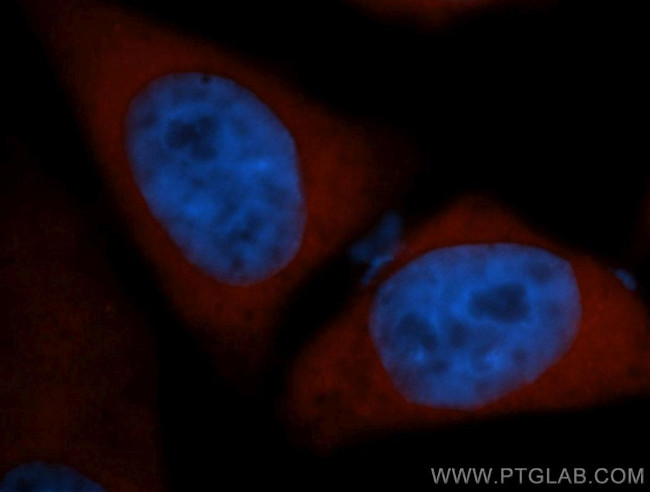
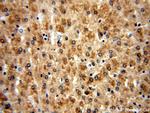
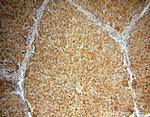
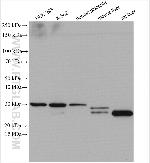
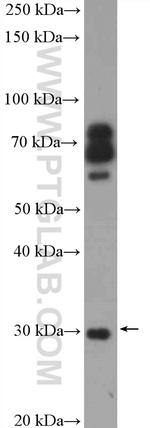
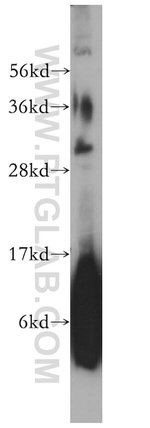
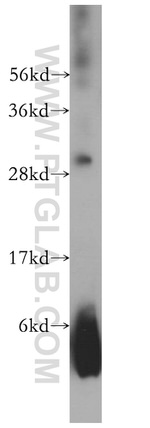
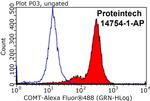
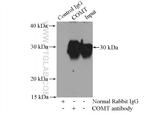
Please note: We are reviewing Western blot images included in the antibody testing data in our catalog, including those provided by third parties. Unless expressly labeled or annotated as “raw-unedited”, Western blot images included in the antibody testing data in our catalog may have been edited, optimized or otherwise adjusted for presentation.


产品信息
14754-1-AP
应用
建议稀释比
已发表文章
产品规格
种属反应
Human,
Mouse,
Rat
已发表种属
Human
宿主/亚型
Rabbit
/ IgG
分类
Polyclonal
类型
Antibody
抗原
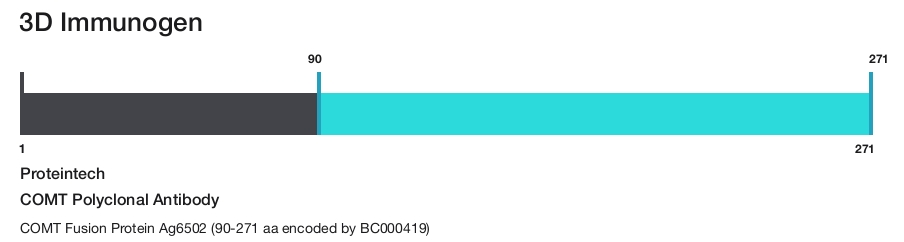
COMT Fusion Protein Ag6502 (90-271 aa encoded by BC000419)
偶联物
Unconjugated
Unconjugated
Unconjugated
形式
Liquid
浓度
0.19 mg/mL
规格
28.5 µg
纯化类型
Antigen affinity chromatography
保存液
PBS, pH 7.3, with 50% glycerol
内含物
0.02% sodium azide
保存条件
-20°C
运输条件
Wet ice (domestic); Dry ice (international)
产品详细信息
Immunogen sequence: MNVGDKKGK IVDAVIQEHQ PSVLLELGAY CGYSAVRMAR LLSPGARLIT IEINPDCAAI TQRMVDFAGM KDKVTLVVGA SQDIIPQLKK KYDVDTLDMV FLDHWKDRYL PDTLLLEECG LLRKGTVLLA DNVICPGAPD FLAHVRGSSC FECTHYQSFL EYREVVDGLE KAIYKGPGSE AGP (90-271 aa encoded by BC000419)
靶标信息
Catechol-O-methyltransferase catalyzes the transfer of a methyl group from S-adenosylmethionine to catecholamines, including the neurotransmitters dopamine, epinephrine, and norepinephrine. This O-methylation results in one of the major degradative pathways of the catecholamine transmitters. In addition to its role in the metabolism of endogenous substances, COMT is important in the metabolism of catechol drugs used in the treatment of hypertension, asthma, and Parkinson disease. COMT is found in two forms in tissues, a soluble form (S-COMT) and a membrane-bound form (MB-COMT). The differences between S-COMT and MB-COMT reside within the N-termini. Several transcript variants are formed through the use of alternative translation initiation sites and promoters.
仅用于科研。不用于诊断过程。未经明确授权不得转售。
生物信息学
蛋白别名: catechol-O-methyltransferase 1; catecholamine-O-methyltransferase; COMT; epididymis secretory sperm binding protein Li 98n; OTTHUMP00000197749; OTTHUMP00000197750; testicular tissue protein Li 42; unnamed protein product
基因别名: Comt1; D16Wsu103e; D330014B15Rik; HEL-S-98n
UniProt ID: (Human) P21964, (Mouse) O88587, (Rat) P22734
Entrez Gene ID: (Human) 1312, (Mouse) 12846, (Rat) 24267
catecholamine metabolic process
methylation
developmental process
dopamine metabolic process
dopamine catabolic process
catecholamine catabolic process
behavioral fear response
response to hypoxia
kidney development
synaptic transmission, dopaminergic
startle response
response to amphetamine
renin secretion into blood stream
glycogen metabolic process
protein phosphorylation
protein methylation
prostaglandin metabolic process
response to stress
response to oxidative stress
female pregnancy
learning or memory
learning
memory
short-term memory
estrogen metabolic process
regulation of blood pressure
visual learning
response to temperature stimulus
response to xenobiotic stimulus
response to wounding
response to toxic substance
catechol-containing compound metabolic process
gene expression
dopamine secretion
cellular response to phosphate starvation
cerebellar cortex morphogenesis
response to food
glomerulus development
cholesterol efflux
multicellular organismal response to stress
response to cytokine
multicellular organism growth
exploration behavior
renal sodium excretion
norepinephrine metabolic process
fear response
macromolecule methylation
negative regulation of dopamine metabolic process
habituation
norepinephrine secretion
response to pain
negative regulation of smooth muscle cell proliferation
cognition
detection of temperature stimulus involved in sensory perception of pain
response to corticosterone
artery development
cellular response to cocaine
mastication
renal albumin absorption
renal filtration
response to salt
response to dopamine
response to angiotensin
response to lipopolysaccharide
response to estrogen
response to olanzapine
response to risperidone
positive regulation of lactation
Disclaimer

Clicking the images or links will redirect you to a website hosted by BenchSci that provides third-party scientific content. Neither the content nor the BenchSci technology and processes for selection have been evaluated by us; we are providing them as-is and without warranty of any kind, including for use or application of the Thermo Fisher Scientific products presented.

