Search
Invitrogen
CRM1 Polyclonal Antibody
{{$productOrderCtrl.translations['antibody.pdp.commerceCard.promotion.promotions']}}
{{$productOrderCtrl.translations['antibody.pdp.commerceCard.promotion.viewpromo']}}
{{$productOrderCtrl.translations['antibody.pdp.commerceCard.promotion.promocode']}}: {{promo.promoCode}} {{promo.promoTitle}} {{promo.promoDescription}}. {{$productOrderCtrl.translations['antibody.pdp.commerceCard.promotion.learnmore']}}
Additional Information:
{{banner.description}}
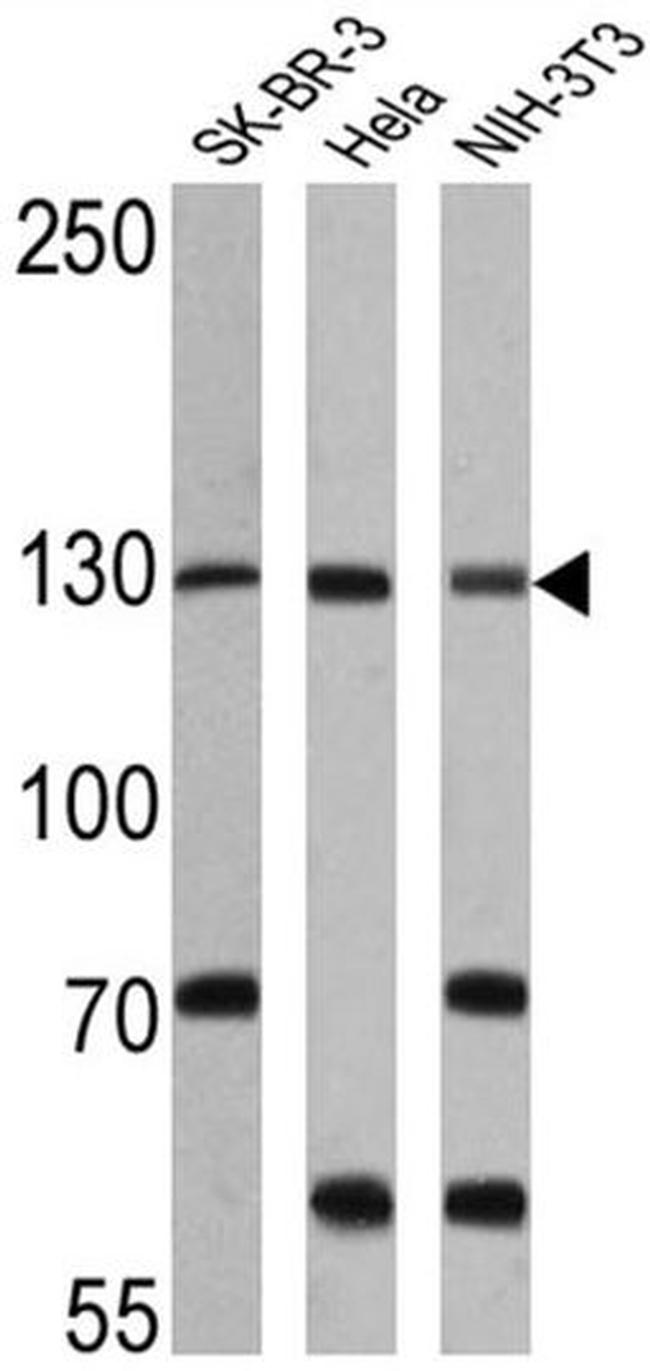
图: 1 / 2
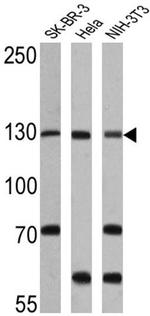
CRM1 Antibody (PA1-083) in WB
Western blot analysis of Exportin 1 was performed by loading 25 µg of SK-BR-3 (lane 1), Hela (lane 2) and NIH-3T3 (lane 3) onto an SDS polyacrylamide gel. Proteins were transferred to a PVDF membrane and blocked at 4°C overnight. The membrane was probed with an Exportin 1 polyclonal antibody (Product # PA1-083) at a dilution of 1:1000 overnight at 4°C, washed in TBST, and probed with an HRP-conjugated secondary antibody for 1 hr at room temperature in the dark. Chemiluminescent detection was performed using Pierce ECL Plus Western Blotting... View More


产品信息
PA1-083
产品规格
宿主/亚型
Rabbit
/ IgG
分类
Polyclonal
类型
Antibody
抗原
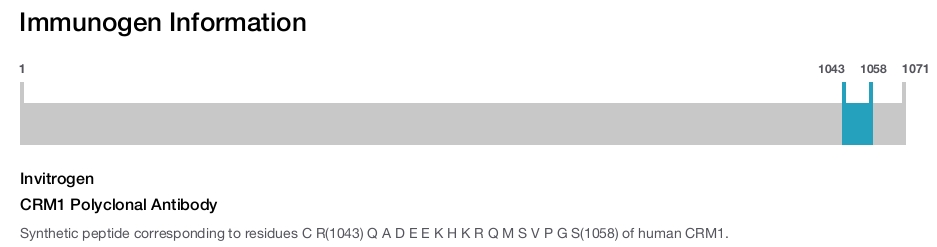
Synthetic peptide corresponding to residues C R(1043) Q A D E E K H K R Q M S V P G S(1058) of human CRM1.
偶联物
形式
Liquid
浓度
1 mg/mL
规格
100 µg
保存条件
-20°C, Avoid Freeze/Thaw Cycles
运输条件
Ambient (domestic); Wet ice (international)
RRID
产品详细信息
PA1-083 detects CRM1 (chromosome region maintenance 1) from bovine retinal extract, human and mouse samples.
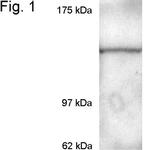
PA1-083 has been successfully used in Western blot and immunoprecipitation procedures. By Western blot, this antibody detects an ~135 kDa protein representing CRM1 from bovine retinal extract.
The PA1-083 immunogen is a synthetic peptide corresponding to residues C R(1043) Q A D E E K H K R Q M S V P G S(1058) of human CRM1. This sequence is 88% conserved in mouse, rat, and Xenopus laevis. The PA1-083 immunizing peptide (Cat. # PEP-162) is available for use in neutralization and control experiments.
靶标信息
Exportin - 1 (XPO1) mediates the nuclear export of cellular proteins bearing a leucine-rich nuclear export signal (NES) and RNAs. In the nucleus, in association with RANBP3, XPO1 binds cooperatively to the NES on its target protein and to the GTPase RAN in its active GTP-bound form (Ran-GTP). Docking of this complex to the nuclear pore complex is mediated through binding to nucleoproteins. Upon transit of a nuclear complex into the cytoplasm, disassembling of the complex and hydrolysis of Ran-GTP to Ran-GDP cause release of the cargo from the export receptor. The directionality of the nuclear export is thought to be conferred by an asymmetric distribution of the GTP and GDP bound forms of Ran between the cytoplasm and nucleus.
仅用于科研。不用于诊断过程。未经明确授权不得转售。
篇参考文献 (0)
您是否在文献中引用过该产品?请点击下方按钮邮件告知我们。
Disclaimer

Clicking the images or links will redirect you to a website hosted by BenchSci that provides third-party scientific content. Neither the content nor the BenchSci technology and processes for selection have been evaluated by us; we are providing them as-is and without warranty of any kind, including for use or application of the Thermo Fisher Scientific products presented.

