Search
Abnova
CTSD Monoclonal Antibody (3F12-1B9)
{{$productOrderCtrl.translations['antibody.pdp.commerceCard.promotion.promotions']}}
{{$productOrderCtrl.translations['antibody.pdp.commerceCard.promotion.viewpromo']}}
{{$productOrderCtrl.translations['antibody.pdp.commerceCard.promotion.promocode']}}: {{promo.promoCode}} {{promo.promoTitle}} {{promo.promoDescription}}. {{$productOrderCtrl.translations['antibody.pdp.commerceCard.promotion.learnmore']}}
Additional Information:
{{banner.description}}
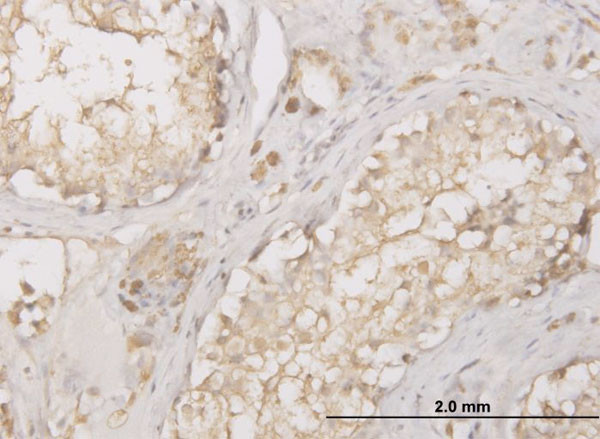
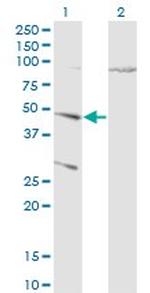
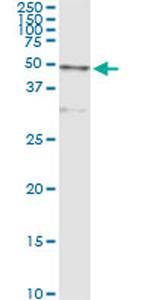


产品信息
H00001509-M01
应用
建议稀释比
已发表文章
产品规格
宿主/亚型
Mouse
/ IgG1, kappa
分类
Monoclonal
类型
Antibody
克隆号
3F12-1B9
抗原
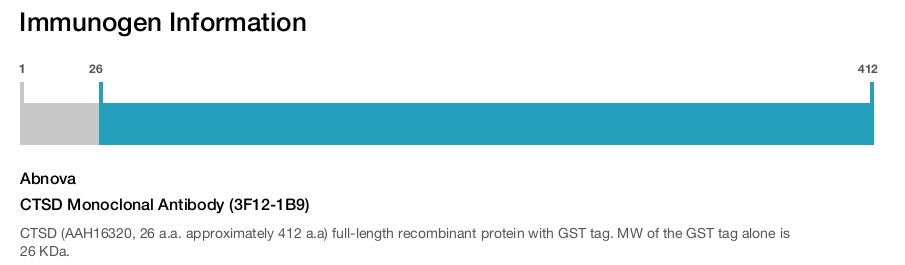
CTSD (AAH16320, 26 a.a. approximately 412 a.a) full-length recombinant protein with GST tag. MW of the GST tag alone is 26 KDa.
偶联物
Unconjugated
Unconjugated
Unconjugated
形式
Liquid
浓度
See Label
规格
100 µg
保存条件
-20°C, Avoid Freeze/Thaw Cycles
运输条件
Ambient (domestic); Wet ice (international)
产品详细信息
Sequence of this protein is as follows: LHKFTSIRRT MSEVGGSVED LIAKGPVSKY SQAVPAVTEG PIPEVLKNYM DAQYYGEIGI GTPPQCFTVV FDTGSSNLWV PSIHCKLLDI ACWIHHKYNS DKSSTYVKNG TSFDIHYGSG SLSGYLSQDT VSVPCQSASS ASALGGVKVE RQVFGEATKQ PGITFIAAKF DGILGMAYPR ISVNNVLPVF DNLMQQKLVD QNIFSFYLSR DPDAQPGGEL MLGGTDSKYY KGSLSYLNVT RKAYWQVHLD QVEVASGLTL CKEGCEAIVD TGTSLMVGPV DEVRELQKAI GAVPLIQGEY MIPCEKVSTL PAITLKLGGK GYKLSPEDYT LKVSQAGKTL CLSGFMGMDI PPPSGPLWIL GDVFIGRYYT VFDRDNNRVG FAEAARL
靶标信息
Cathepsin D is a gene located on chromosome 11p15.5 that encodes a lysosomal aspartic protease involved in the degradation of proteins. This enzyme is widely expressed in various tissues but is particularly abundant in the liver, kidneys, and brain, where it plays a crucial role in intracellular protein catabolism and turnover. Cathepsin D is synthesized as an inactive precursor, procathepsin D, which is activated in the acidic environment of lysosomes. Beyond its fundamental role in protein degradation, Cathepsin D has been implicated in several physiological and pathological processes, including apoptosis, hormone processing, and antigen presentation. Dysregulation of Cathepsin D expression or activity is associated with various diseases, such as neurodegenerative disorders, cancer, and cardiovascular diseases. In the context of cancer, Cathepsin D overexpression has been linked to tumor progression and metastasis, making it a potential biomarker and therapeutic target. Research continues to explore its diverse biological functions and therapeutic implications in various medical conditions.
仅用于科研。不用于诊断过程。未经明确授权不得转售。
篇参考文献 (0)
您是否在文献中引用过该产品?请点击下方按钮邮件告知我们。
Disclaimer

Clicking the images or links will redirect you to a website hosted by BenchSci that provides third-party scientific content. Neither the content nor the BenchSci technology and processes for selection have been evaluated by us; we are providing them as-is and without warranty of any kind, including for use or application of the Thermo Fisher Scientific products presented.

