Search
Proteintech
CUL4B Monoclonal Antibody (4E10B10)
{{$productOrderCtrl.translations['antibody.pdp.commerceCard.promotion.promotions']}}
{{$productOrderCtrl.translations['antibody.pdp.commerceCard.promotion.viewpromo']}}
{{$productOrderCtrl.translations['antibody.pdp.commerceCard.promotion.promocode']}}: {{promo.promoCode}} {{promo.promoTitle}} {{promo.promoDescription}}. {{$productOrderCtrl.translations['antibody.pdp.commerceCard.promotion.learnmore']}}
Additional Information:
{{banner.description}}
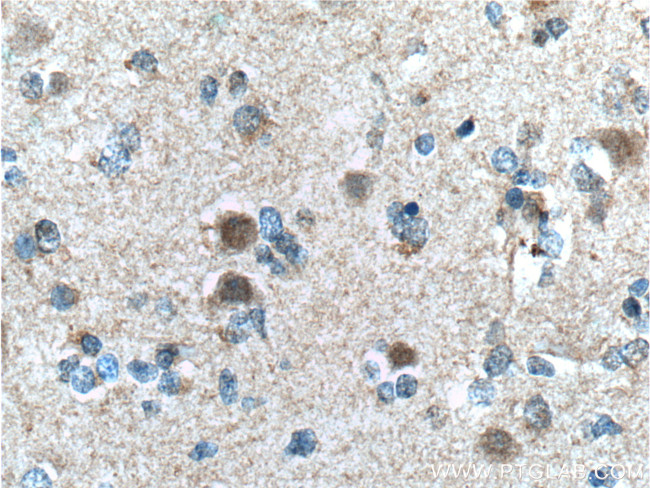

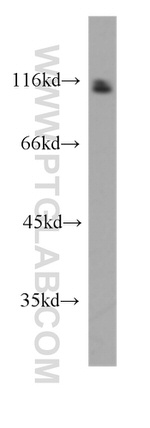
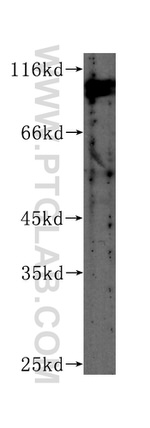


产品信息
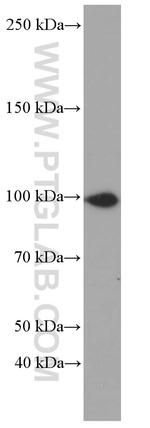
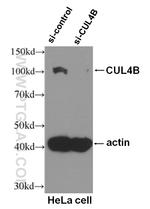
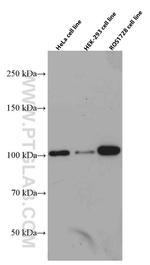
60151-1-IG
应用
建议稀释比
已发表文章
产品规格
种属反应
Human,
Rat
已发表种属
Human
宿主/亚型
Mouse
/ IgG1
分类
Monoclonal
类型
Antibody
克隆号
4E10B10
抗原
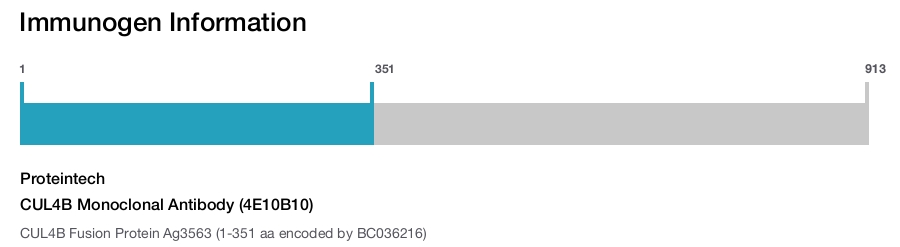
CUL4B Fusion Protein Ag3563 (1-351 aa encoded by BC036216)
偶联物
Unconjugated
Unconjugated
Unconjugated
形式
Liquid
浓度
1 mg/mL
规格
150 µg
纯化类型
Caprylic acid precipitation
保存液
PBS, pH 7.3, with 50% glycerol
内含物
0.02% sodium azide
保存条件
-20°C
运输条件
Wet ice (domestic); Dry ice (international)
产品详细信息
Immunogen sequence: MMSQSSGSG DGNDDEATTS KDGGFSSPSP SAAAAAQEVR SATDGNTSTT PPTSAKKRKL NSSSSSSSNS SNEREDFDST SSSSSTPPLQ PRDSASPSTS SFCLGVSVAA SSHVPIQKKL RFEDTLEFVG FDAKMAEESS SSSSSSSPTA ATSQQQQLKN KSILISSVAS VHHANGLAKS STTVSSFANS KPGSAKKLVI KNFKDKPKLP ENYTDETWQK LKEAVEAIQN STSIKYNLEE LYQAVENLCS YKISANLYKQ LRQICEDHIK AQIHQFREDS LDSVLFLKKI DRCWQNHCRQ MIMIRSIFLF LDRTYVLQNS MLPSIWDMGL ELFRAHIISD QKVQNKTIDG IL (1-351 aa encoded by BC036216)
靶标信息
Core component of multiple cullin-RING-based E3 ubiquitin-protein ligase complexes which mediate the ubiquitination and subsequent proteasomal degradation of target proteins. The functional specificity of the E3 ubiquitin-protein ligase complex depends on the variable substrate recognition subunit. CUL4B may act within the complex as a scaffold protein, contributing to catalysis through positioning of the substrate and the ubiquitin-conjugating enzyme. Plays a role as part of the E3 ubiquitin-protein ligase complex in polyubiquitination of CDT1, histone H2A, histone H3 and histone H4 in response to radiation-induced DNA damage. Targeted to UV damaged chromatin by DDB2 and may be important for DNA repair and DNA replication. Required for ubiquitination of cyclin E, and consequently, normal G1 cell cycle progression. Regulates the mammalian target-of-rapamycin (mTOR) pathway involved in control of cell growth, size and metabolism. Specific CUL4B regulation of the mTORC1-mediated pathway is dependent upon 26S proteasome function and requires interaction between CUL4B and MLST8.
仅用于科研。不用于诊断过程。未经明确授权不得转售。
生物信息学
蛋白别名: CUL-4B; Cullin-4B; ubiquitin E3 ligase; unnamed protein product
基因别名: CUL-4B; CUL4B; KIAA0695; MRXHF2; MRXS15; MRXSC; RGD1564494; SFM2
UniProt ID: (Human) Q13620
Entrez Gene ID: (Human) 8450, (Rat) 302502
G1/S transition of mitotic cell cycle
protein polyubiquitination
DNA repair
ubiquitin-dependent protein catabolic process
cellular response to DNA damage stimulus
gene expression
proteasomal protein catabolic process
protein ubiquitination
cellular response to UV
ribosome biogenesis
positive regulation of protein catabolic process
astrocyte differentiation
UV-damage excision repair
positive regulation of G1/S transition of mitotic cell cycle
neuron projection development
histone H2A monoubiquitination
Disclaimer

Clicking the images or links will redirect you to a website hosted by BenchSci that provides third-party scientific content. Neither the content nor the BenchSci technology and processes for selection have been evaluated by us; we are providing them as-is and without warranty of any kind, including for use or application of the Thermo Fisher Scientific products presented.

