Search
Disclaimer

Clicking the images or links will redirect you to a website hosted by BenchSci that provides third-party scientific content. Neither the content nor the BenchSci technology and processes for selection have been evaluated by us; we are providing them as-is and without warranty of any kind, including for use or application of the Thermo Fisher Scientific products presented.
Invitrogen
CX3CL1 Recombinant Superclonal™ Antibody (11HCLC)
{{$productOrderCtrl.translations['antibody.pdp.commerceCard.promotion.promotions']}}
{{$productOrderCtrl.translations['antibody.pdp.commerceCard.promotion.viewpromo']}}
{{$productOrderCtrl.translations['antibody.pdp.commerceCard.promotion.promocode']}}: {{promo.promoCode}} {{promo.promoTitle}} {{promo.promoDescription}}. {{$productOrderCtrl.translations['antibody.pdp.commerceCard.promotion.learnmore']}}
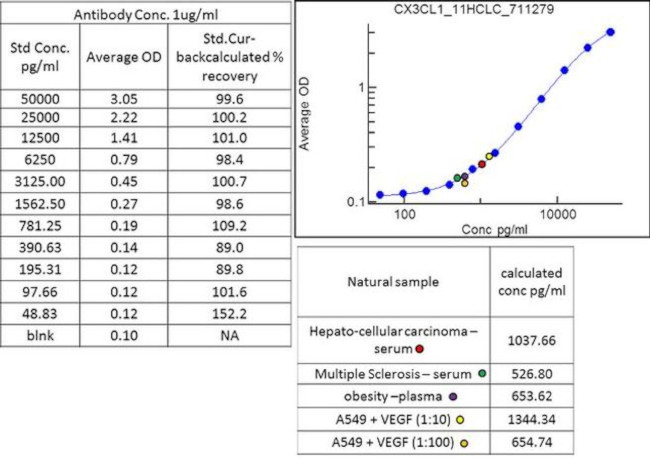
图: 1 / 1
CX3CL1 Antibody (711279) in ELISA
Indirect ELISA analysis of Anti-CX3CL1 Recombinant Rabbit Superclonal™ Antibody (Product # 711279) was performed by coating recombinant human CX3CL1 protein standard at concentrations ranging from 48.8 pg/mL to 50,000 pg/mL onto a plate. The coated protein was bound by Anti-CX3CL1 Recombinant Rabbit Superclonal™ Antibody at 1 µg/mL and was detected using Goat anti-Rabbit IgG (H+L) secondary antibody, HRP-conjugate (Product # G-21234, 1:5000 dilution). The plate was developed using stabilized chromogen solution, TMB+H2O2 (Product # SB01). T... View More

产品信息
711279
产品规格
宿主/亚型
Rabbit
/ IgG
Expression System
Expi293
分类
Recombinant Superclonal
类型
Antibody
克隆号
11HCLC
抗原
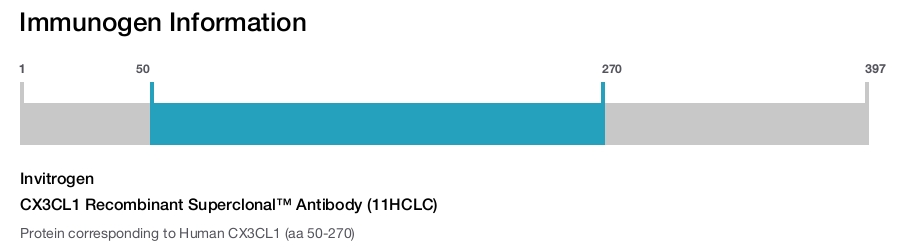
Protein corresponding to Human CX3CL1 (aa 50-270)
偶联物
形式
Liquid
浓度
0.5 mg/mL
保存条件
Store at 4°C short term. For long term storage, store at -20°C, avoiding freeze/thaw cycles.
运输条件
Wet ice
RRID
产品详细信息
This antibody is predicted to react with Monkey, Cat and Dog
Recombinant rabbit Superclonal™ antibodies are unique offerings from Thermo Fisher Scientific. They are comprised of a selection of multiple different recombinant monoclonal antibodies, providing the best of both worlds - the sensitivity of polyclonal antibodies with the specificity of monoclonal antibodies - all delivered with the consistency only found in a recombinant antibody. While functionally the same as a polyclonal antibody - recognizing multiple epitope sites on the target and producing higher detection sensitivity for low abundance targets - a recombinant rabbit Superclonal™ antibody has a known mixture of light and heavy chains. The exact population can be produced in every lot, circumventing the biological variability typically associated with polyclonal antibody production. Note: Formerly called “Recombinant polyclonal antibody”, this product is now rebranded as “Recombinant Superclonal™ antibody”. The physical product and the performance remain unchanged.
靶标信息
Chemokines are a family of proteins associated with the trafficking of leukocytes in immune surveillance and inflammatory cell recruitment. They are classified based on the positions of key cysteine residues. CX3CL1 is a CX3C chemokine known to induce adhesion and migration of leukocytes mediated by a membrane-bound and soluble form respectively. Recent experiments have shown that CX3CL1 can suppress the production of nitrous oxide, interleukin-6, and TNF-a in activated microglia and neuronal cells, suggesting that it may act as an intrinsic inhibitor against neurotoxicity by activated microglia. Its receptor, CX3CR1, also functions as a co-receptor for HIV-1 and HIV-2 envelope fusion and virus infection, which can be inhibited by CX3CL1.
仅用于科研。不用于诊断过程。未经明确授权不得转售。
篇参考文献 (0)
您是否在文献中引用过该产品?请点击下方按钮邮件告知我们。

