Search
Invitrogen
CaV1.3 Polyclonal Antibody
{{$productOrderCtrl.translations['antibody.pdp.commerceCard.promotion.promotions']}}
{{$productOrderCtrl.translations['antibody.pdp.commerceCard.promotion.viewpromo']}}
{{$productOrderCtrl.translations['antibody.pdp.commerceCard.promotion.promocode']}}: {{promo.promoCode}} {{promo.promoTitle}} {{promo.promoDescription}}. {{$productOrderCtrl.translations['antibody.pdp.commerceCard.promotion.learnmore']}}
Additional Information:
{{banner.description}}
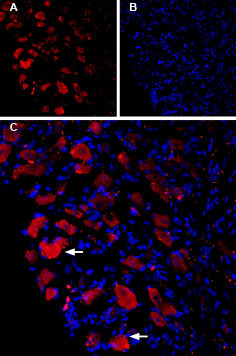
图: 1 / 2
CaV1.3 Antibody (PA5-111820) in IHC
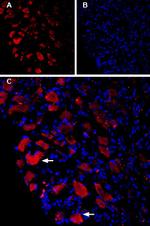
Immunohistochemistry analysis of CaV1.3 in rat DRGs tissue sections using CaV1.3 Antibody (Product # PA5-111820) at a dilution of 1:200. A) CaV1.3 staining (red) is detected in some DRG cells (arrows). B) Nuclei staining using DAPI as the counterstain. C) Merged image of panels A and B.


产品信息
PA5-111820
产品规格
宿主/亚型
Guinea pig
/ IgG
分类
Polyclonal
类型
Antibody
抗原
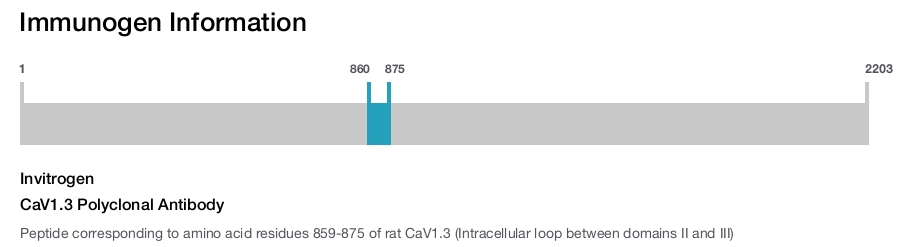
Peptide corresponding to amino acid residues 859-875 of rat CaV1.3 (Intracellular loop between domains II and III)
偶联物
Unconjugated
Unconjugated
Unconjugated
形式
Lyophilized
浓度
0.85 mg/mL
规格
42.5 µg
保存条件
-20°C
运输条件
Wet ice
RRID
产品详细信息
Reconstitute antibody with 50 µL of double distilled water (DDW). The reconstituted solution can be stored at 4 degrees C for up to 1 week. For longer periods, small aliquots should be stored at -20 degrees C. Avoid multiple freezing and thawing. Centrifuge all antibody preparations before use (10000 x g 5 min).
Peptide sequence is: (C)DNKVTID DYQEEAEDKD
Homology: Mouse - 16/17 amino acid residues identical; human -15/17 amino acid residues identical.
靶标信息
CACNA1D is also known as PASNA, SANDD or Cav1. 3. Voltage-dependent calcium channels mediate the entry of calcium ions into excitable cells, and are also involved in a variety of calcium-dependent processes, including muscle contraction, hormone or neurotransmitter release, and gene expression. Calcium channels are multisubunit complexes composed of alpha-1, beta, alpha-2/delta, and gamma subunits. The channel activity is directed by the pore-forming alpha-1 subunit, whereas the others act as auxiliary subunits regulating this activity. The distinctive properties of the calcium channel types are related primarily to the expression of a variety of alpha-1 isoforms, namely alpha-1A, B, C, D, E, and S. This gene encodes the alpha-1D subunit. Several transcript variants encoding different isoforms have been found for this gene.
仅用于科研。不用于诊断过程。未经明确授权不得转售。
篇参考文献 (0)
您是否在文献中引用过该产品?请点击下方按钮邮件告知我们。
Disclaimer

Clicking the images or links will redirect you to a website hosted by BenchSci that provides third-party scientific content. Neither the content nor the BenchSci technology and processes for selection have been evaluated by us; we are providing them as-is and without warranty of any kind, including for use or application of the Thermo Fisher Scientific products presented.

