Search
Invitrogen
Cathepsin D Polyclonal Antibody
{{$productOrderCtrl.translations['antibody.pdp.commerceCard.promotion.promotions']}}
{{$productOrderCtrl.translations['antibody.pdp.commerceCard.promotion.promocode']}}: {{promo.promoCode}} {{promo.promoTitle}} {{promo.promoDescription}}. {{$productOrderCtrl.translations['antibody.pdp.commerceCard.promotion.learnmore']}}
{{$ctrl.translations['antibody.pdp.skuNotes.additionalInformation']}}:
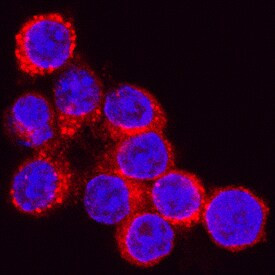
图: 1 / 3
Cathepsin D Antibody (PA5-47046) in ICC/IF
Immunocytochemistry analysis of Cathepsin D in immersion fixed RAW 264.7 mouse monocyte/macrophage cell line. Samples were incubated in Cathepsin D polyclonal antibody (Product # PA5-47046) using a dilution of 5 µg/mL for 3 hours at room temperature followed by NorthernLights™ 557-conjugated Anti-Goat IgG Secondary Antibody (red) and counterstained with DAPI (blue). Specific staining was localized to lysoso... View More
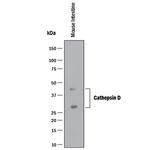
Please note: We are reviewing Western blot images included in the antibody testing data in our catalog, including those provided by third parties. Unless expressly labeled or annotated as “raw-unedited”, Western blot images included in the antibody testing data in our catalog may have been edited, optimized or otherwise adjusted for presentation.


产品信息
PA5-47046
应用
建议稀释比
已发表文章
产品规格
种属反应
Mouse
已发表种属
Mouse
宿主/亚型
Goat
/ IgG
分类
Polyclonal
类型
Antibody
抗原
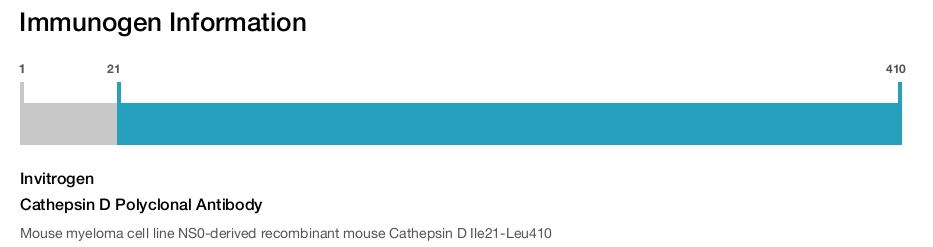
Mouse myeloma cell line NS0-derived recombinant mouse Cathepsin D Ile21-Leu410
偶联物
Unconjugated
Unconjugated
Unconjugated
形式
Lyophilized
浓度
0.2 mg/mL once reconstituted
规格
100 µg
纯化类型
Antigen affinity chromatography
保存液
PBS with 5% trehalose
内含物
No Preservative
保存条件
-20°C, Avoid Freeze/Thaw Cycles
运输条件
Ambient (domestic); Wet ice (international)
RRID
产品详细信息
In direct ELISAs, approximately 20% cross-reactivity with recombinant human (rh) Cathepsin D is observed and less than 1% cross-reactivity with rhCathepsin A, B, C, L, X, and recombinant mouse (rm) Cathepsin B, C, H, and X is observed. In Western blots, approximately 100% cross-reactivity with rhCathepsin D is observed and less than 1% cross-reactivity with rmCathepsin E is observed.
Reconstitute at 0.2 mg/mL in sterile PBS.
靶标信息
Cathepsin D is a gene located on chromosome 11p15.5 that encodes a lysosomal aspartic protease involved in the degradation of proteins. This enzyme is widely expressed in various tissues but is particularly abundant in the liver, kidneys, and brain, where it plays a crucial role in intracellular protein catabolism and turnover. Cathepsin D is synthesized as an inactive precursor, procathepsin D, which is activated in the acidic environment of lysosomes. Beyond its fundamental role in protein degradation, Cathepsin D has been implicated in several physiological and pathological processes, including apoptosis, hormone processing, and antigen presentation. Dysregulation of Cathepsin D expression or activity is associated with various diseases, such as neurodegenerative disorders, cancer, and cardiovascular diseases. In the context of cancer, Cathepsin D overexpression has been linked to tumor progression and metastasis, making it a potential biomarker and therapeutic target. Research continues to explore its diverse biological functions and therapeutic implications in various medical conditions.
仅用于科研。不用于诊断过程。未经明确授权不得转售。
生物信息学
蛋白别名: CathepsinD; Ceroid lipofuscinosis neuronal 10; MGC2311; OTTHUMP00000196039; OTTHUMP00000198692; unnamed protein product
基因别名: CatD; CD
UniProt ID: (Mouse) P18242
Entrez Gene ID: (Mouse) 13033
autophagosome assembly
proteolysis
protein catabolic process
insulin receptor recycling
lipoprotein catabolic process
positive regulation of apoptotic process
epithelial tube branching involved in lung morphogenesis
regulation of establishment of protein localization
execution phase of apoptosis
vesicle-mediated transport in synapse
synaptic vesicle endosomal processing
insulin catabolic process
Disclaimer

Clicking the images or links will redirect you to a website hosted by BenchSci that provides third-party scientific content. Neither the content nor the BenchSci technology and processes for selection have been evaluated by us; we are providing them as-is and without warranty of any kind, including for use or application of the Thermo Fisher Scientific products presented.

