Search
NeoBiotechnologies
Chromogranin A/CHGA (Neuroendocrine Marker) Recombinant Rabbit Monoclonal Antibody (MSVA-380R)
{{$productOrderCtrl.translations['antibody.pdp.commerceCard.promotion.promotions']}}
{{$productOrderCtrl.translations['antibody.pdp.commerceCard.promotion.viewpromo']}}
{{$productOrderCtrl.translations['antibody.pdp.commerceCard.promotion.promocode']}}: {{promo.promoCode}} {{promo.promoTitle}} {{promo.promoDescription}}. {{$productOrderCtrl.translations['antibody.pdp.commerceCard.promotion.learnmore']}}
Additional Information:
{{banner.description}}
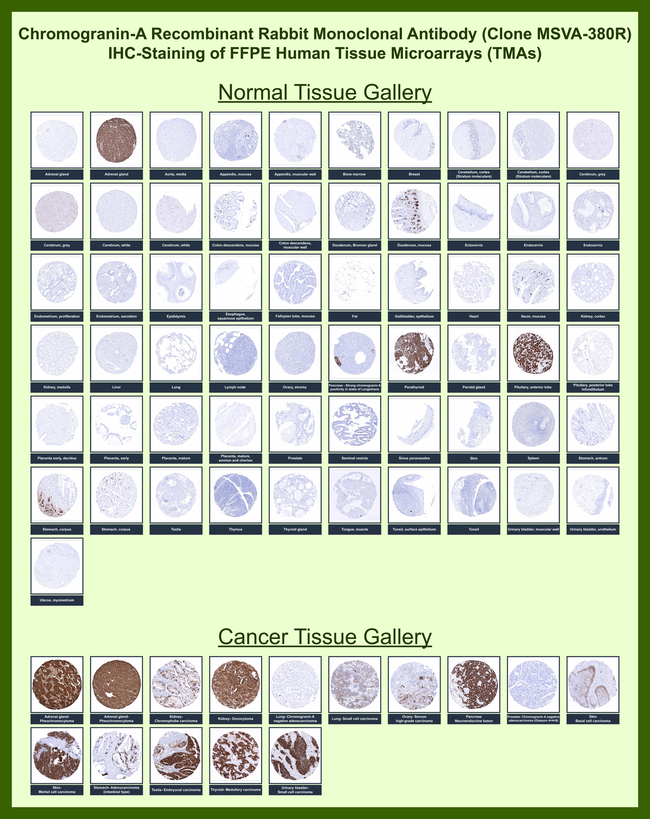
图: 1 / 1
Chromogranin A/CHGA (Neuroendocrine Marker) Antibody (1113-RBM38-P1) in IHC (P)
Chromogranin-A Rabbit Recombinant Monoclonal Antibody (MSVA-380R) tested on many normal and cancer tissues. The immunohistochemistry staining in these tissues aligns with the expression data in Human Protein Atlas.

产品信息
1113-RBM38-P1
产品规格
种属反应
Human
宿主/亚型
Rabbit
/ IgG, kappa
Expression System
HEK293 cells
分类
Recombinant Monoclonal
类型
Antibody
克隆号
MSVA-380R
抗原
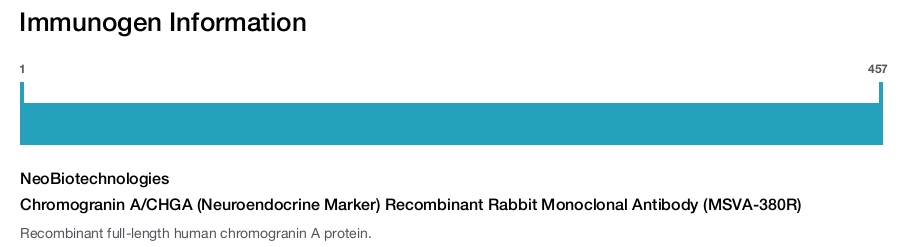
Recombinant full-length human chromogranin A protein.
偶联物
Unconjugated
Unconjugated
Unconjugated
形式
Liquid
浓度
200 µg/mL
规格
100 µg
纯化类型
Protein A
保存液
PBS with 0.05% BSA
内含物
0.05% sodium azide
保存条件
4°C
运输条件
Ambient (domestic); Wet ice (international)
产品详细信息
Product cellular localization: Cytoplasmic vesicle, Neuronal dense core vesicle, Secreted, Secretory vesicle.
Positive control: Appendix: An at least weak to moderate staining must be seen in the axons and ganglion cells of the peripheral nerves while mucosal neuroendocrine cells exhibit a strong staining (neuroendocrine cells are not sufficient as positive controls because they express CGA so strongly, that even inefficient staining will detect its expression).
Tissue specificity: GE-25 is found in the brain.
靶标信息
Chromogranin A (CHGA) is a member of the chromogranin/secretogranin family of neuroendocrine secretory proteins. It is found in secretory vesicles of neurons and endocine cells. CHGA is a precursor to three biologically active peptides: vasostatin, pancreastatin, and parastatin. These peptides act as autocine or paracrine negative modulators of the neuroendocrine system. CHGA is an excellent marker for carcinoid tumors, pheo-chromocytomas, paragangliomas, and other neuro-endocrine tumors. Coexpression of chromogranin A and neuron specific enolase (NSE) is common in neuroendocrine neoplasms.
仅用于科研。不用于诊断过程。未经明确授权不得转售。
篇参考文献 (0)
您是否在文献中引用过该产品?请点击下方按钮邮件告知我们。
生物信息学
蛋白别名: betagranin (N-terminal fragment of chromogranin A); catestatin; CgA; chromofungin; chromogranin A; chromogranin A precursor; Chromogranin-A; CTNNB; DKFZp686D02253; FLJ25606; FLJ37923; MGC105435; parathyroid secretory protein 1; Pituitary secretory protein I; SP-I; unnamed protein product
基因别名: CGA; CHGA; PHE5; PHES
UniProt ID: (Human) P10645
Entrez Gene ID: (Human) 1113
regulation of the force of heart contraction
mast cell chemotaxis
regulation of blood pressure
killing of cells of other organism
protein localization to secretory granule
negative regulation of catecholamine secretion
defense response to bacterium
mast cell degranulation
innate immune response
mast cell activation
negative regulation of insulin secretion
defense response to Gram-negative bacterium
defense response to Gram-positive bacterium
defense response to fungus
positive regulation of cardiac muscle contraction
adenylate cyclase-activating adrenergic receptor signaling pathway
positive regulation of phospholipase C-activating G-protein coupled receptor signaling pathway
positive regulation of relaxation of cardiac muscle
positive regulation of dense core granule biogenesis
Disclaimer

Clicking the images or links will redirect you to a website hosted by BenchSci that provides third-party scientific content. Neither the content nor the BenchSci technology and processes for selection have been evaluated by us; we are providing them as-is and without warranty of any kind, including for use or application of the Thermo Fisher Scientific products presented.

