Search
Invitrogen
Connexin 43 Polyclonal Antibody
{{$productOrderCtrl.translations['antibody.pdp.commerceCard.promotion.promotions']}}
{{$productOrderCtrl.translations['antibody.pdp.commerceCard.promotion.promocode']}}: {{promo.promoCode}} {{promo.promoTitle}} {{promo.promoDescription}}. {{$productOrderCtrl.translations['antibody.pdp.commerceCard.promotion.learnmore']}}
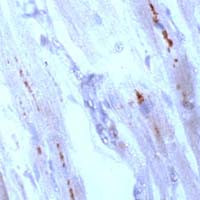
图: 1 / 1
Connexin 43 Antibody (PA1-37497) in IHC (P)
Immunohistochemistry was performed on formalin-fixed, paraffin-embedded human heart tissue sections. To expose target proteins, tissues were boiled for 10 minutes in 10mM citrate buffer, pH 6.0. Following antigen retrieval, tissues were blocked and then probed with a Connexin 43 polyclonal antibody (Product # PA1-37497) at a dilution of 1:100 for at least 10 minutes at room temperature. Tissues were washed ... View More
Please note: We are reviewing Western blot images included in the antibody testing data in our catalog, including those provided by third parties. Unless expressly labeled or annotated as “raw-unedited”, Western blot images included in the antibody testing data in our catalog may have been edited, optimized or otherwise adjusted for presentation.

产品信息
PA1-37497
产品规格
宿主/亚型
Rabbit
/ IgG
分类
Polyclonal
类型
Antibody
抗原
Synthetic peptide derived from a segment of the 3 cytoplasmic domain of rat connexin 43
偶联物
Unconjugated
Unconjugated
Unconjugated
形式
Liquid
保存条件
-20°C, Avoid Freeze/Thaw Cycles
运输条件
Gel ice packs
RRID
产品详细信息
This antibody is predicted to react with bovine, canine, mouse, porcine and rabbit based on sequence homology.
Heat-mediated antigen retrieval is recommended prior to staining, using a 10mM citrate buffer, pH 6.0, for 10 minutes followed by cooling at room temperature for 20 min. Following antigen retrieval, incubate samples with primary antibody for 10 min at room temperature. A suggested positive control is heart tissue.
靶标信息
Connexin 43 (Cx43), encoded by the GJA1 gene, is a widely expressed gap junction protein that plays an important role in direct cell-to-cell communication. Six Cx43 proteins assemble to form a connexon, or hemichannel, which can pair with a connexon on a neighboring cell to create a gap junction channel. These channels allow ions, metabolites, and small signaling molecules to pass between adjacent cells, helping coordinate processes such as electrical conduction, tissue development, wound healing, and cellular homeostasis. Cx43 is especially abundant in tissues such as the heart, brain, bone, and skin, and changes in its expression, localization, or function have been associated with cardiovascular disease, neurological disorders, impaired tissue repair, and cancer. Because of its broad role in intercellular signaling and disease biology, Cx43 is an important target for studying gap junction function and developing potential therapeutic strategies.
仅用于科研。不用于诊断过程。未经明确授权不得转售。
篇参考文献 (0)
您是否在文献中引用过该产品?请点击下方按钮邮件告知我们。
Disclaimer

Clicking the images or links will redirect you to a website hosted by BenchSci that provides third-party scientific content. Neither the content nor the BenchSci technology and processes for selection have been evaluated by us; we are providing them as-is and without warranty of any kind, including for use or application of the Thermo Fisher Scientific products presented.

