Search
NeoBiotechnologies
Cytokeratin 10 (Suprabasal Epithelial Marker) Recombinant Mouse Monoclonal Antibody (MSVA-610M)
{{$productOrderCtrl.translations['antibody.pdp.commerceCard.promotion.promotions']}}
{{$productOrderCtrl.translations['antibody.pdp.commerceCard.promotion.promocode']}}: {{promo.promoCode}} {{promo.promoTitle}} {{promo.promoDescription}}. {{$productOrderCtrl.translations['antibody.pdp.commerceCard.promotion.learnmore']}}
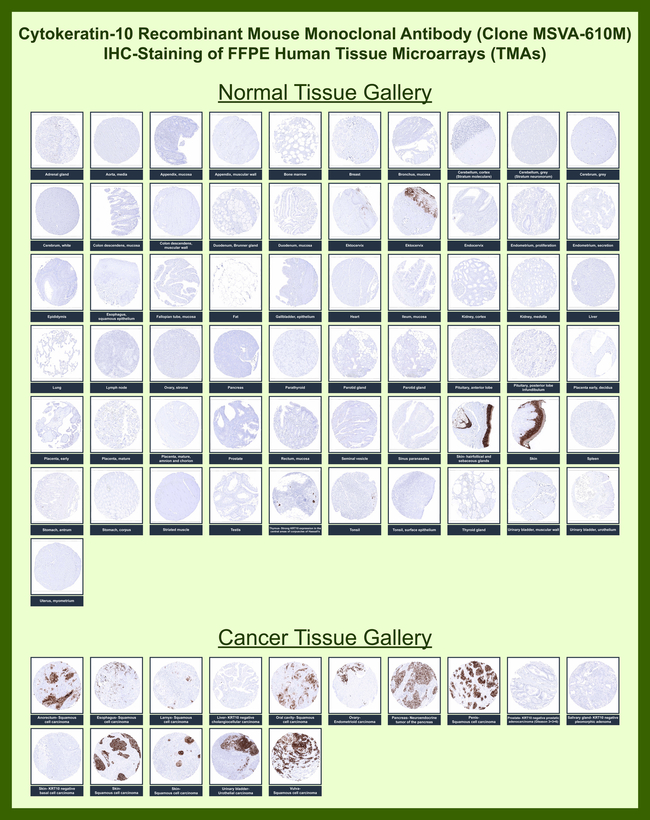
图: 1 / 1
Cytokeratin 10 (Suprabasal Epithelial Marker) Antibody (3858-MSM18-P1) in IHC (P)
Keratin, type I cytoskeletal 10 Mouse Recombinant Monoclonal Antibody (MSVA-610M) tested on many normal and cancer tissues. The immunohistochemistry staining in these tissues aligns with the expression data in Human Protein Atlas.
Please note: We are reviewing Western blot images included in the antibody testing data in our catalog, including those provided by third parties. Unless expressly labeled or annotated as “raw-unedited”, Western blot images included in the antibody testing data in our catalog may have been edited, optimized or otherwise adjusted for presentation.

产品信息
3858-MSM18-P1
产品规格
种属反应
Human
宿主/亚型
Mouse
/ IgG1, kappa
Expression System
HEK293 cells
分类
Recombinant Monoclonal
类型
Antibody
克隆号
MSVA-610M
抗原
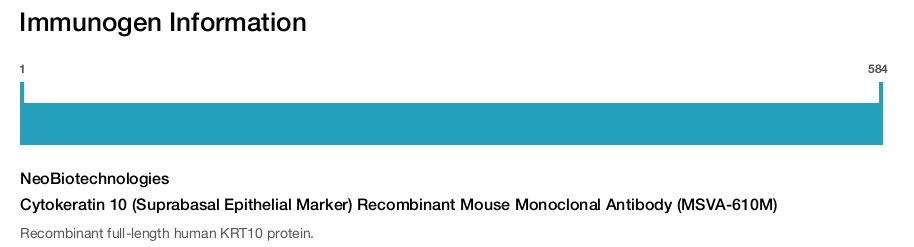
Recombinant full-length human KRT10 protein.
偶联物
Unconjugated
Unconjugated
Unconjugated
形式
Liquid
浓度
200 µg/mL
规格
100 µg
纯化类型
Protein G
保存液
PBS with 0.05% BSA
内含物
0.05% sodium azide
保存条件
4°C
运输条件
Ambient (domestic); Wet ice (international)
产品详细信息
Product cellular localization: Cytoplasm.
Positive control: Pancreas: CK7 staining is at least weak to moderate cytoplasmic intercalating ducts and strong in large pancreatic ducts.
Tissue specificity: Expressed in cultured epidermal, bronchial and mesothelial cells but absent in colon, ectocervix and liver. Observed throughout the glandular cells in the junction between stomach and esophagus but is absent in the esophagus.
靶标信息
Cytokeratins (CK) are intermediate filaments of epithelial cells, both in keratinizing tissue (i.e., skin) and non-keratinizing cells (i.e. mesothelial cells). Although not a traditional marker for endothelial cells, cytokeratins have also been found in some microvascular endothelial cells. At least 20 different cytokeratins (CK) in the molecular range of 40-70 kDa and isoelectric points of 5-8. 5 can be identified using two dimensional gel electrophoresis. Biochemically, most members of the CK family fall into one of two classes, type I (acidic polypeptides) and type II (basic polypeptides). At least one member of the acidic family and one member of the basic family is expressed in all epithelial cells. Monoclonal antibodies to cytokeratin proteins can be useful markers for tumor identification and classification.
仅用于科研。不用于诊断过程。未经明确授权不得转售。
篇参考文献 (0)
您是否在文献中引用过该产品?请点击下方按钮邮件告知我们。
生物信息学
蛋白别名: CK-10; CK-17; cytokeratin 10; keratin 10, type I; keratin-10; keratin-17
基因别名: BCIE; BIE; CK10; EHK; EHK2; EHK2A; EHK2B; IHL; K10; KPP
UniProt ID: (Human) P13645
Entrez Gene ID: (Human) 3858
Disclaimer

Clicking the images or links will redirect you to a website hosted by BenchSci that provides third-party scientific content. Neither the content nor the BenchSci technology and processes for selection have been evaluated by us; we are providing them as-is and without warranty of any kind, including for use or application of the Thermo Fisher Scientific products presented.

