Search
Bethyl Laboratories
DDHD1 Polyclonal Antibody
{{$productOrderCtrl.translations['antibody.pdp.commerceCard.promotion.promotions']}}
{{$productOrderCtrl.translations['antibody.pdp.commerceCard.promotion.promocode']}}: {{promo.promoCode}} {{promo.promoTitle}} {{promo.promoDescription}}. {{$productOrderCtrl.translations['antibody.pdp.commerceCard.promotion.learnmore']}}
{{$ctrl.translations['antibody.pdp.skuNotes.additionalInformation']}}:
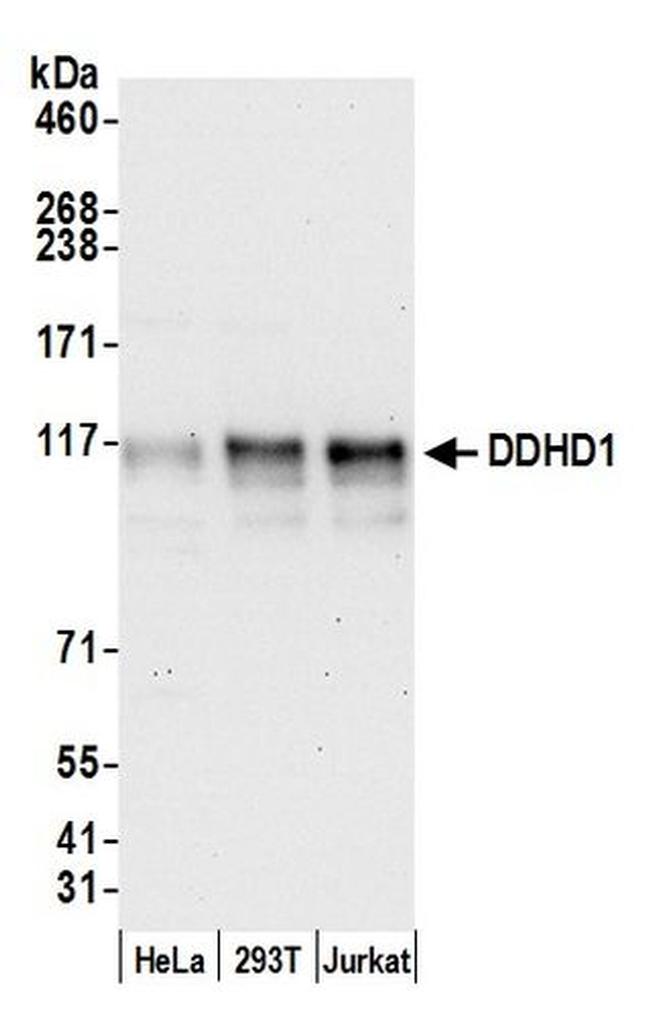
图: 1 / 4
DDHD1 Antibody (A305-756A-T) in WB
Detection of human DDHD1 by western blot. Samples: Whole cell lysate (15 µg) from HeLa, 293T, and Jurkat cells prepared using NETN lysis buffer. Antibody: Affinity purified rabbit anti-DDHD1 antibody A305-756A-M (lot A305-756A-M-1) used for WB at 1:1000. Detection: Chemiluminescence with an exposure time of 30 seconds.
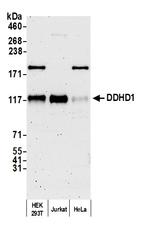
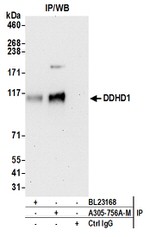
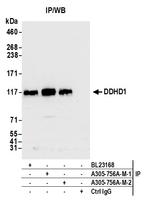
Please note: We are reviewing Western blot images included in the antibody testing data in our catalog, including those provided by third parties. Unless expressly labeled or annotated as “raw-unedited”, Western blot images included in the antibody testing data in our catalog may have been edited, optimized or otherwise adjusted for presentation.


产品信息
A305-756A-T
产品规格
种属反应
Human
宿主/亚型
Rabbit
/ IgG
分类
Polyclonal
类型
Antibody
抗原
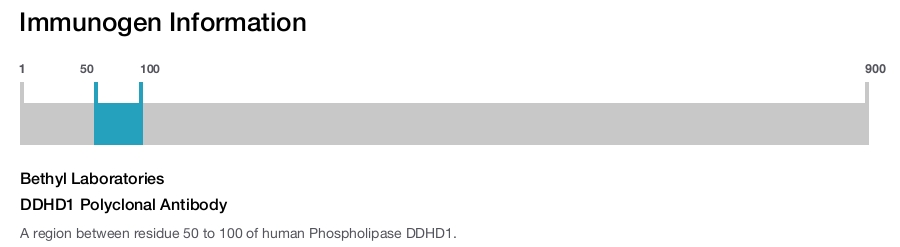
A region between residue 50 to 100 of human Phospholipase DDHD1.
偶联物
Unconjugated
Unconjugated
Unconjugated
形式
Liquid
浓度
1 mg/mL
规格
10 µg
纯化类型
Antigen affinity chromatography
保存液
phosphate/tris citrate, pH 7.0 to 8.0
内含物
0.09% sodium azide
保存条件
4°C
运输条件
Ambient (domestic); Wet ice (international)
产品详细信息
The recommended shelf life for this product is 1 year from date of receipt.
靶标信息
This gene is a member of the intracellular phospholipase A1 gene family. The protein encoded by this gene preferentially hydrolyzes phosphatidic acid. It is a cytosolic protein with some mitochondrial localization, and is thought to be involved in the regulation of mitochondrial dynamics. Overexpression of this gene causes fragmentation of the tubular structures in mitochondria, while depletion of the gene results in mitochondrial tubule elongation. Deletion of this gene in male mice caused fertility defects, resulting from disruption in the organization of the mitochondria during spermiogenesis. In humans, mutations in this gene have been associated with hereditary spastic paraplegia (HSP), also known as Strumpell-Lorrain disease, or, familial spastic paraparesis (FSP). This inherited disorder is characterized by progressive weakness and spasticity of the legs. Alternative splicing results in multiple transcript variants encoding different isoforms.
仅用于科研。不用于诊断过程。未经明确授权不得转售。
篇参考文献 (0)
您是否在文献中引用过该产品?请点击下方按钮邮件告知我们。
生物信息学
蛋白别名: intracellular phospholipase A1 alpha; lipase; phosphatidic acid-preferring phospholipase A1 homolog; phosphatidic acid-preferring phospholipase A1-like protein; phospholipase; phospholipid sn-1 acylhydrolase; spastic paraplegia 28 (autosomal recessive); unnamed protein product
基因别名: iPLA1alpha; iPLA1I; PA-PLA1; PAPLA1; SPG28
UniProt ID: (Human) Q8NEL9
Entrez Gene ID: (Human) 80821
Disclaimer

Clicking the images or links will redirect you to a website hosted by BenchSci that provides third-party scientific content. Neither the content nor the BenchSci technology and processes for selection have been evaluated by us; we are providing them as-is and without warranty of any kind, including for use or application of the Thermo Fisher Scientific products presented.

