Search
Invitrogen
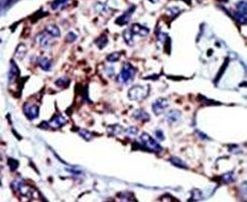
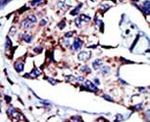
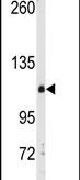
DGKD Polyclonal Antibody
{{$productOrderCtrl.translations['antibody.pdp.commerceCard.promotion.promotions']}}
{{$productOrderCtrl.translations['antibody.pdp.commerceCard.promotion.viewpromo']}}
{{$productOrderCtrl.translations['antibody.pdp.commerceCard.promotion.promocode']}}: {{promo.promoCode}} {{promo.promoTitle}} {{promo.promoDescription}}. {{$productOrderCtrl.translations['antibody.pdp.commerceCard.promotion.learnmore']}}
Additional Information:
{{banner.description}}


产品信息
PA5-15414
产品规格
宿主/亚型
Rabbit
/ IgG
分类
Polyclonal
类型
Antibody
抗原
KLH conjugated synthetic peptide between 1061-1091 amino acids from the C-terminal region of human DGKD
偶联物
Unconjugated
Unconjugated
Unconjugated
形式
Liquid
浓度
Lot-specific
保存条件
-20°C, Avoid Freeze/Thaw Cycles
运输条件
Wet ice
RRID
靶标信息
Diacylglycerol kinases (DGKs) phosphorylate diacylglycerol (DAG) to produce phosphatidic acid. DAG and phosphatidic acid are lipids that act as second messengers in signaling cascades. DGK-alpha influences cell activation and secretion of lethal exosomes, which in turn control cell death. DGK-beta is abundant in restricted brain regions such as the caudate putamen and olfactory tubercle. DGK-gamma encodes full-length and truncated transcripts that are present in a range of human tissues, with greatest expression observed in retina. DGK-delta is most abundant in skeletal muscle. DGK-epsilon shows specificity for arachidonylcontaining diacylglycerol and is expressed predominantly in testis. DGK-theta is most abundant in the cerebellum and hippocampus. DGK-iota is present in brain and retina as a predominant transcript of more than 12 kb, including a long 3-prime untranslated region, with additional low abundance transcripts of 9.5 and 7.5 kb. DGK-eta is closely related to DGK-delta. DGK-zeta is most abundant in brain and muscle. DGKs have structural motifs that play regulatory roles, and these motifs form the basis for dividing the DGKs into five subtypes.
仅用于科研。不用于诊断过程。未经明确授权不得转售。
篇参考文献 (0)
您是否在文献中引用过该产品?请点击下方按钮邮件告知我们。
Disclaimer

Clicking the images or links will redirect you to a website hosted by BenchSci that provides third-party scientific content. Neither the content nor the BenchSci technology and processes for selection have been evaluated by us; we are providing them as-is and without warranty of any kind, including for use or application of the Thermo Fisher Scientific products presented.

