Search
Disclaimer

Clicking the images or links will redirect you to a website hosted by BenchSci that provides third-party scientific content. Neither the content nor the BenchSci technology and processes for selection have been evaluated by us; we are providing them as-is and without warranty of any kind, including for use or application of the Thermo Fisher Scientific products presented.
Proteintech
Di-Methyl-Histone H4 (Arg3) Recombinant Rabbit Monoclonal Antibody (1E21)
{{$productOrderCtrl.translations['antibody.pdp.commerceCard.promotion.promotions']}}
{{$productOrderCtrl.translations['antibody.pdp.commerceCard.promotion.viewpromo']}}
{{$productOrderCtrl.translations['antibody.pdp.commerceCard.promotion.promocode']}}: {{promo.promoCode}} {{promo.promoTitle}} {{promo.promoDescription}}. {{$productOrderCtrl.translations['antibody.pdp.commerceCard.promotion.learnmore']}}
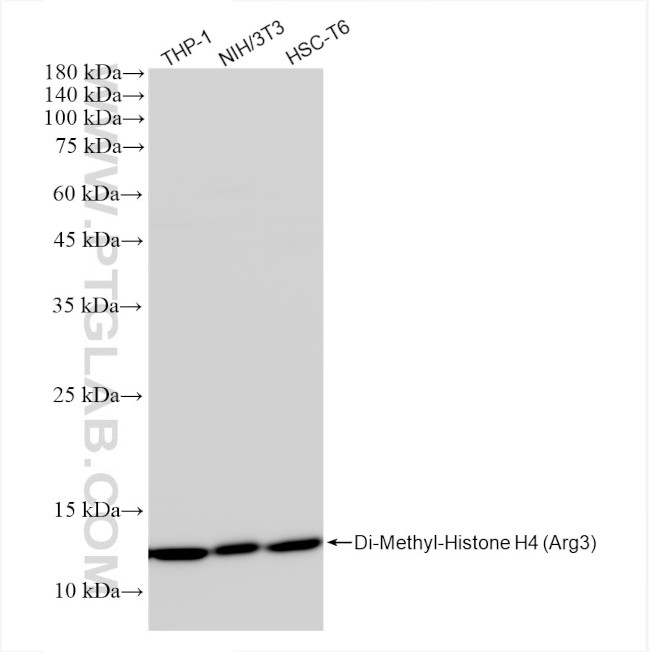


产品信息
82859-1-RR
应用
建议稀释比
已发表文章
产品规格
种属反应
Human,
Mouse,
Rat
宿主/亚型
Rabbit
/ IgG
Expression System
HEK293F
分类
Recombinant Monoclonal
类型
Antibody
克隆号
1E21
抗原
Peptide
偶联物
形式
Liquid
浓度
0.8 mg/mL
纯化类型
Protein A
保存液
PBS, pH 7.3, with 50% glycerol
内含物
0.02% sodium azide
保存条件
-20°C
运输条件
Wet ice
靶标信息
H4R3me2a/s refers to the dimethylation of arginine residue at position 3 on histone H4, specifically generating two forms: asymmetrical dimethylarginine (H4R3me2a) and symmetrical dimethylarginine (H4R3me2s). These modifications are crucial in the regulation of gene expression through epigenetic mechanisms, affecting chromatin structure and function. Recent studies suggest that H4R3me2a is linked to transcriptional activation, whereas H4R3me2s is often associated with transcriptional repression. These modifications are brought about by the activity of specific histone methyltransferases, such as PRMT1 for asymmetrical and PRMT5 for symmetrical dimethylation. The balance and dynamics of these modifications are essential for various cellular processes and can influence developmental pathways and disease pathogenesis, including cancer and metabolic disorders.
仅用于科研。不用于诊断过程。未经明确授权不得转售。
篇参考文献 (0)
您是否在文献中引用过该产品?请点击下方按钮邮件告知我们。
生物信息学
蛋白别名: H4 histone family, member A; H4 histone family, member B; H4 histone family, member C; H4 histone family, member D; H4 histone family, member E; H4 histone family, member G; H4 histone family, member H; H4 histone family, member I; H4 histone family, member J; H4 histone family, member K; H4 histone family, member M; H4 histone family, member N; H4 histone, family 2; histone 1, H4a; histone 1, H4b; histone 1, H4c; histone 1, H4d; histone 1, H4e; histone 1, H4f; histone 1, H4h; histone 1, H4i; histone 1, H4j; histone 1, H4k; histone 1, H4l; histone 2, H4; histone 2, H4a; histone 2, H4b; Histone 4 family, member M; histone family member; Histone H4; histone IV, family 2
基因别名: dJ160A22.1; dJ160A22.2; dJ221C16.1; dJ221C16.9; FO108; H4; H4-12; H4-16; H4-53; H4.k; H4/A; H4/B; H4/C; H4/D; H4/E; H4/G; H4/H; H4/I; H4/J; H4/K; H4/M; H4/N; H4/O; H4C1; H4C11; H4C12; H4C13; H4C14; H4C15; H4C16; H4C2; H4C3; H4C4; H4C5; H4C6; H4C8; H4C9; H4f16; H4F2; H4F2iii; H4F2iv; H4FA; H4FB; H4FC; H4FD; H4FE; H4FG; H4FH; H4FI; H4FJ; H4FK; H4FM; H4FN; H4FO; H4M; HIST1H4A; HIST1H4B; HIST1H4C; HIST1H4D; HIST1H4E; HIST1H4F; HIST1H4H; HIST1H4I; HIST1H4J; HIST1H4K; HIST1H4L; Hist1h4m; HIST2H4; HIST2H4A; HIST2H4B; HIST4H4; X04652
UniProt ID: (Human) P62805, (Mouse) P62806, (Mouse) A4QMY0
chromatin silencing at rDNA
double-strand break repair via nonhomologous end joining
nucleosome assembly
DNA replication-dependent nucleosome assembly
DNA replication-independent nucleosome assembly
DNA-templated transcription, initiation
telomere capping
gene silencing by RNA
telomere organization
CENP-A containing nucleosome assembly
cellular protein metabolic process
negative regulation of megakaryocyte differentiation
negative regulation of gene expression, epigenetic
positive regulation of gene expression, epigenetic
protein heterotetramerization
beta-catenin-TCF complex assembly

