Search
Invitrogen
DnaJ Polyclonal Antibody
{{$productOrderCtrl.translations['antibody.pdp.commerceCard.promotion.promotions']}}
{{$productOrderCtrl.translations['antibody.pdp.commerceCard.promotion.promocode']}}: {{promo.promoCode}} {{promo.promoTitle}} {{promo.promoDescription}}. {{$productOrderCtrl.translations['antibody.pdp.commerceCard.promotion.learnmore']}}
{{$ctrl.translations['antibody.pdp.skuNotes.additionalInformation']}}:
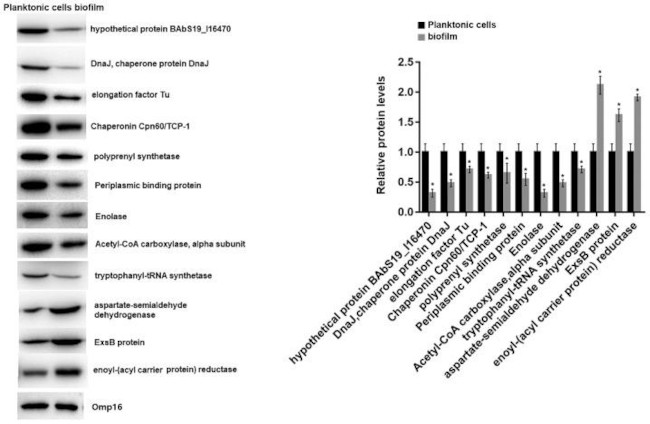
图: 1 / 1
DnaJ Antibody (PA3-018) in WB
Molecular medicine reports 2020 -
Figure 5. Analysis of differential protein expression in Brucella abortus cultured under planktonic or biofilm conditions. Western blot analysis of 12 proteins showed that 9 proteins were downregulated and 3 were upregulated between biofilms and planktonic cells. Omp16, outer membrane protein 16. *P<0.05 vs. control (planktonic cells).
Please note: We are reviewing Western blot images included in the antibody testing data in our catalog, including those provided by third parties. Unless expressly labeled or annotated as “raw-unedited”, Western blot images included in the antibody testing data in our catalog may have been edited, optimized or otherwise adjusted for presentation.

产品信息
PA3-018
产品规格
种属反应
Bacteria
已发表种属
Bacteria
宿主/亚型
Mouse
/ IgG
分类
Polyclonal
类型
Antibody
抗原
Synthetic peptide corresponding to residues S(13) K T A E E R E I R K A Y K(27) of E. coli DnaJ.
偶联物
Unconjugated
Unconjugated
Unconjugated
形式
Liquid
浓度
Conc. Not Determined
保存液
ascites, PBS
内含物
0.05% sodium azide
保存条件
-20°C, Avoid Freeze/Thaw Cycles
运输条件
Ambient (domestic); Wet ice (international)
RRID
产品详细信息
PA3-018 detects DnaJ from bacteria.
PA3-018 has been successfully used in Western blot procedures. By Western blot, this antibody detects a single ~40 kDa band representing DnaJ from E. coli extract.
The PA3-018 immunogen is a synthetic peptide corresponding to residues S(13) K T A E E R E I R K A Y K(27) of E. coli DnaJ.
靶标信息
In prokaryotes, the heat shock response is characterized by the induction of several proteins including DnaJ, DnaK, GroEL and GroES. DnaK is a member of the HSP70 family, and like other members, exhibits ATPase activity which facilitates the release of bound proteins and disaggregation of protein complexes within the cell. Members of this protein group serve as molecular chaperones. Levels of DnaJ and DnaK are closely linked and, in E. coli, are constituents of a single operon. DnaJ regulates DnaK in several different systems. Relative to DnaK, the level of DnaJ synthesis is quite low. Studies have shown that DnaJ and DnaK, together with GrpE, cooperatively interact with firefly luciferase as it unfolds during thermal denaturation allowing renaturation of the protein upon return to normal temperatures. Also, DnaK together with DnaJ stimulates the binding of RepA initiator protein to the origin of P1 phage in vitro.
仅用于科研。不用于诊断过程。未经明确授权不得转售。
生物信息学
蛋白别名: CPR3; DNAJA2; DNJ3; Escherichia coli; HDJ-2
Disclaimer

Clicking the images or links will redirect you to a website hosted by BenchSci that provides third-party scientific content. Neither the content nor the BenchSci technology and processes for selection have been evaluated by us; we are providing them as-is and without warranty of any kind, including for use or application of the Thermo Fisher Scientific products presented.

