Search
Abnova
EIF4EBP2 Monoclonal Antibody (2G8)
{{$productOrderCtrl.translations['antibody.pdp.commerceCard.promotion.promotions']}}
{{$productOrderCtrl.translations['antibody.pdp.commerceCard.promotion.promocode']}}: {{promo.promoCode}} {{promo.promoTitle}} {{promo.promoDescription}}. {{$productOrderCtrl.translations['antibody.pdp.commerceCard.promotion.learnmore']}}
产品信息
H00001979-M04
产品规格
种属反应
Human
宿主/亚型
Mouse
/ IgG2a, kappa
分类
Monoclonal
类型
Antibody
克隆号
2G8
抗原
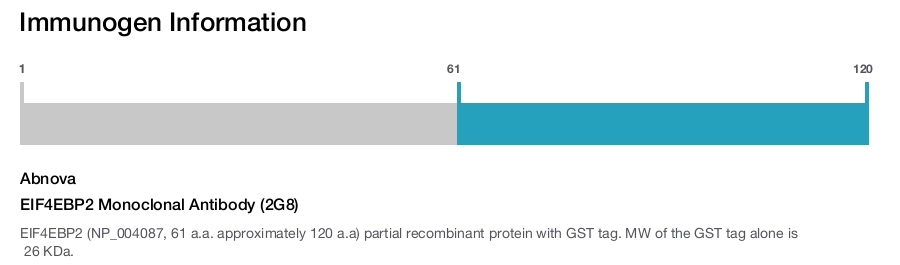
EIF4EBP2 (NP_004087, 61 a.a. approximately 120 a.a) partial recombinant protein with GST tag. MW of the GST tag alone is 26 KDa.
偶联物
Unconjugated
Unconjugated
Unconjugated
形式
Liquid
浓度
See Label
规格
100 µg
纯化类型
Affinity chromatography
保存液
PBS, pH 7.4
内含物
no preservative
保存条件
-20°C, Avoid Freeze/Thaw Cycles
运输条件
Ambient (domestic); Wet ice (international)
产品详细信息
Sequence of this protein is as follows: DRRNSPMAQT PPCHLPNIPG VTSPGTLIED SKVEVNNLNN LNNHDRKHAV GDDAQFEMDI
靶标信息
PHAS-II (eIF4E-binding protein II) is involved in translation initiation. PHAS-II is highest in liver and kidney. PHAS proteins bind to eIF-4E, the mRNA cap-binding protein, and inhibit translation of capped mRNA in vitro and in cells. Phosphorylation in the appropriate site(s) promotes dissociation of PHAS/eIF-4E complexes. This allows eIF-4E to bind to eIF-4G (p220), thereby increasing the amount of the eIF-4F complex and the rate of translation initiation. Pharmacological and genetic evidence indicates that the mTOR/p70S6K pathway is involved in the control of PHAS-I and -II. Thus, PHAS proteins may be mediators of the effects of this pathway on protein synthesis and cell proliferation.
仅用于科研。不用于诊断过程。未经明确授权不得转售。
篇参考文献 (0)
您是否在文献中引用过该产品?请点击下方按钮邮件告知我们。
生物信息学
蛋白别名: eIF4E-binding protein 2; EIF4EBP2; phosphorylated, heat and acid stable regulated by insulin protein II; unnamed protein product
基因别名: 4EBP2; PHASII
UniProt ID: (Human) Q13542
Entrez Gene ID: (Human) 1979
Disclaimer

Clicking the images or links will redirect you to a website hosted by BenchSci that provides third-party scientific content. Neither the content nor the BenchSci technology and processes for selection have been evaluated by us; we are providing them as-is and without warranty of any kind, including for use or application of the Thermo Fisher Scientific products presented.

