Search
Proteintech
EPHA8 Polyclonal Antibody
{{$productOrderCtrl.translations['antibody.pdp.commerceCard.promotion.promotions']}}
{{$productOrderCtrl.translations['antibody.pdp.commerceCard.promotion.viewpromo']}}
{{$productOrderCtrl.translations['antibody.pdp.commerceCard.promotion.promocode']}}: {{promo.promoCode}} {{promo.promoTitle}} {{promo.promoDescription}}. {{$productOrderCtrl.translations['antibody.pdp.commerceCard.promotion.learnmore']}}
Additional Information:
{{banner.description}}
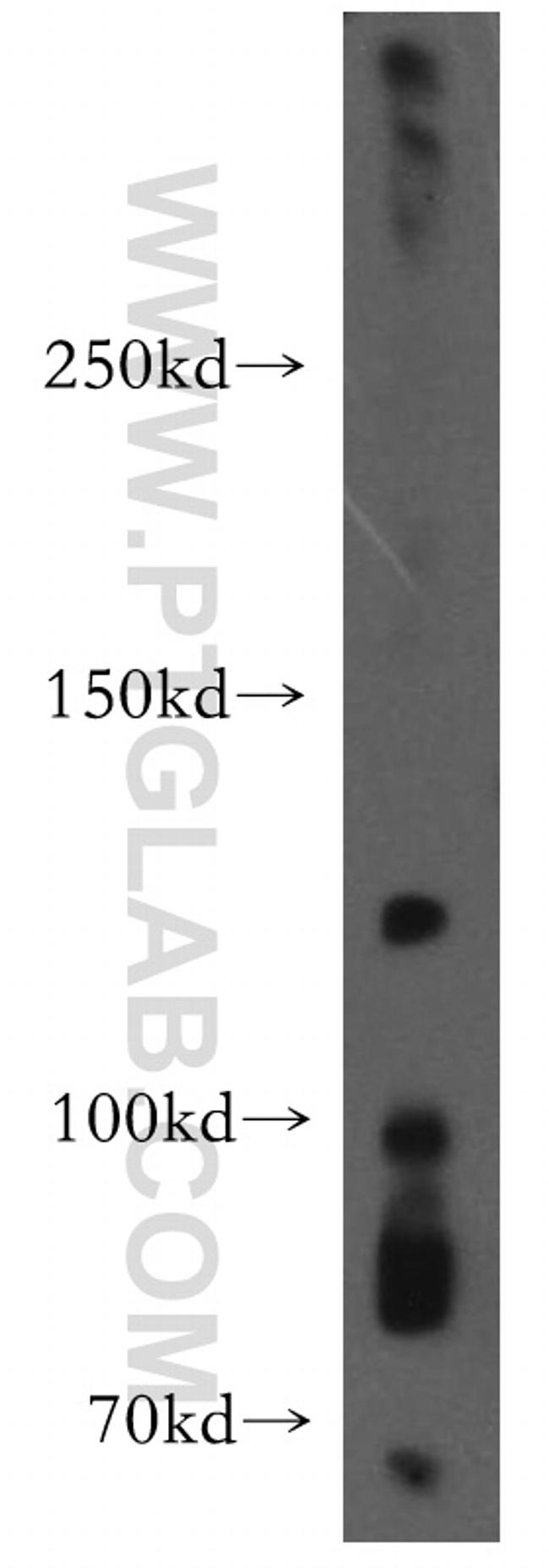


产品信息
13724-1-AP
应用
建议稀释比
已发表文章
产品规格
种属反应
Human,
Mouse,
Rat
宿主/亚型
Rabbit
/ IgG
分类
Polyclonal
类型
Antibody
抗原
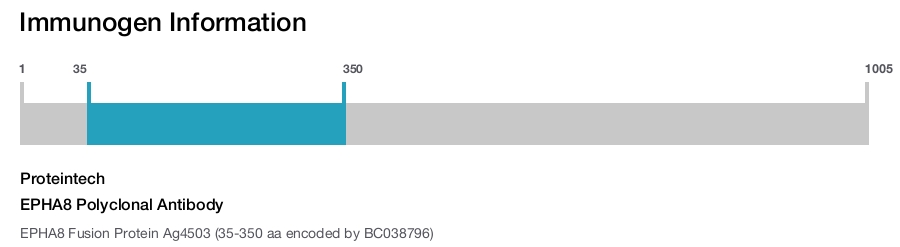
EPHA8 Fusion Protein Ag4503 (35-350 aa encoded by BC038796)
偶联物
形式
Liquid
浓度
0.13 mg/mL
规格
19.5 µg
纯化类型
Antigen affinity chromatography
保存液
PBS, pH 7.3, with 50% glycerol
内含物
0.02% sodium azide
保存条件
-20°C
运输条件
Wet ice (domestic); Dry ice (international)
产品详细信息
Immunogen sequence: LDTSTIHGD WGWLTYPAHG WDSINEVDES FQPIHTYQVC NVMSPNQNNW LRTSWVPRDG ARRVYAEIKF TLRDCNSMPG VLGTCKETFN LYYLESDRDL GASTQESQFL KIDTIAADES FTGADLGVRR LKLNTEVRSV GPLSKRGFYL AFQDIGACLA ILSLRIYYKK CPAMVRNLAA FSEAVTGADS SSLVEVRGQC VRHSEERDTP KMYCSAEGEW LVPIGKCVCS AGYEERRDAC VACELGFYKS APGDQLCARC PPHSHSAAPA AQACHCDLSY YRAALDPPSS ACTRPPSAPV NLISSVNGTS VTLEWAP (35-350 aa encoded by BC038796)
靶标信息
EPHA8 belongs to the ephrin receptor subfamily of the protein-tyrosine kinase family. EPH and EPH-related receptors have been implicated in mediating developmental events, particularly in the nervous system. EPHA8 plays a role in short-range contact-mediated axonal guidance during development of the mammalian nervous system. Receptors in the EPH subfamily typically have a single kinase domain and an extracellular region containing a Cys-rich domain and 2 fibronectin type III repeats. The ephrin receptors are divided into 2 groups based on the similarity of their extracellular domain sequences and their affinities for binding ephrin-A and ephrin-B ligands.
仅用于科研。不用于诊断过程。未经明确授权不得转售。
生物信息学
蛋白别名: EK3; epa8; EPH- and ELK-related kinase; EPH- and ELK-related tyrosine kinase; EPH-like kinase 3; Ephrin type-A receptor 8; Ephrin type-A receptor 8 precursor (Tyrosine-protein kinase receptor EEK) (EPH-and ELK-related kinase); hydroxyaryl-protein kinase; protein-tyrosine kinase; Tyrosine-protein kinase receptor EEK; tyrosylprotein kinase
基因别名: AW047546; EEK; EK3; EPHA8; HEK3; KIAA1459; mKIAA1459
UniProt ID: (Human) P29322, (Mouse) O09127
Entrez Gene ID: (Human) 2046, (Rat) 60589, (Mouse) 13842
nucleotide binding
protein kinase activity
protein tyrosine kinase activity
transmembrane receptor protein tyrosine kinase activity
ephrin receptor activity
GPI-linked ephrin receptor activity
transmembrane-ephrin receptor activity
ATP binding
kinase activity
transferase activity
growth factor binding
protein binding
transferase activity, transferring phosphorus-containing groups
transmembrane signal receptor
substrate-dependent cell migration
cell adhesion
transmembrane receptor protein tyrosine kinase signaling pathway
nervous system development
axon guidance
neuron remodeling
regulation of cell adhesion
neuron projection development
regulation of cell adhesion mediated by integrin
positive regulation of MAPK cascade
ephrin receptor signaling pathway
positive regulation of protein kinase B signaling
cellular response to follicle-stimulating hormone stimulus
peptidyl-tyrosine phosphorylation
positive regulation of phosphatidylinositol 3-kinase activity
protein autophosphorylation
protein phosphorylation
multicellular organism development
phosphorylation
Disclaimer

Clicking the images or links will redirect you to a website hosted by BenchSci that provides third-party scientific content. Neither the content nor the BenchSci technology and processes for selection have been evaluated by us; we are providing them as-is and without warranty of any kind, including for use or application of the Thermo Fisher Scientific products presented.

