Search
Alomone Labs, LTD
Ephrin-A2 (extracellular) Polyclonal Antibody
{{$productOrderCtrl.translations['antibody.pdp.commerceCard.promotion.promotions']}}
{{$productOrderCtrl.translations['antibody.pdp.commerceCard.promotion.promocode']}}: {{promo.promoCode}} {{promo.promoTitle}} {{promo.promoDescription}}. {{$productOrderCtrl.translations['antibody.pdp.commerceCard.promotion.learnmore']}}
{{$ctrl.translations['antibody.pdp.skuNotes.additionalInformation']}}:
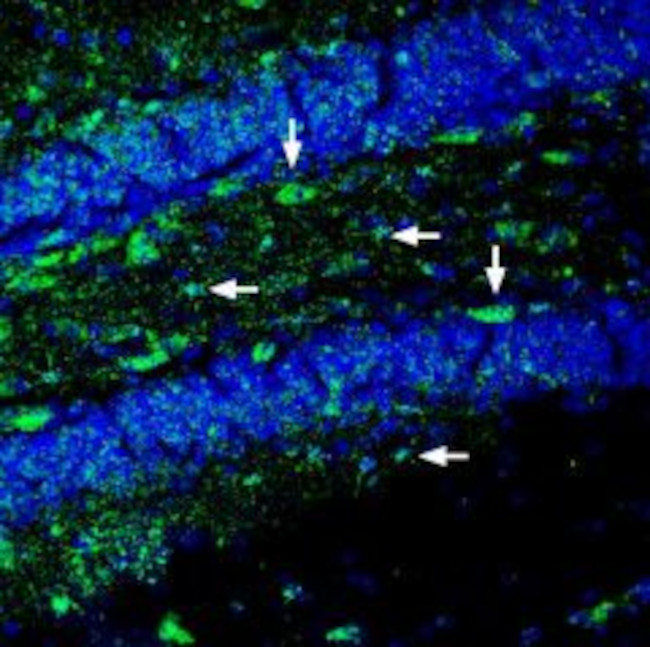
图: 1 / 3
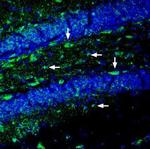
Ephrin-A2 (extracellular) Antibody (AER-032-200UL) in IHC (F)
Expression of Ephrin-A2 in mouse hippocampus - Immunohistochemical staining of perfusion-fixed frozen mouse brain sections with Anti-Ephrin-A2 (extracellular) Antibody (#AER-032), (1:200), followed by goat- Anti-rabbit-AlexaFluor-488. Ephrin-A2 staining (green) in hippocampal dentate gyrus appears in neurons (vertical arrows) and astrocytes (horizontal arrows). Cell nuclei are stained with DAPI (blue).
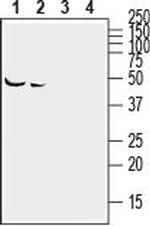
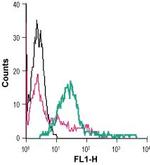
Please note: We are reviewing Western blot images included in the antibody testing data in our catalog, including those provided by third parties. Unless expressly labeled or annotated as “raw-unedited”, Western blot images included in the antibody testing data in our catalog may have been edited, optimized or otherwise adjusted for presentation.


产品信息
AER-032-200UL
产品规格
种属反应
Human,
Mouse,
Rat
宿主/亚型
Rabbit
/ IgG
分类
Polyclonal
类型
Antibody
抗原
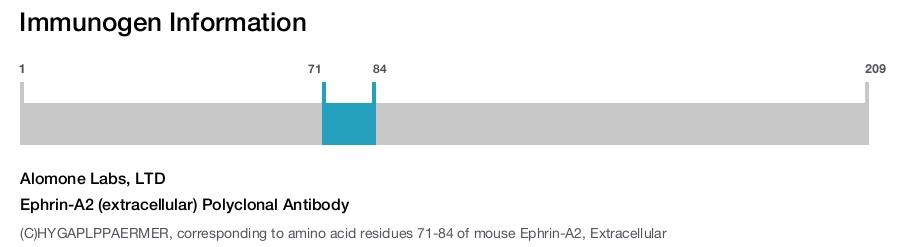
(C)HYGAPLPPAERMER, corresponding to amino acid residues 71-84 of mouse Ephrin-A2, Extracellular
偶联物
Unconjugated
Unconjugated
Unconjugated
形式
Lyophilized
浓度
0.8 mg/mL once reconstituted
规格
160 µg
纯化类型
Antigen affinity chromatography
保存液
PBS, pH 7.4, with 1% BSA
内含物
0.05% sodium azide
保存条件
-20°C, Avoid Freeze/Thaw Cycles
运输条件
Ambient (domestic); Wet ice (international)
产品详细信息
Reconstitution: 25 µL, 50 µL or 0.2 mL double distilled water (DDW), depending on the sample size. The antibody ships as a lyophilized powder at room temperature. Upon arrival, it should be stored at -20C. The reconstituted solution can be stored at 4C for up to 1 week. For longer periods, small aliquots should be stored at -20C. Avoid multiple freezing and thawing. Centrifuge all antibody preparations before use (10000 x g 5 min).
靶标信息
The Eph subfamily represents the largest group of receptor protein tyrosine kinases identified to date. While the biological activities of these receptors have yet to be determined, there is increasing evidence that they are involved in central nervous system function and in development. The Eph subfamily receptors of human origin (and their murine/avian homologs) include EphA1(Eph), EphA2 (Eck), EphA3 (Hek4), EphA4 (Hek8), EphA5 (Hek7), EphA6 (Hek12), EphA7 (Hek11/MDK1), EphA8 (Hek3), EphB1 (Hek6), EphB2 (Hek5), EphB3(Cek10, Hek2), EphB4 (Htk), EphB5 (Hek9) and EphB6 (Mep). Ligands for Eph receptors include ephrin-A4 (LERK-4) which binds EphA3 and EphB1. In addition, Ephrin-A2 (Elf-1) has been described as the ligand for EphA4, ephrin-A3 (Ehk1-L) as the ligand for EphA5 and ephrin-B2 (Htk-L) as the ligand for EphB4 (Htk).
仅用于科研。不用于诊断过程。未经明确授权不得转售。
篇参考文献 (0)
您是否在文献中引用过该产品?请点击下方按钮邮件告知我们。
生物信息学
蛋白别名: CEK7-ligand; EPH related receptor tyrosine kinase ligand 6; eph-related receptor tyrosine kinase ligand 6; ephrin A-2; ephrin A6; EphrinA2; HEK7 ligand; unnamed protein product
基因别名: CEK7L; ELF-1; Elf1; Epl6; EPLG6; HEK7-L; LERK-6; LERK6
UniProt ID: (Human) O43921, (Mouse) P52801
Entrez Gene ID: (Human) 1943, (Rat) 84358, (Mouse) 13637
Disclaimer

Clicking the images or links will redirect you to a website hosted by BenchSci that provides third-party scientific content. Neither the content nor the BenchSci technology and processes for selection have been evaluated by us; we are providing them as-is and without warranty of any kind, including for use or application of the Thermo Fisher Scientific products presented.

