Search
Proteintech
GCS1 Polyclonal Antibody
{{$productOrderCtrl.translations['antibody.pdp.commerceCard.promotion.promotions']}}
{{$productOrderCtrl.translations['antibody.pdp.commerceCard.promotion.promocode']}}: {{promo.promoCode}} {{promo.promoTitle}} {{promo.promoDescription}}. {{$productOrderCtrl.translations['antibody.pdp.commerceCard.promotion.learnmore']}}
{{$ctrl.translations['antibody.pdp.skuNotes.additionalInformation']}}:
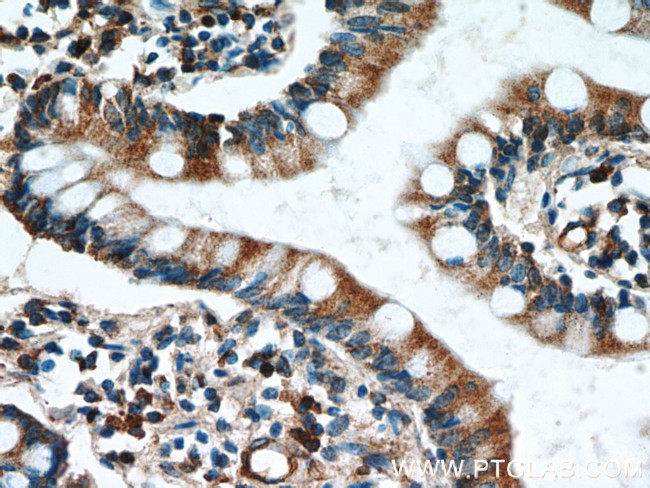
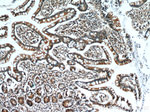
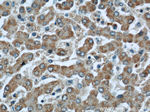
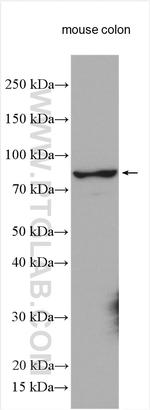
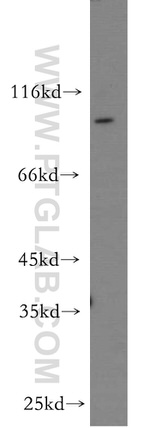
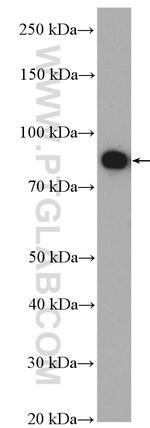
Please note: We are reviewing Western blot images included in the antibody testing data in our catalog, including those provided by third parties. Unless expressly labeled or annotated as “raw-unedited”, Western blot images included in the antibody testing data in our catalog may have been edited, optimized or otherwise adjusted for presentation.


产品信息
17859-1-AP
应用
建议稀释比
已发表文章
产品规格
种属反应
Human,
Mouse
宿主/亚型
Rabbit
/ IgG
分类
Polyclonal
类型
Antibody
抗原
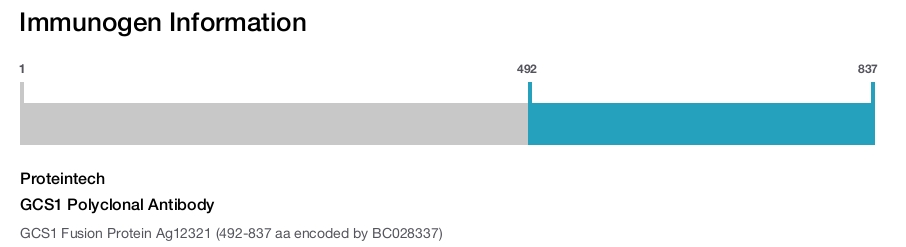
GCS1 Fusion Protein Ag12321 (492-837 aa encoded by BC028337)
偶联物
Unconjugated
Unconjugated
Unconjugated
形式
Liquid
浓度
0.13 mg/mL
规格
19.5 µg
纯化类型
Antigen affinity chromatography
保存液
PBS, pH 7.3, with 50% glycerol
内含物
0.02% sodium azide
保存条件
-20°C
运输条件
Wet ice (domestic); Dry ice (international)
产品详细信息
Immunogen sequence: DEARARVPP EFLVQRAVHA NPPTLLLPVA HMLEVGDPDD LAFLRKALPR LHAWFSWLHQ SQAGPLPLSY RWRGRDPALP TLLNPKTLPS GLDDYPRASH PSVTERHLDL RCWVALGARV LTRLAEHLGE AEVAAELGPL AASLEAAESL DELHWAPELG VFADFGNHTK AVQLKPRPPQ GLVRVVGRPQ PQLQYVDALG YVSLFPLLLR LLDPTSSRLG PLLDILADSR HLWSPFGLRS LAASSSFYGQ RNSEHDPPYW RGAVWLNVNY LALGALHHYG HLEGPHQARA AKLHGELRAN VVGNVWRQYQ ATGFLWEQYS DRDGRGMGCR PFHGWTSLVL LAMAEDY (492-837 aa encoded by BC028337 )
靶标信息
GCS1 cleaves the distal alpha 1,2-linked glucose residue from the Glc(3)Man(9)GlcNAc(2) oligosaccharide precursor in a highly specific manner. Defects in GCS1 are the cause of type IIb congenital disorder of glycosylation (CDGIIb). This syndrome is also known as glucosidase I deficiency and is characterized by marked generalized hypotonia and hypomotility of the neonate, dysmorphic features, including a prominent occiput, short palpebral fissures, retrognathia, high arched palate, generalized edema, and hypoplastic genitalia. Symptoms include hepatomegaly, hypoventilation, feeding problems and seizures. The clinical course is progressive and survival is at most a few months.
仅用于科研。不用于诊断过程。未经明确授权不得转售。
生物信息学
蛋白别名: endoplasmic reticulum alpha-glucosidase I; epididymis secretory sperm binding protein; ER glu I; glucosidase 1; glucosidase I; glycoprotein-processing glucosidase I; processing A-glucosidase I; unnamed protein product
基因别名: 1810017N02Rik; CDG2B; CWH41; DER7; GCS1
UniProt ID: (Human) Q13724, (Mouse) Q80UM7
Entrez Gene ID: (Human) 7841, (Mouse) 57377
Disclaimer

Clicking the images or links will redirect you to a website hosted by BenchSci that provides third-party scientific content. Neither the content nor the BenchSci technology and processes for selection have been evaluated by us; we are providing them as-is and without warranty of any kind, including for use or application of the Thermo Fisher Scientific products presented.

