Search
Proteintech
GDF15 Polyclonal Antibody
{{$productOrderCtrl.translations['antibody.pdp.commerceCard.promotion.promotions']}}
{{$productOrderCtrl.translations['antibody.pdp.commerceCard.promotion.viewpromo']}}
{{$productOrderCtrl.translations['antibody.pdp.commerceCard.promotion.promocode']}}: {{promo.promoCode}} {{promo.promoTitle}} {{promo.promoDescription}}. {{$productOrderCtrl.translations['antibody.pdp.commerceCard.promotion.learnmore']}}
Additional Information:
{{banner.description}}
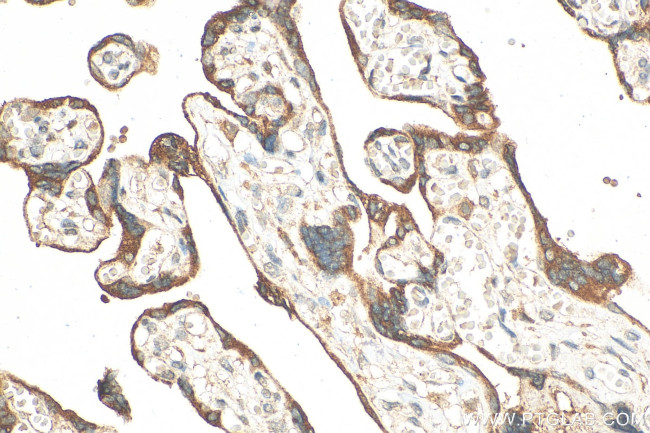
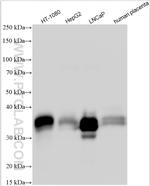


产品信息
27845-1-AP
应用
建议稀释比
已发表文章
产品规格
种属反应
Human
宿主/亚型
Rabbit
/ IgG
分类
Polyclonal
类型
Antibody
抗原
GDF-15 fusion protein Ag24090
偶联物
形式
Liquid
浓度
1.3 mg/mL
规格
195 µg
纯化类型
Antigen affinity chromatography
保存液
PBS, pH 7.3, with 50% glycerol
内含物
0.02% sodium azide
保存条件
-20°C
运输条件
Wet ice
产品详细信息
Immunogen sequence: MPGQELRTVN GSQMLLVLLV LSWLPHGGAL SLAEASRASF PGPSELHSED SRFRELRKRY EDLLTRLRAN QSWEDSNTDL VPAPAVRILT PEVRLGSGGH LHLRISRAAL PEGLPEASRL HRALFRLSPT ASRSWDVTRP LRRQLSLARP QAPALHLRLS PPPSQSDQLL AESSSARPQL ELHLRPQAAR GRRRARARNG DHCPLGPGRC CRLHTVRASL EDLGWADWVL SPREVQVTMC IGACPSQFRA ANMHAQIKTS LHRLKPDTVP APCCVPASYN PMVLIQKTDT GVSLQTYDDL LAKDCHCI
靶标信息
GDF-15 belongs to the TGF-beta cytokine family, whose members play an important role during prenatal development and postnatal growth, and the remodeling and maintenance of a variety of tissues and organs. GDF-15 is expressed predominantly in the placenta and, to a much lesser extent, in various other tissues. The presence of GDF-15 in amniotic fluid and its elevated levels in the sera of pregnant women suggest GDF-15's involvement in gestation and embryonic development. GDF-15 generally exerts tumor suppressive activities and is one of the predominant factors produced and secreted in response to activation of the p53 pathway. Interestingly, the serum level of GDF-15 is positively correlated with neoplastic progression of several tumor types, including certain colorectal, pancreatic, and prostate cancers.
仅用于科研。不用于诊断过程。未经明确授权不得转售。
篇参考文献 (0)
您是否在文献中引用过该产品?请点击下方按钮邮件告知我们。
生物信息学
蛋白别名: GDF-15; Growth/differentiation factor 15; Macrophage inhibitory cytokine 1; MIC-1; NAG-1; NAG1; non-steroidal anti-inflammatory drug-activated gene-1; NRG-1; NSAID (nonsteroidal anti-inflammatory drug)-activated protein 1; NSAID-activated gene 1 protein; NSAID-regulated gene 1 protein; PDF; Placental bone morphogenetic protein; Placental TGF-beta; Prostate differentiation factor; PTGF-beta; TGF-b superfamily cytokine; unnamed protein product
基因别名: GDF-15; GDF15; HG; MIC-1; MIC1; NAG-1; PDF; PLAB; PTGFB
UniProt ID: (Human) Q99988
Entrez Gene ID: (Human) 9518
reduction of food intake in response to dietary excess
negative regulation of leukocyte migration
signal transduction
transmembrane receptor protein serine/threonine kinase signaling pathway
transforming growth factor beta receptor signaling pathway
cell-cell signaling
negative regulation of transforming growth factor beta receptor signaling pathway
negative regulation of appetite
negative regulation of multicellular organism growth
positive regulation of MAPK cascade
positive regulation of fatty acid oxidation
positive regulation of protein kinase B signaling
negative regulation of SMAD protein import into nucleus
negative regulation of growth hormone receptor signaling pathway
cellular response to chemical stress
energy homeostasis
GDF15-GFRAL signaling pathway
response to metformin
positive regulation of myoblast fusion
Disclaimer

Clicking the images or links will redirect you to a website hosted by BenchSci that provides third-party scientific content. Neither the content nor the BenchSci technology and processes for selection have been evaluated by us; we are providing them as-is and without warranty of any kind, including for use or application of the Thermo Fisher Scientific products presented.

