Search
Invitrogen
GHSR Polyclonal Antibody
{{$productOrderCtrl.translations['antibody.pdp.commerceCard.promotion.promotions']}}
{{$productOrderCtrl.translations['antibody.pdp.commerceCard.promotion.promocode']}}: {{promo.promoCode}} {{promo.promoTitle}} {{promo.promoDescription}}. {{$productOrderCtrl.translations['antibody.pdp.commerceCard.promotion.learnmore']}}
{{$ctrl.translations['antibody.pdp.skuNotes.additionalInformation']}}:
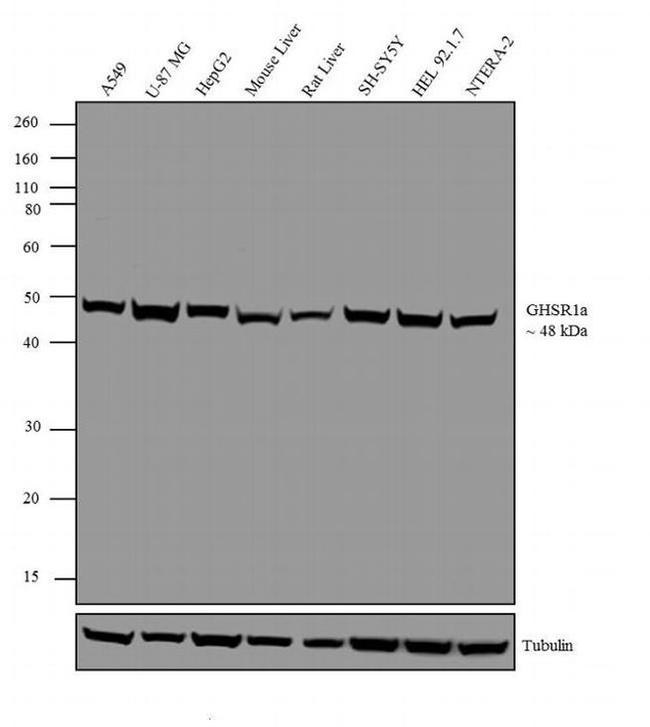
图: 1 / 4
GHSR Antibody (720278) in WB
Western blot analysis was performed on tissue and membrane enriched cell extracts (30 µg lysate) of A549 (Lane 1), U-87 MG (Lane 2), Hep G2 (Lane 3), Mouse liver (Lane 4), Rat liver (Lane 5), SH-SY5Y (Lane 6), HEL 92.1.7 (Lane 7) and NTERA-2 (Lane 8). The blots were probed with Growth hormone secretagogue receptor 1a/GHSR1a Rabbit Polyclonal antibody (Product # 720278, 1-2 µg/mL) and detected by chemiluminescence using Goat anti-Rabbit IgG (Heavy Chain) Superclonal™ Secondary Antibody, HRP conjugate (Product # A27036, 0.4 µg/mL, 1:2500 dil... View More
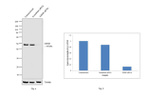
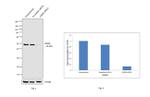
Please note: We are reviewing Western blot images included in the antibody testing data in our catalog, including those provided by third parties. Unless expressly labeled or annotated as “raw-unedited”, Western blot images included in the antibody testing data in our catalog may have been edited, optimized or otherwise adjusted for presentation.


产品信息
720278
应用
建议稀释比
已发表文章
产品规格
种属反应
Human,
Mouse,
Rat
宿主/亚型
Rabbit
/ IgG
分类
Polyclonal
类型
Antibody
抗原
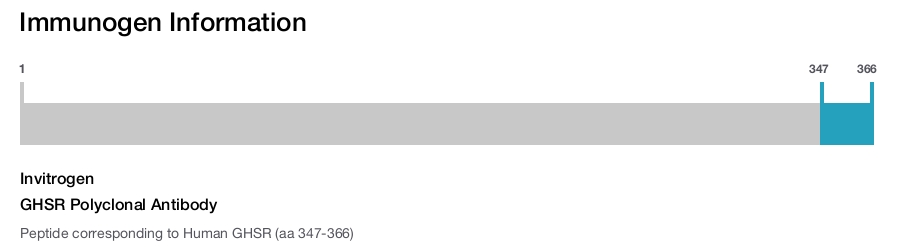
Peptide corresponding to Human GHSR (aa 347-366)
偶联物
Unconjugated
Unconjugated
Unconjugated
形式
Liquid
浓度
0.5 mg/mL
规格
100 µg
纯化类型
Affinity chromatography
保存液
PBS, pH 7.2-7.4, with 30% glycerol, 0.1% BSA
内含物
0.09% sodium azide
保存条件
Store at 4°C short term. For long term storage, store at -20°C, avoiding freeze/thaw cycles.
运输条件
Ambient (domestic); Wet ice (international)
RRID
产品详细信息
These Polyclonal antibodies are of rabbit origin developed by immunizing animals with proteins or peptides. The polyclonal antibody is purified by affinity purification from the rabbit sera generated after immunizing the rabbits with a specific type of protein or peptide. The purified antibody is tested for its functionality in various relevant research applications. The antibody is developed for Research Use Only and is non-hazardous or non-infectious in nature.
This antibody is predicted to react with Monkey, Cat, Rat and Bovine.
靶标信息
Growth hormone secretagogue receptor 1a (GHSR) is a member of the G-protein coupled receptor family. GHSR may play a role in energy homeostasis and regulation of body weight. Two identified transcript variants are expressed in several tissues and are evolutionary conserved in fish and swine. One transcript, 1a, excises an intron and encodes the functional protein; this protein is the receptor for the Ghrelin ligand and defines a neuroendocrine pathway for growth hormone release. The second transcript (1b) retains the intron and does not function as a receptor for Ghrelin; however, it may function to attenuate activity of isoform 1a. Mutations to the gene can cause isolated partial growth hormone deficiency.
仅用于科研。不用于诊断过程。未经明确授权不得转售。
生物信息学
蛋白别名: G-protein coupled receptor; GH-releasing peptide receptor; ghrelin receptor; GHRP; Ghrp receptor; GHS receptor; GHS-R; unnamed protein product
基因别名: C530020I22Rik; GHDP; GHRP; GHS-R; GHS-R1a; GHSR-1a; Ghsr1a
UniProt ID: (Human) Q92847, (Mouse) Q99P50, (Rat) O08725
Entrez Gene ID: (Human) 2693, (Mouse) 208188, (Rat) 84022
G-protein coupled receptor signaling pathway
phospholipase C-activating G-protein coupled receptor signaling pathway
spermatogenesis
female pregnancy
learning or memory
learning
memory
actin polymerization or depolymerization
adult feeding behavior
response to hormone
hormone-mediated signaling pathway
negative regulation of norepinephrine secretion
peptide hormone secretion
growth hormone secretion
negative regulation of appetite
positive regulation of appetite
response to follicle-stimulating hormone
response to estradiol
negative regulation of interleukin-1 beta production
negative regulation of interleukin-6 production
negative regulation of tumor necrosis factor production
cellular response to hormone stimulus
ghrelin secretion
positive regulation of multicellular organism growth
regulation of hindgut contraction
positive regulation of fatty acid metabolic process
positive regulation of growth
decidualization
regulation of synaptic plasticity
negative regulation of inflammatory response
regulation of transmission of nerve impulse
regulation of growth hormone secretion
regulation of feeding behavior
response to growth hormone
cellular response to lipopolysaccharide
response to dexamethasone
negative regulation of locomotion involved in locomotory behavior
cellular response to thyroid hormone stimulus
regulation of neurotransmitter receptor localization to postsynaptic specialization membrane
postsynaptic modulation of chemical synaptic transmission
regulation of postsynapse organization
positive regulation of small intestinal transit
response to L-glutamate
positive regulation of sprouting angiogenesis
positive regulation of eating behavior
positive regulation of small intestine smooth muscle contraction
regulation of gastric motility
positive regulation of vascular endothelial cell proliferation
cellular response to insulin-like growth factor stimulus
negative regulation of macrophage apoptotic process
regulation of defecation
G-protein coupled receptor internalization
response to food
regulation of response to food
regulation of appetite
cellular response to insulin stimulus
positive regulation of insulin-like growth factor receptor signaling pathway
negative regulation of insulin secretion
regulation of synapse assembly
Disclaimer

Clicking the images or links will redirect you to a website hosted by BenchSci that provides third-party scientific content. Neither the content nor the BenchSci technology and processes for selection have been evaluated by us; we are providing them as-is and without warranty of any kind, including for use or application of the Thermo Fisher Scientific products presented.

