Search
Invitrogen
GPR182 Polyclonal Antibody
{{$productOrderCtrl.translations['antibody.pdp.commerceCard.promotion.promotions']}}
{{$productOrderCtrl.translations['antibody.pdp.commerceCard.promotion.viewpromo']}}
{{$productOrderCtrl.translations['antibody.pdp.commerceCard.promotion.promocode']}}: {{promo.promoCode}} {{promo.promoTitle}} {{promo.promoDescription}}. {{$productOrderCtrl.translations['antibody.pdp.commerceCard.promotion.learnmore']}}
Additional Information:
{{banner.description}}


产品信息
PA1-33165
产品规格
宿主/亚型
Rabbit
/ IgG
分类
Polyclonal
类型
Antibody
抗原
Synthetic peptide, KLH conjugated. Peptide sequence identity/similarity to Mouse: 70/85%. Rat: 70/90%.
偶联物
Unconjugated
Unconjugated
Unconjugated
形式
Liquid
浓度
1 mg/mL
规格
25 µg
保存条件
Store at 4°C short term. For long term storage, store at -20°C, avoiding freeze/thaw cycles.
运输条件
Wet ice
RRID
产品详细信息
PA1-33165 detects GPCR L1/G10D from human samples.
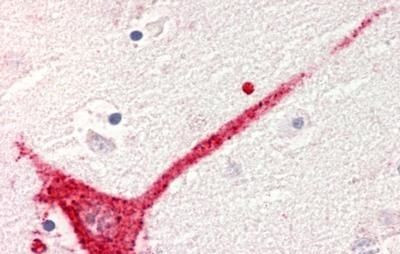
PA1-33165 has been successfully used in immunohistochemistry (paraffin tissue) applications.
The PA1-33165 immunogen is: Synthetic peptide, KLH conjugated. Peptide sequence identity/similarity to Mouse: 70/85%. Rat: 70/90%.
靶标信息
Adrenomedullin (ADM) is a hypotensive peptide that belongs to a peptide superfamily, which includes the calcitonin gene-related peptide (CGRP) and amylin. ADM was originally identified in the adrenal medulla, where it is highly expressed. It is also produced by most contractile cells and is upregulated during sepsis and ischemia. Three distinct receptors have the ability to bind ADM and are designated ADM receptor (also designated L1), RDC-1 and the Calcitonin Receptor-Like Receptor (CRLR). The CRLR associates with receptor activity-modifying proteins (RAMPs), which determine the specificity of CRLR binding. Co-expression with RAMP1 results in CRLR binding to CGRP, whereas association with RAMP2 or 3 results in ADM binding. The ADM receptor, a seven transmembrane G protein-coupled receptor, specifically binds ADM and is highly expressed in heart, brain, skeletal muscle, the immune system, adrenal gland and liver. The ADM receptor mediates the signals produced by ADM through G proteins, which activate adenylate cyclase.
仅用于科研。不用于诊断过程。未经明确授权不得转售。
篇参考文献 (0)
您是否在文献中引用过该产品?请点击下方按钮邮件告知我们。
Disclaimer

Clicking the images or links will redirect you to a website hosted by BenchSci that provides third-party scientific content. Neither the content nor the BenchSci technology and processes for selection have been evaluated by us; we are providing them as-is and without warranty of any kind, including for use or application of the Thermo Fisher Scientific products presented.

