Search
Invitrogen
Glypican 4 Polyclonal Antibody
{{$productOrderCtrl.translations['antibody.pdp.commerceCard.promotion.promotions']}}
{{$productOrderCtrl.translations['antibody.pdp.commerceCard.promotion.promocode']}}: {{promo.promoCode}} {{promo.promoTitle}} {{promo.promoDescription}}. {{$productOrderCtrl.translations['antibody.pdp.commerceCard.promotion.learnmore']}}
{{$ctrl.translations['antibody.pdp.skuNotes.additionalInformation']}}:
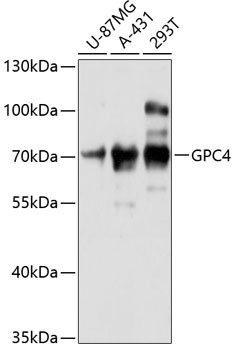
图: 1 / 2
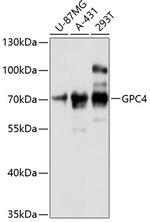
Glypican 4 Antibody (PA5-88766) in WB
Western blot analysis of Glypican 4 in extracts of various cell lines. Samples were incubated with Glypican 4 Polyclonal antibody (Product # PA5-88766) using a dilution of 1:3,000, followed by HRP Goat Anti-Rabbit IgG (H+L) at a dilution of 1:10,000. Lysates/proteins: 25 µg per lane. Blocking buffer: 3% nonfat dry milk in TBST. Detection: ECL Basic Kit. Exposure time: 30s.
Please note: We are reviewing Western blot images included in the antibody testing data in our catalog, including those provided by third parties. Unless expressly labeled or annotated as “raw-unedited”, Western blot images included in the antibody testing data in our catalog may have been edited, optimized or otherwise adjusted for presentation.


产品信息
PA5-88766
产品规格
种属反应
Human,
Mouse
宿主/亚型
Rabbit
/ IgG
分类
Polyclonal
类型
Antibody
抗原
Recombinant protein (or fragment)
偶联物
Unconjugated
Unconjugated
Unconjugated
形式
Liquid
浓度
2.95 mg/mL
规格
295 µg
纯化类型
Affinity Chromatography
保存液
PBS, pH 7.3, with 50% glycerol
内含物
0.09% sodium azide
保存条件
-20°C, Avoid Freeze/Thaw Cycles
运输条件
Ambient (domestic); Wet ice (international)
RRID
产品详细信息
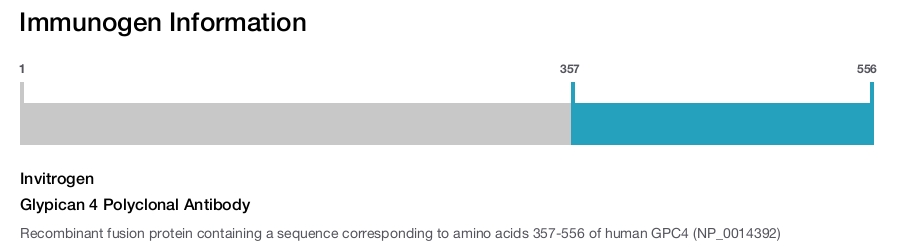
Immunogen sequence: SESAFSARFR PHHPEERPTT AAGTSLDRLV TDVKEKLKQA KKFWSSLPSN VCNDERMAAG NGNEDDCWNG KGKSRYLFAV TGNGLANQGN NPEVQVDTSK PDILILRQIM ALRVMTSKMK NAYNGNDVDF FDISDESSGE GSGSGCEYQQ CPSEFDYNAT DHAGKSANEK ADSAGVRPGA QAYLLTVFCI LFLVMQREWR; Positive Samples: U-87MG, A-431, 293T; Cellular Location: Cell membrane, Extracellular side, GPI-anchor, Lipid-anchor, extracellular space
靶标信息
Cell surface heparan sulfate proteoglycans are composed of a membrane-associated protein core substituted with a variable number of heparan sulfate chains. Members of the glypican-related integral membrane proteoglycan family contain a core protein anchored to the cytoplasmic membrane via a glycosyl phosphatidylinositol linkage. These proteins may play a role in the control of cell division and growth regulation. The GPC4 gene is adjacent to the 3' end of GPC3 and may also play a role in Simpson-Golabi-Behmel syndrome.
仅用于科研。不用于诊断过程。未经明确授权不得转售。
生物信息学
蛋白别名: dJ900E8.1 (glypican 4); glypican proteoglycan 4; K-glypican; unnamed protein product
基因别名: 9530073D23Rik; K-glypican; KPTS
UniProt ID: (Human) O75487, (Mouse) P51655
Entrez Gene ID: (Human) 2239, (Mouse) 14735
Disclaimer

Clicking the images or links will redirect you to a website hosted by BenchSci that provides third-party scientific content. Neither the content nor the BenchSci technology and processes for selection have been evaluated by us; we are providing them as-is and without warranty of any kind, including for use or application of the Thermo Fisher Scientific products presented.

