Search
Active Motif
Histone H3K14bz Polyclonal Antibody
{{$productOrderCtrl.translations['antibody.pdp.commerceCard.promotion.promotions']}}
{{$productOrderCtrl.translations['antibody.pdp.commerceCard.promotion.viewpromo']}}
{{$productOrderCtrl.translations['antibody.pdp.commerceCard.promotion.promocode']}}: {{promo.promoCode}} {{promo.promoTitle}} {{promo.promoDescription}}. {{$productOrderCtrl.translations['antibody.pdp.commerceCard.promotion.learnmore']}}
Additional Information:
{{banner.description}}


产品信息
39303ACTMOTIF
产品规格
种属反应
Human
宿主/亚型
Rabbit
/ IgG
分类
Polyclonal
类型
Antibody
抗原
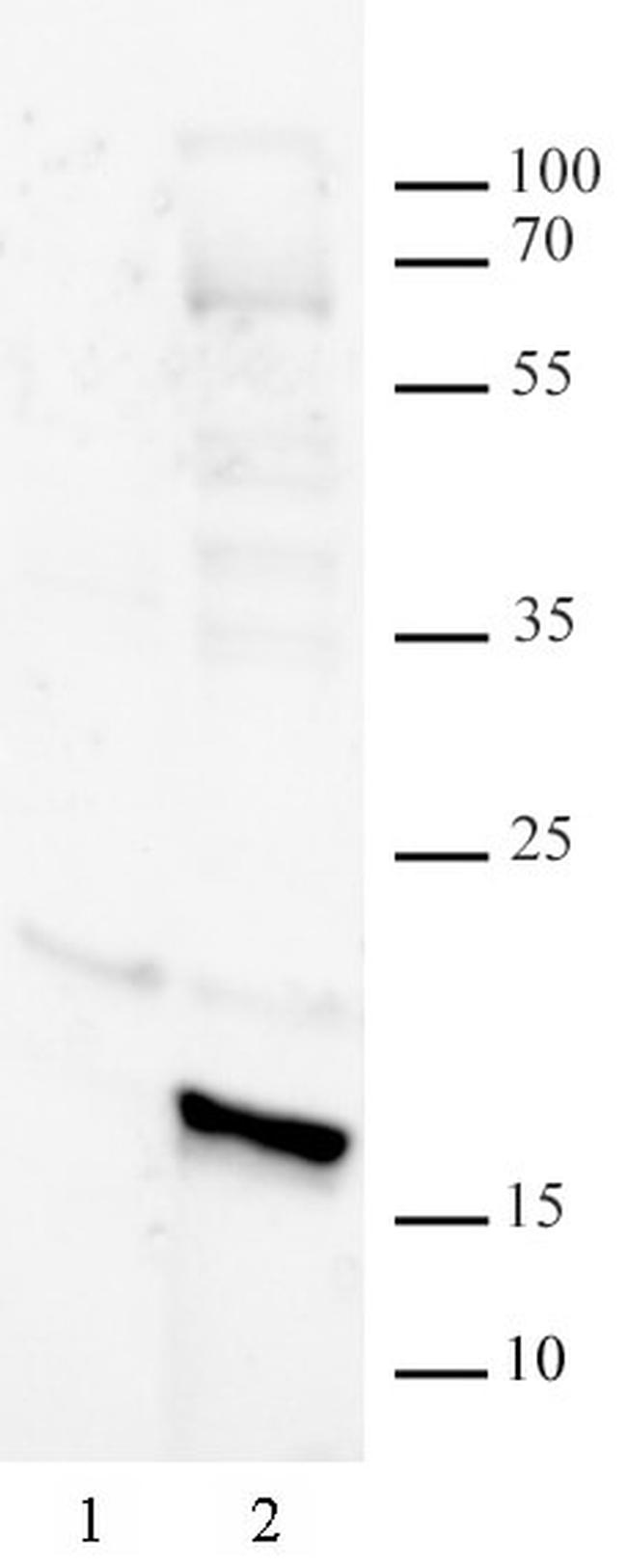
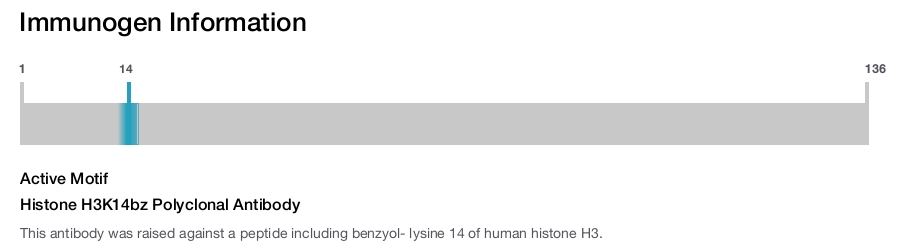
This antibody was raised against a peptide including benzyol- lysine 14 of human histone H3.
偶联物
Unconjugated
Unconjugated
Unconjugated
形式
Liquid
浓度
Conc. Not Determined
纯化类型
Affinity chromatography
保存液
70mM tris
内含物
0.035% sodium azide
保存条件
-20°C, Avoid Freeze/Thaw Cycles
运输条件
Ambient (domestic); Wet ice (international)
靶标信息
Histone H3 is one of the core components of the nucleosome. The nucleosome is the smallest subunit of chromatin and consists of 147 base pairs of DNA wrapped around an octamer of core histone proteins (two each of Histone H2A, Histone H2B, Histone H3 and Histone H4). Histone H1 is a linker histone, present at the interface between the nucleosome core and DNA entry/exit points. Histone H1 is responsible for establishing higher-order chromatin structure. Chromatin is subject to a variety of chemical modifications, including post-translational modifications of the histone proteins and the methylation of cytosine residues in the DNA. Reported histone modifications include acetylation, methylation, phosphorylation, ubiquitylation, glycosylation, ADP-ribosylation, carbonylation and SUMOylation. More recently, the identification of the lysine benzoylation (Kbz) has been shown to be associated with gene expression and to have physiological relevance that is distinct from other histone modifications. Benzoylation can be induced by sodium benzoate, which is a widely used chemical food preservative and FDA-approved drug, generating an interest in the impact of chemical preservatives on histone modification and the potential effect of metabolite-direct modifications on cellular metabolism.
仅用于科研。不用于诊断过程。未经明确授权不得转售。
篇参考文献 (0)
您是否在文献中引用过该产品?请点击下方按钮邮件告知我们。
生物信息学
蛋白别名: H3 histone family, member A; H3 histone family, member B; H3 histone family, member C; H3 histone family, member D; H3 histone family, member F; H3 histone family, member H; H3 histone family, member I; H3 histone family, member J; H3 histone family, member K; H3 histone family, member L; HIST1H3A; HIST1H3E; HIST1H3F; histone 1, H3a; histone 1, H3b; histone 1, H3c; histone 1, H3d; histone 1, H3e; histone 1, H3f; histone 1, H3g; histone 1, H3h; histone 1, H3i; histone 1, H3j; histone cluster 1 H3 family member a; histone cluster 1 H3 family member b; histone cluster 1 H3 family member c; histone cluster 1 H3 family member d; histone cluster 1 H3 family member e; histone cluster 1 H3 family member f; histone cluster 1 H3 family member g; histone cluster 1 H3 family member h; histone cluster 1 H3 family member i; histone cluster 1 H3 family member j; histone cluster 1, H3a; histone cluster 1, H3b; histone cluster 1, H3c; histone cluster 1, H3d; histone cluster 1, H3e; histone cluster 1, H3f; histone cluster 1, H3g; histone cluster 1, H3h; histone cluster 1, H3i; histone cluster 1, H3j; Histone H3.1; Histone H3/a; Histone H3/b; Histone H3/c; Histone H3/d; Histone H3/f; Histone H3/h; Histone H3/i; Histone H3/j; Histone H3/k; Histone H3/l; unnamed protein product
基因别名: H3.1; H3.f; H3/A; H3/b; H3/c; H3/d; H3/f; H3/h; H3/i; H3/j; H3/k; H3/l; H3C1; H3C10; H3C11; H3C12; H3C2; H3C3; H3C4; H3C6; H3C7; H3C8; H3F1K; H3FA; H3FB; H3FC; H3FC HIST1H3C; H3FD; H3FF; H3FH; H3FI; H3FJ; H3FK; H3FL; HIST1H3A; HIST1H3B; HIST1H3C; HIST1H3D; HIST1H3E; HIST1H3F; HIST1H3G; HIST1H3H; HIST1H3I; HIST1H3J
UniProt ID: (Human) P68431
Entrez Gene ID: (Human) 8350, (Human) 8357, (Human) 8354, (Human) 8356, (Human) 8358, (Human) 8352, (Human) 8351, (Human) 8353, (Human) 8968, (Human) 8355
Disclaimer

Clicking the images or links will redirect you to a website hosted by BenchSci that provides third-party scientific content. Neither the content nor the BenchSci technology and processes for selection have been evaluated by us; we are providing them as-is and without warranty of any kind, including for use or application of the Thermo Fisher Scientific products presented.

