Search
Invitrogen
Human Parechovirus 3 VP3 (Strain: WA17c-06) Recombinant Rabbit Monoclonal Antibody (HL2544)
{{$productOrderCtrl.translations['antibody.pdp.commerceCard.promotion.promotions']}}
{{$productOrderCtrl.translations['antibody.pdp.commerceCard.promotion.promocode']}}: {{promo.promoCode}} {{promo.promoTitle}} {{promo.promoDescription}}. {{$productOrderCtrl.translations['antibody.pdp.commerceCard.promotion.learnmore']}}
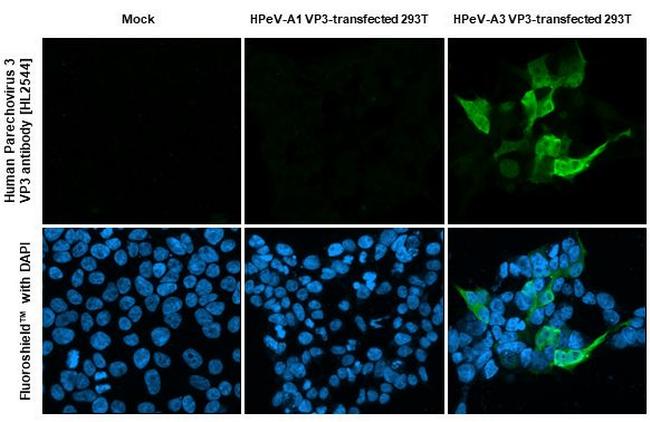
图: 1 / 2
Human Parechovirus 3 VP3 (Strain: WA17c-06) Antibody (MA5-56754) in ICC/IF
Immunocytochemistry analysis of Human Parechovirus 3 VP3 (Strain: WA17c-06) using Human Parechovirus 3 VP3 (Strain: WA17c-06) Recombinant Monoclonal Antibody (Product # MA5-56754) in Mock and transfected Expi293 cells fixed in 4% paraformaldehyde at RT for 15 min. Human Parechovirus 3 VP3 (Strain: WA17c-06) antibody diluted at 1:500. Blue: Fluoroshield with DAPI.
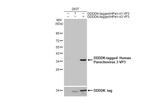
Please note: We are reviewing Western blot images included in the antibody testing data in our catalog, including those provided by third parties. Unless expressly labeled or annotated as “raw-unedited”, Western blot images included in the antibody testing data in our catalog may have been edited, optimized or otherwise adjusted for presentation.


产品信息
MA5-56754
产品规格
种属反应
Virus
宿主/亚型
Rabbit
/ IgG
Expression System
HEK293 cells
分类
Recombinant Monoclonal
类型
Antibody
克隆号
HL2544
抗原
Synthetic peptide of Human Parechovirus 3 VP3. (strain: WA17c-06)
偶联物
Unconjugated
Unconjugated
Unconjugated
形式
Liquid
浓度
1 mg/mL
规格
100 µg
纯化类型
Protein A
保存液
PBS
内含物
no preservative
保存条件
-20°C, Avoid Freeze/Thaw Cycles
运输条件
Ambient (domestic); Dry ice (international)
RRID
靶标信息
The Human Parechovirus Type 3 (HPeV-3) VP3 protein is a vital structural component of the HPeV-3 virus, which belongs to the Picornaviridae family. The VP3 protein is one of the capsid proteins that form the outer shell of the virus, encapsulating and protecting its RNA genome. This protein plays a crucial role in the virus's ability to infect host cells, as it is involved in the initial attachment and entry into the host cell, as well as in the assembly and stability of the viral particle. HPeV-3 is associated with a range of clinical manifestations, particularly severe in infants and young children, including neonatal sepsis, meningitis, encephalitis, and respiratory infections. The VP3 protein is highly immunogenic, making it an important target for the development of diagnostic tools, vaccines, and antiviral therapies. Understanding the structure and function of the VP3 protein in HPeV-3 is essential for advancing research into the pathogenic mechanisms of the virus and for creating effective strategies to prevent and treat HPeV-3 infections.
仅用于科研。不用于诊断过程。未经明确授权不得转售。
篇参考文献 (0)
您是否在文献中引用过该产品?请点击下方按钮邮件告知我们。
生物信息学
蛋白别名: Human PeV 3 VP3
Disclaimer

Clicking the images or links will redirect you to a website hosted by BenchSci that provides third-party scientific content. Neither the content nor the BenchSci technology and processes for selection have been evaluated by us; we are providing them as-is and without warranty of any kind, including for use or application of the Thermo Fisher Scientific products presented.

