Search
Proteintech
IMPA1 Polyclonal Antibody
{{$productOrderCtrl.translations['antibody.pdp.commerceCard.promotion.promotions']}}
{{$productOrderCtrl.translations['antibody.pdp.commerceCard.promotion.viewpromo']}}
{{$productOrderCtrl.translations['antibody.pdp.commerceCard.promotion.promocode']}}: {{promo.promoCode}} {{promo.promoTitle}} {{promo.promoDescription}}. {{$productOrderCtrl.translations['antibody.pdp.commerceCard.promotion.learnmore']}}
Additional Information:
{{banner.description}}
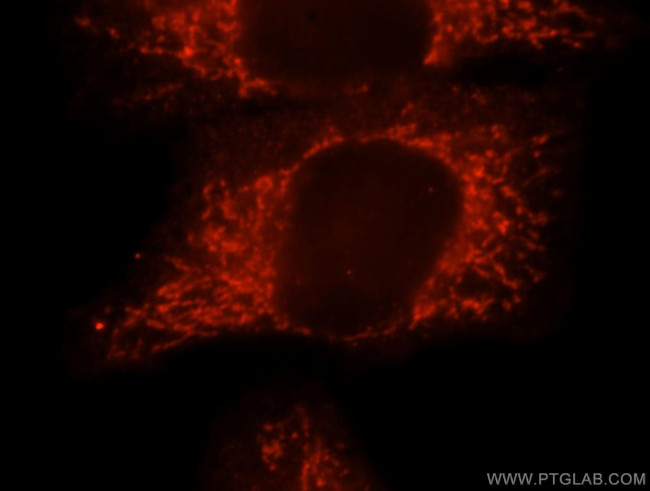



产品信息
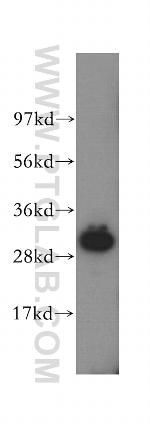
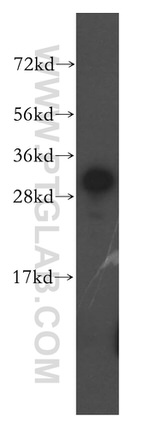
16593-1-AP
应用
建议稀释比
已发表文章
产品规格
种属反应
Human,
Mouse,
Rat
宿主/亚型
Rabbit
/ IgG
分类
Polyclonal
类型
Antibody
抗原
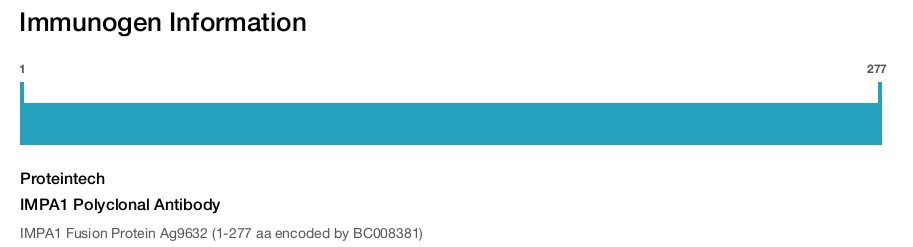
IMPA1 Fusion Protein Ag9632 (1-277 aa encoded by BC008381)
偶联物
形式
Liquid
浓度
0.21 mg/mL
规格
31.5 µg
纯化类型
Antigen affinity chromatography
保存液
PBS, pH 7.3, with 50% glycerol
内含物
0.02% sodium azide
保存条件
-20°C
运输条件
Wet ice (domestic); Dry ice (international)
产品详细信息
Immunogen sequence: MADPWQECM DYAVTLARQA GEVVCEAIKN EMNVMLKSSP VDLVTATDQK VEKMLISSIK EKYPSHSFIG EESVAAGEKS ILTDNPTWII DPIDGTTNFV HRFPFVAVSI GFAVNKKIEF GVVYSCVEGK MYTARKGKGA FCNGQKLQVS QQEDITKSLL VTELGSSRTP ETVRMVLSNM EKLFCIPVHG IRSVGTAAVN MCLVATGGAD AYYEMGIHCW DVAGAGIIVT EAGGVLMDVT GGPFDLMSRR VIAANNRILA ERIAKEIQVI PLQRDDED (1-277 aa encoded by BC008381)
靶标信息
IMPA1, also known as Myo-inositol monophosphatase 1, is responsible for the procurement of inositol that is required for synthesis of phosphatidylinositol and polyphosphoinositides. IMPA1 exists as a homodimer and has been identified as the pharmacological target for lithium action in the brain. IMPA1 is the principal enzyme of the phosphatidyl inositol signaling pathway, and inhibition of inositol monophosphatase hydrolysis may underlie the anti-manic and anti-depressant actions of Li+. Studies indicate that a variation in the 277 codon coding region of the IMPA1 gene has not been observed in manic-depressive patients, therefore suggesting that polymorphisms or mutations in the noncoding regions of this gene may influence the lithium response in psychiatric patients.
仅用于科研。不用于诊断过程。未经明确授权不得转售。
篇参考文献 (0)
您是否在文献中引用过该产品?请点击下方按钮邮件告知我们。
生物信息学
蛋白别名: D-galactose 1-phosphate phosphatase; IMP 1; IMPase 1; Inositol monophosphatase 1; inositol(myo)-1(or 4)-monophosphatase 1; Inositol-1(or 4)-monophosphatase 1; Lithium-sensitive myo-inositol monophosphatase A1; myo-inositol monophosphatase 1; testicular tissue protein Li 94; unnamed protein product
基因别名: 2610002K09Rik; 2900059K10Rik; AI325909; IMP; IMPA; IMPA1; Impa1-L; MRT59
UniProt ID: (Human) P29218, (Rat) P97697
Entrez Gene ID: (Human) 3612, (Rat) 83523, (Mouse) 55980
magnesium ion binding
glucose-6-phosphatase activity
protein binding
glucose-1-phosphatase activity
inositol monophosphate 1-phosphatase activity
hydrolase activity
manganese ion binding
lithium ion binding
identical protein binding
protein homodimerization activity
metal ion binding
glycerol-2-phosphatase activity
inositol monophosphate 3-phosphatase activity
inositol monophosphate 4-phosphatase activity
inositol monophosphate phosphatase activity
fructose-1-phosphatase activity
phosphatase
Disclaimer

Clicking the images or links will redirect you to a website hosted by BenchSci that provides third-party scientific content. Neither the content nor the BenchSci technology and processes for selection have been evaluated by us; we are providing them as-is and without warranty of any kind, including for use or application of the Thermo Fisher Scientific products presented.

