Search
Proteintech
IP6K2 Polyclonal Antibody
{{$productOrderCtrl.translations['antibody.pdp.commerceCard.promotion.promotions']}}
{{$productOrderCtrl.translations['antibody.pdp.commerceCard.promotion.viewpromo']}}
{{$productOrderCtrl.translations['antibody.pdp.commerceCard.promotion.promocode']}}: {{promo.promoCode}} {{promo.promoTitle}} {{promo.promoDescription}}. {{$productOrderCtrl.translations['antibody.pdp.commerceCard.promotion.learnmore']}}
Additional Information:
{{banner.description}}


产品信息
13155-1-AP
产品规格
宿主/亚型
Rabbit
/ IgG
分类
Polyclonal
类型
Antibody
抗原
IP6K2 Fusion Protein Ag3786 (1-350 aa encoded by BC019694)
偶联物
形式
Liquid
浓度
0.17 mg/mL
规格
25.5 µg
保存条件
-20°C
运输条件
Wet ice (domestic); Dry ice (international)
产品详细信息
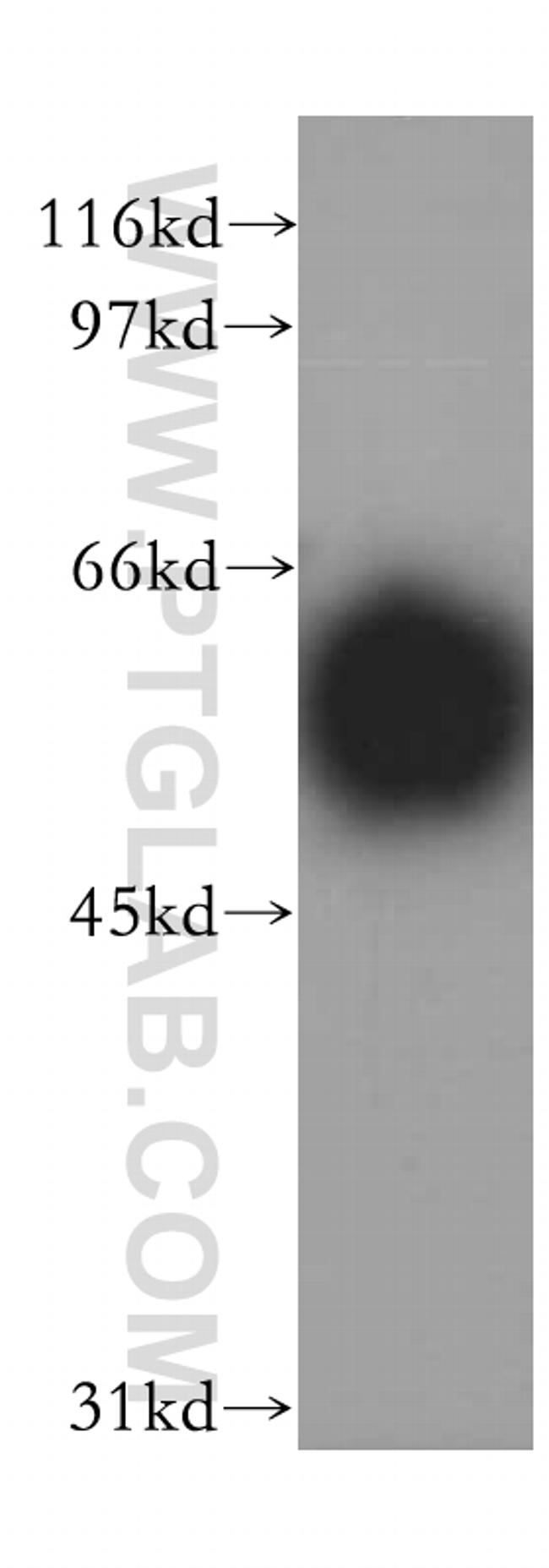
This antibody recognizes the others except the 8 kDa isoform of IP6K2.
Immunogen sequence: MSPAFRAMD VEPRAKGVLL EPFVHQVGGH SCVLRFNETT LCKPLVPREH QFYETLPAEM RKFTPQYKGV VSVRFEEDED RNLCLIAYPL KGDHGIVDIV DNSDCEPKSK LLRWTTNKKH HVLETEKTPK DWVRQHRKEE KMKSHKLEEE FEWLKKSEVL YYTVEKKGNI SSQLKHYNPW SMKCHQQQLQ RMKENAKHRN QYKFILLENL TSRYEVPCVL DLKMGTRQHG DDASEEKAAN QIRKCQQSTS AVIGVRVCGM QVYQAGSGQL MFMNKYHGRK LSVQGFKEAL FQFFHNGRYL RRELLGPVLK KLTELKAVLE RQESYRFYSS SLLVIYDGKE RPEVVLDSDA E (1-350 aa encoded by BC019694)
靶标信息
The members of the inositol hexakisphosphate kinase family, IP6K1 and IP6K2, have a high affinity and selectivity for inositol hexakisphosphate (InsP6) as a substrate. IP6K1 and IP6K2 (also designated PiUS) convert InsP6 to PP-InsP5. However, neither kinase demonstrates any catalytic activity with other inositol pyrophosphates. The presence of InsP6, which inhibits serine/threonine protein phosphatases, increases the influx of calcium across the plasma membrane and implies that it may mediate the regulation of insulin exocytosis. IP6K1 was purified as a 54 kDa protein in rat brain extracts. By homology, IP6K1 and IP6K2 were characterized in mouse as a 50 kDa and 49 kDa protein, respectively. IP6K1 displays ATP synthase activity by transferring a phosphate from PP-InsP5 to ADP, which suggests a role for the IP6 kinases as high energy phosphate donors.
仅用于科研。不用于诊断过程。未经明确授权不得转售。
篇参考文献 (0)
您是否在文献中引用过该产品?请点击下方按钮邮件告知我们。
Disclaimer

Clicking the images or links will redirect you to a website hosted by BenchSci that provides third-party scientific content. Neither the content nor the BenchSci technology and processes for selection have been evaluated by us; we are providing them as-is and without warranty of any kind, including for use or application of the Thermo Fisher Scientific products presented.

