Search
Proteintech
KANSL2 Polyclonal Antibody
{{$productOrderCtrl.translations['antibody.pdp.commerceCard.promotion.promotions']}}
{{$productOrderCtrl.translations['antibody.pdp.commerceCard.promotion.viewpromo']}}
{{$productOrderCtrl.translations['antibody.pdp.commerceCard.promotion.promocode']}}: {{promo.promoCode}} {{promo.promoTitle}} {{promo.promoDescription}}. {{$productOrderCtrl.translations['antibody.pdp.commerceCard.promotion.learnmore']}}
Additional Information:
{{banner.description}}

产品信息
27261-1-AP
产品规格
种属反应
Human,
Mouse
宿主/亚型
Rabbit
/ IgG
分类
Polyclonal
类型
Antibody
抗原
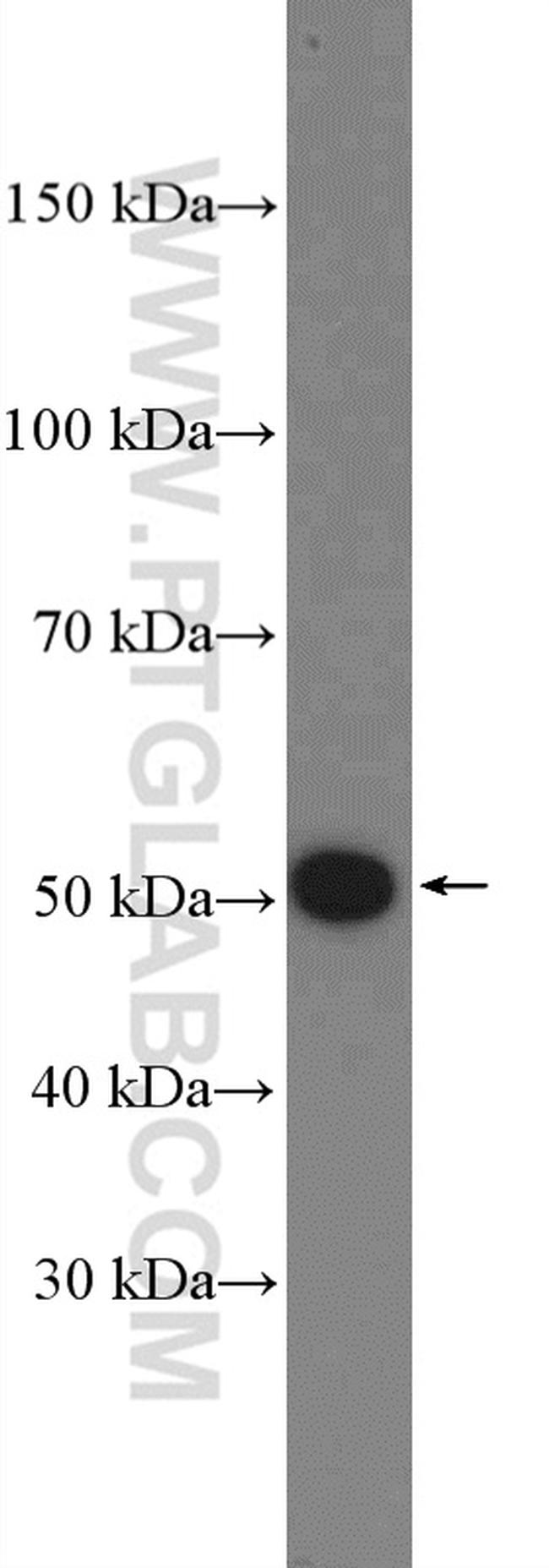
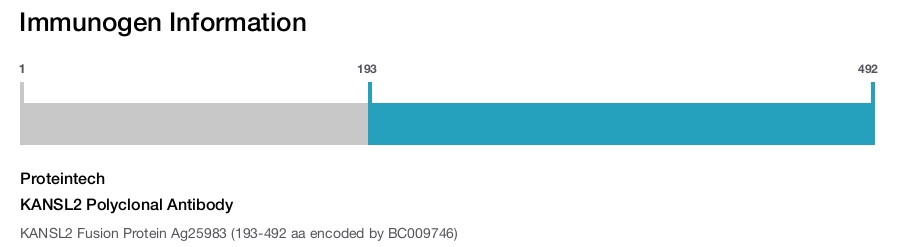
KANSL2 Fusion Protein Ag25983 (193-492 aa encoded by BC009746)
偶联物
形式
Liquid
浓度
0.4 mg/mL
规格
60 µg
纯化类型
Antigen affinity chromatography
保存液
PBS, pH 7.3, with 50% glycerol
内含物
0.02% sodium azide
保存条件
-20°C
运输条件
Wet ice (domestic); Dry ice (international)
产品详细信息
Immunogen sequence: ALIMREKLI RLQSLYIDQF KRLQHLLKEK KRRYLHNRKV EHEALGSSLL TGPEGLLAKE RENLKRLKCL RRYRQRYGVE ALLHRQLKER RMLATDGAAQ QAHTTRSSQR CLAFVDDVRC SNQSLPMTRH CLTHICQDTN QVLFKCCQGS EEVPCNKPVP VSLSEDPCCP LHFQLPPQMY KPEQVLSVPD DLEAGPMDLY LSAAELQPTE SLPLEFSDDL DVVGDGMQCP PSPLLFDPSL TLEDHLVKEI AEDTVDILGQ MQMAGDGCRS QGSRNSEKAS APLSQSGLAT ANGKPEPTSI S (193-492 aa encoded by BC009746)
靶标信息
The C12orf41 gene, also known as CFAP70 (Cilia and Flagella Associated Protein 70), is located on chromosome 12 and encodes a protein that is essential for the proper function of cilia and flagella. The CFAP70 protein plays a critical role in the assembly and maintenance of axonemal structures, which are core components of cilia and flagella. Cilia and flagella are vital for various cellular processes, including motility, fluid movement across cell surfaces, and signal transduction. Mutations in CFAP70 have been linked to primary ciliary dyskinesia (PCD), a genetic disorder characterized by chronic respiratory tract infections, abnormal situs (organ positioning), and infertility due to defective motility of cilia and flagella. CFAP70 is also involved in the regulation of dynein arms and radial spokes, which are necessary for the effective beating of cilia and flagella. Research into CFAP70 continues to uncover its multifaceted roles in cellular function and its potential implications in ciliopathies.
仅用于科研。不用于诊断过程。未经明确授权不得转售。
篇参考文献 (0)
您是否在文献中引用过该产品?请点击下方按钮邮件告知我们。
生物信息学
蛋白别名: KAT8 regulatory NSL complex subunit 2; Non-specific lethal 2 homolog; NSL complex protein NSL2; unnamed protein product
基因别名: 2310037I24Rik; B930009D17; C12orf41; KANSL2; NSL2
UniProt ID: (Human) Q9H9L4, (Mouse) Q8BQR4
Entrez Gene ID: (Human) 54934, (Mouse) 69612
Disclaimer

Clicking the images or links will redirect you to a website hosted by BenchSci that provides third-party scientific content. Neither the content nor the BenchSci technology and processes for selection have been evaluated by us; we are providing them as-is and without warranty of any kind, including for use or application of the Thermo Fisher Scientific products presented.

