Search
Invitrogen
KIR2DL3 Recombinant Rabbit Monoclonal Antibody (014)
{{$productOrderCtrl.translations['antibody.pdp.commerceCard.promotion.promotions']}}
{{$productOrderCtrl.translations['antibody.pdp.commerceCard.promotion.promocode']}}: {{promo.promoCode}} {{promo.promoTitle}} {{promo.promoDescription}}. {{$productOrderCtrl.translations['antibody.pdp.commerceCard.promotion.learnmore']}}
{{$ctrl.translations['antibody.pdp.skuNotes.additionalInformation']}}:
产品信息
MA5-30608
产品规格
种属反应
Human
宿主/亚型
Rabbit
/ IgG
Expression System
HEK293 cells
分类
Recombinant Monoclonal
类型
Antibody
克隆号
014
抗原
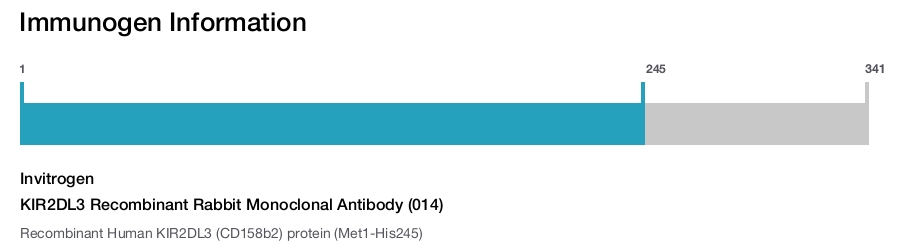
Recombinant Human KIR2DL3 (CD158b2) protein (Met1-His245)
偶联物
Unconjugated
Unconjugated
Unconjugated
形式
Liquid
浓度
1 mg/mL
规格
100 µg
纯化类型
Protein A
保存液
PBS
内含物
no preservative
保存条件
Store at 4°C short term. For long term storage, store at -20°C, avoiding freeze/thaw cycles.
运输条件
Ambient (domestic); Wet ice (international)
RRID
产品详细信息
This product is preservative free. It is recommended to add sodium azide to avoid contamination (final concentration 0.05%-0.1%).
Recombinant rabbit monoclonal antibodies are produced using in vitro expression systems. The expression systems are developed by cloning in the specific antibody DNA sequences from immunoreactive rabbits. Then, individual clones are screened to select the best candidates for production. The advantages of using recombinant rabbit monoclonal antibodies include: better specificity and sensitivity, lot-to-lot consistency, animal origin-free formulations, and broader immunoreactivity to diverse targets due to larger rabbit immune repertoire.
This antibody has specificity for Human KIR2DL3 (CD158b2).
靶标信息
NKAT (NK-associated transcripts) gene products, known as killer immuno-globulin-like receptors or KIRs, downregulate the cytotoxicity of NK cells upon recognition of specific class I major histocompatibility complex (MHC) molecules on target cells. This family of receptors is characterized by an extracellular region with two to three immunoglobulin-superfamily domains and a cytoplasmic domain with an antigen receptor activation motif (ARAM). KIRs and other inhibitory receptors also possess a common cytoplasmic sequence (I/VxYxxL/V) known as an ITIM (immunoreceptor tyrosine-based inhibitory motif). The human inhibitory human killer cell immunoglobulin-like receptor 2DL3 (KIR2DL3), also referred to as CD158b, is an inhibitory receptor that is specific for the human MHC class I molecule HLA-Cw3 and related alleles.
仅用于科研。不用于诊断过程。未经明确授权不得转售。
篇参考文献 (0)
您是否在文献中引用过该产品?请点击下方按钮邮件告知我们。
生物信息学
蛋白别名: CD158 antigen-like family member B2; CU464054.1; extracellular domain; killer cell immunoglobulin-like receptor two domains long cytoplasmic tail 3; killer cell immunoglobulin-like receptor, two domains, short cytoplasmic tail, 5; killer inhibitory receptor cl 2-3; MGC129943; natural killer associated transcript 2; natural killer cell inhibitory receptor KIR2DL3; natural killer cell receptor; nkat2a; putative; nkat2b; putative; p58 KIR; p58 natural killer cell receptor clone CL-6; p58 NK receptor CL-6; p58.2 MHC class-I specific NK receptor
基因别名: CD158b; CD158B2; GL183; KIR-023GB; KIR-K7b; KIR-K7c; KIR2DL; KIRCL23; NKAT; NKAT-2; NKAT2; NKAT2A; NKAT2B; p58
UniProt ID: (Human) P43628
Entrez Gene ID: (Human) 3804
Disclaimer

Clicking the images or links will redirect you to a website hosted by BenchSci that provides third-party scientific content. Neither the content nor the BenchSci technology and processes for selection have been evaluated by us; we are providing them as-is and without warranty of any kind, including for use or application of the Thermo Fisher Scientific products presented.

