Search
Invitrogen
KLHL26 Polyclonal Antibody
{{$productOrderCtrl.translations['antibody.pdp.commerceCard.promotion.promotions']}}
{{$productOrderCtrl.translations['antibody.pdp.commerceCard.promotion.promocode']}}: {{promo.promoCode}} {{promo.promoTitle}} {{promo.promoDescription}}. {{$productOrderCtrl.translations['antibody.pdp.commerceCard.promotion.learnmore']}}
{{$ctrl.translations['antibody.pdp.skuNotes.additionalInformation']}}:
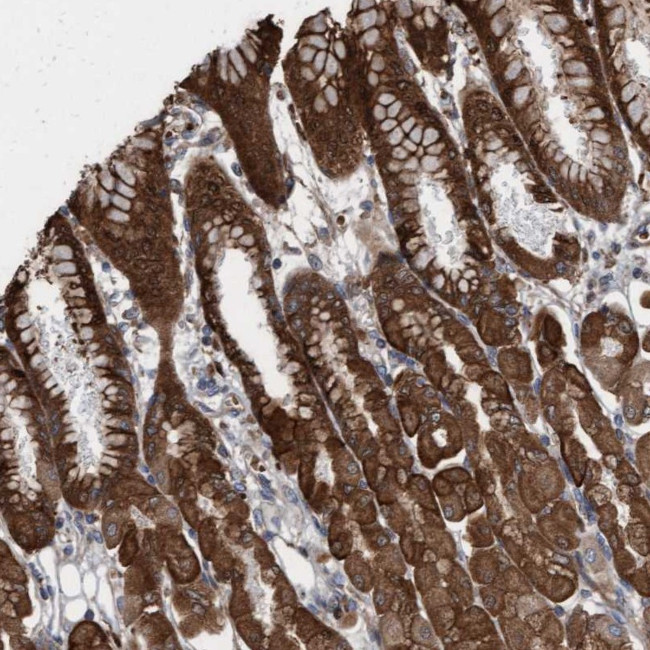
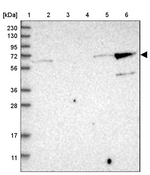
Please note: We are reviewing Western blot images included in the antibody testing data in our catalog, including those provided by third parties. Unless expressly labeled or annotated as “raw-unedited”, Western blot images included in the antibody testing data in our catalog may have been edited, optimized or otherwise adjusted for presentation.


产品信息
PA5-54688
产品规格
种属反应
Human
宿主/亚型
Rabbit
/ IgG
分类
Polyclonal
类型
Antibody
抗原
偶联物
Unconjugated
Unconjugated
Unconjugated
形式
Liquid
浓度
0.2 mg/mL
规格
20 µg
纯化类型
Antigen affinity chromatography
保存液
PBS, pH 7.2, with 40% glycerol
内含物
0.02% sodium azide
保存条件
Store at 4°C short term. For long term storage, store at -20°C, avoiding freeze/thaw cycles.
运输条件
Ambient (domestic); Wet ice (international)
RRID
产品详细信息
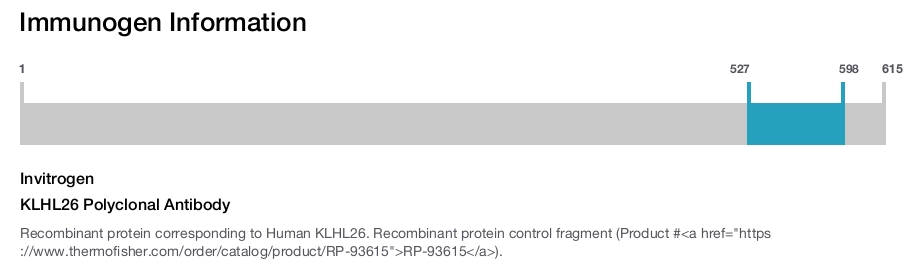
Immunogen sequence: LAVEYYVPET DQWTSVSPMR AGQSEAGCCL LERKIYIVGG YNWRLNNVTG IVQVYNTDTD EWERDLHFPE SF
Highest antigen sequence identity to the following orthologs: Mouse - 94%, Rat - 94%.
靶标信息
KLHL26, part of the Kelch-like family member 26, is a protein-coding gene located on chromosome 19. It has been associated with various cellular functions due to its structural components, particularly the BTB/POZ domain at the N-terminus which spans about 115 amino acids. This domain plays crucial roles in forming E3 ubiquitin ligases by facilitating interactions with Cullin3 and enabling KLHL protein homodimerization. The significance of KLHL26 extends to its potential involvement in familial genetic conditions, as evidenced by the identification of a novel damaging variant, which was validated through Sanger sequencing in affected family members. Moreover, the Kelch motif within the KLHL proteins underlines their diverse roles in cellular morphology, gene expression regulation, and interaction with extracellular entities, including possible implications in actin binding and virus interactions post-infection.
仅用于科研。不用于诊断过程。未经明确授权不得转售。
篇参考文献 (0)
您是否在文献中引用过该产品?请点击下方按钮邮件告知我们。
生物信息学
蛋白别名: kelch-like 26; unnamed protein product
UniProt ID: (Human) Q53HC5
Entrez Gene ID: (Human) 55295
Disclaimer

Clicking the images or links will redirect you to a website hosted by BenchSci that provides third-party scientific content. Neither the content nor the BenchSci technology and processes for selection have been evaluated by us; we are providing them as-is and without warranty of any kind, including for use or application of the Thermo Fisher Scientific products presented.

