Search
Invitrogen
L3MBTL1 Recombinant Mouse Monoclonal Antibody
{{$productOrderCtrl.translations['antibody.pdp.commerceCard.promotion.promotions']}}
{{$productOrderCtrl.translations['antibody.pdp.commerceCard.promotion.viewpromo']}}
{{$productOrderCtrl.translations['antibody.pdp.commerceCard.promotion.promocode']}}: {{promo.promoCode}} {{promo.promoTitle}} {{promo.promoDescription}}. {{$productOrderCtrl.translations['antibody.pdp.commerceCard.promotion.learnmore']}}
Additional Information:
{{banner.description}}
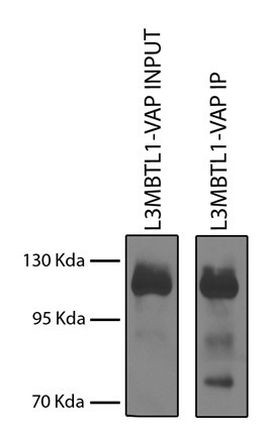
图: 1 / 1
L3MBTL1 Antibody (730022) in IP
Immunoprecipitation analysis of Anti-L3MBTL1 Recombinant Mouse Monoclonal Antibody (Product # 730022). Immunoprecipitation analysis was performed on HEK293 cells over expressing flag tagged L3MBTL1 protein. Western blot using anti-flag antibody was performed on the raw lysate (lane 1), and samples immunoprecipitated with Anti-L3MBTL1 Recombinant Mouse Monoclonal Antibody (lane 2).

产品信息
730022
应用
建议稀释比
已发表文章
产品规格
已发表种属
Human
宿主/亚型
Mouse
/ IgG1
分类
Recombinant Monoclonal
类型
Antibody
抗原
200-530 of 772 of L3MBTL1 Protein.
偶联物
Unconjugated
Unconjugated
Unconjugated
形式
Liquid
浓度
0.5 mg/mL
规格
100 µg
保存条件
Maintain refrigerated at 2-8°C for up to 1 month. For long term storage store at -20°C
运输条件
Wet ice
RRID
产品详细信息
Recombinant antibodies are produced using specific genes that code for the desired antibodies. These genes are cloned into an expression vector and expressed in vitro. The advantages of recombinant antibodies include: better specificity, animal origin-free formulation, and more lot-to-lot consistency.
靶标信息
L3MBTL1 is the homolog of a protein identified in Drosophila as a suppressor of malignant transformation of neuroblasts and ganglion-mother cells in the optic centers of the brain. L3MBTL1 is localized to condensed chromosomes in mitotic cells and overexpression of this protein in a glioma cell line results in improper nuclear segregation and cytokinesis producing multinucleated cells. L3MBTL1 represents a polycomb group gene the encoded protein functions to regulate gene activity, likely via chromatin modification. Polycomb group protein specifically recognizes and binds mono- and dimethyllysine residues on target proteins, thereby acting as a reader of a network of post-translational modifications. Alternatively spliced transcript variants encoding different isoforms of the L3MBTL1 gene have been identified.
仅用于科研。不用于诊断过程。未经明确授权不得转售。
Disclaimer

Clicking the images or links will redirect you to a website hosted by BenchSci that provides third-party scientific content. Neither the content nor the BenchSci technology and processes for selection have been evaluated by us; we are providing them as-is and without warranty of any kind, including for use or application of the Thermo Fisher Scientific products presented.

