Search
Proteintech
LBP Monoclonal Antibody (3A7E3)
{{$productOrderCtrl.translations['antibody.pdp.commerceCard.promotion.promotions']}}
{{$productOrderCtrl.translations['antibody.pdp.commerceCard.promotion.viewpromo']}}
{{$productOrderCtrl.translations['antibody.pdp.commerceCard.promotion.promocode']}}: {{promo.promoCode}} {{promo.promoTitle}} {{promo.promoDescription}}. {{$productOrderCtrl.translations['antibody.pdp.commerceCard.promotion.learnmore']}}
Additional Information:
{{banner.description}}
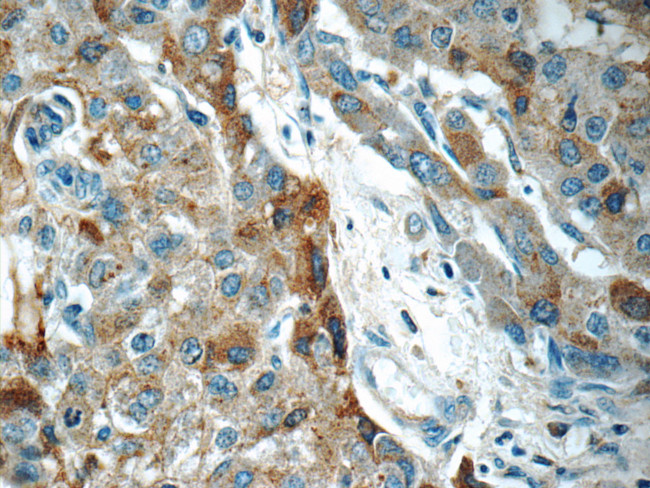


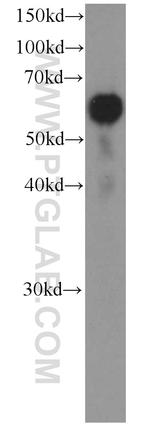


产品信息
66181-1-IG
产品规格
种属反应
Human
宿主/亚型
Mouse
/ IgG2b
分类
Monoclonal
类型
Antibody
克隆号
3A7E3
抗原
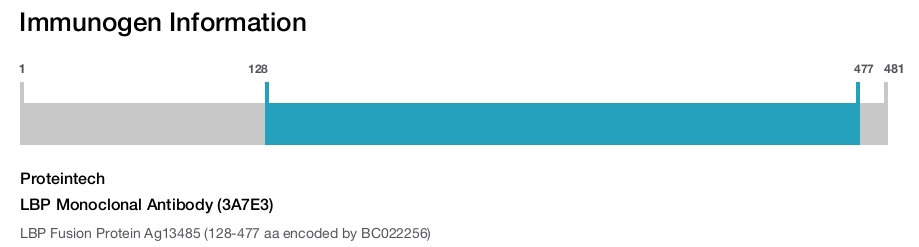
LBP Fusion Protein Ag13485 (128-477 aa encoded by BC022256)
偶联物
Unconjugated
Unconjugated
Unconjugated
形式
Liquid
浓度
1 mg/mL
规格
150 µg
纯化类型
Protein A
保存液
PBS, pH 7.3, with 50% glycerol
内含物
0.02% sodium azide
保存条件
-20°C
运输条件
Wet ice (domestic); Dry ice (international)
产品详细信息
Immunogen sequence: SFDVSVKGI SISVNLLLGS ESSGRPTVTA SSCSSDIADV EVDMSGDLGW LLNLFHNQIE SKFQKVLESR ICEMIQKSVS SDLQPYLQTL PVTTEIDSFA DIDYSLVEAP RATAQMLEVM FKGEIFHRNH RSPVTLLAAV MSLPEEHNKM VYFAISDYVF NTASLVYHEE GYLNFSITDD MIPPDSNIRL TTKSFRPFVP RLARLYPNMN LELQGSVPSA PLLNFSPGNL SVDPYMEIDA FVLLPSSSKE PVFRLSVATN VSATLTFNTS KITGFLKPGK VKVELKESKV GLFNAELLEA LLNYYILNTF YPKFNDKLAE GFPLPLLKRV QLYDLGLQIH KDFPSRRDHP P (128-477 aa encoded by BC022256)
靶标信息
The LBP protein is involved in the acute-phase immunologic response to gram-negative bacterial infections. Gram-negative bacteria contain a glycolipid, lipopolysaccharide (LPS), on their outer cell wall. Together with bactericidal permeability-increasing protein (BPI), the encoded protein binds LPS and interacts with the CD14 receptor, probably playing a role in regulating LPS-dependent monocyte responses. This protein is part of a family of structurally and functionally related proteins, including BPI, plasma cholesteryl ester transfer protein (CETP), and phospholipid transfer protein (PLTP). Finally, this gene is found on chromosome 20, immediately downstream of the BPI gene.
仅用于科研。不用于诊断过程。未经明确授权不得转售。
篇参考文献 (0)
您是否在文献中引用过该产品?请点击下方按钮邮件告知我们。
生物信息学
蛋白别名: BPI fold containing family D, member 2; LBP; lipopolysaccharide binding protein (LBP) precursor; Lipopolysaccharide-binding protein; LPS-binding protein; unnamed protein product
基因别名: BPIFD2; LBP
UniProt ID: (Human) P18428
Entrez Gene ID: (Human) 3929
leukocyte chemotaxis involved in inflammatory response
macrophage activation involved in immune response
immune system process
cell surface pattern recognition receptor signaling pathway
lipid transport
acute-phase response
cellular defense response
opsonization
lipopolysaccharide transport
neutrophil chemotaxis
lipopolysaccharide-mediated signaling pathway
detection of molecule of bacterial origin
response to lipopolysaccharide
negative regulation of tumor necrosis factor production
positive regulation of chemokine production
positive regulation of interleukin-6 production
positive regulation of interleukin-8 production
positive regulation of tumor necrosis factor production
positive regulation of toll-like receptor 4 signaling pathway
defense response to bacterium
positive regulation of macrophage activation
innate immune response
defense response to Gram-negative bacterium
defense response to Gram-positive bacterium
positive regulation of respiratory burst involved in inflammatory response
cellular response to lipopolysaccharide
cellular response to lipoteichoic acid
positive regulation of neutrophil chemotaxis
Disclaimer

Clicking the images or links will redirect you to a website hosted by BenchSci that provides third-party scientific content. Neither the content nor the BenchSci technology and processes for selection have been evaluated by us; we are providing them as-is and without warranty of any kind, including for use or application of the Thermo Fisher Scientific products presented.

