Search
Abnova
LY6E Polyclonal Antibody, MaxPab™
{{$productOrderCtrl.translations['antibody.pdp.commerceCard.promotion.promotions']}}
{{$productOrderCtrl.translations['antibody.pdp.commerceCard.promotion.promocode']}}: {{promo.promoCode}} {{promo.promoTitle}} {{promo.promoDescription}}. {{$productOrderCtrl.translations['antibody.pdp.commerceCard.promotion.learnmore']}}
{{$ctrl.translations['antibody.pdp.skuNotes.additionalInformation']}}:
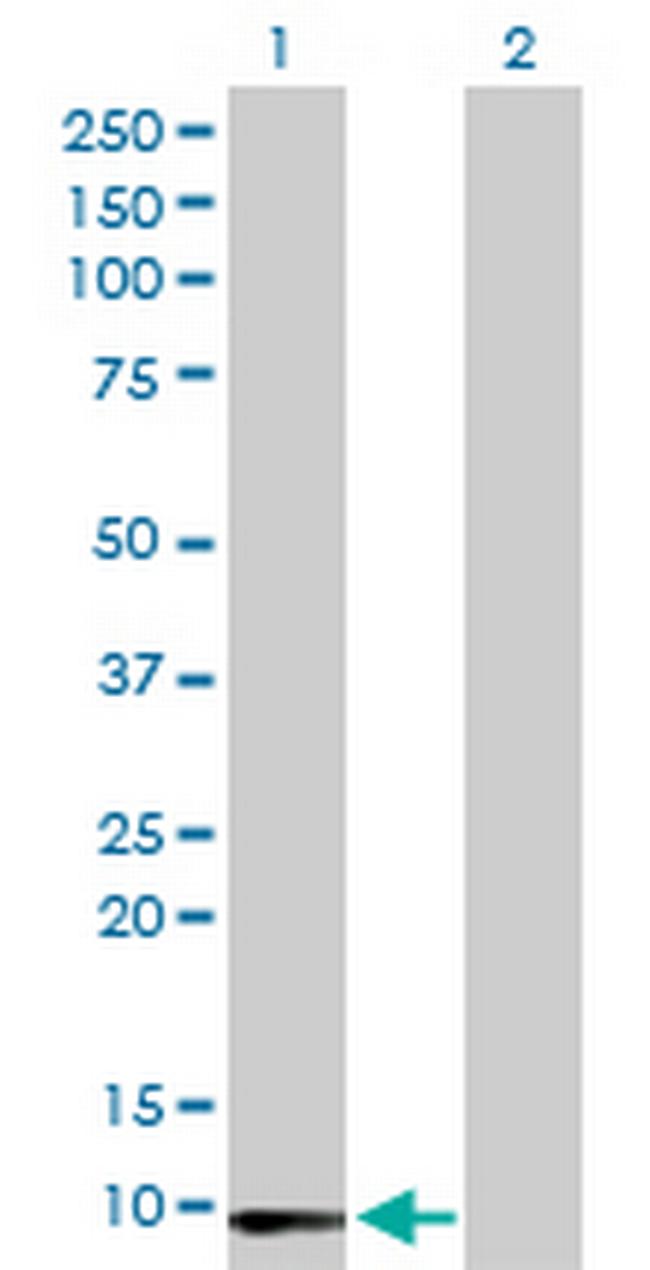
Please note: We are reviewing Western blot images included in the antibody testing data in our catalog, including those provided by third parties. Unless expressly labeled or annotated as “raw-unedited”, Western blot images included in the antibody testing data in our catalog may have been edited, optimized or otherwise adjusted for presentation.

产品信息
H00004061-D01P
产品规格
种属反应
Human
宿主/亚型
Rabbit
/ IgG
分类
Polyclonal
类型
Antibody
抗原
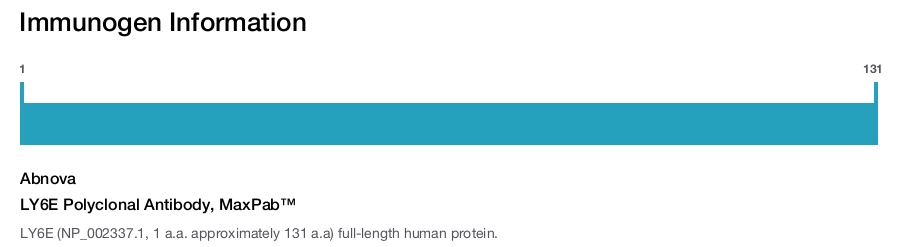
LY6E (NP_002337.1, 1 a.a. approximately 131 a.a) full-length human protein.
偶联物
Unconjugated
Unconjugated
Unconjugated
形式
Liquid
浓度
1 mg/mL
规格
100 µg
纯化类型
Protein A
保存液
PBS, pH 7.4
内含物
no preservative
保存条件
-20°C, Avoid Freeze/Thaw Cycles
运输条件
Ambient (domestic); Wet ice (international)
产品详细信息
Product may be used with Western Blot (Transfected lysate).
The Isotype of this product is composed of an IgG Mixture.
Immunogen sequence: MKIFLPVLLA ALLGVERASS LMCFSCLNQK SNLYCLKPTI CSDQDNYCVT VSASAGIGNL VTFGHSLSKT CSPACPIPEG VNVGVASMGI SCCQSFLCNF SAADGGLRAS VTLLGAGLLL SLLPALLRFG P
靶标信息
Sca1, also known as Ly6A/E, is a member of the Ly6 multigene family of type V glycophosphatidylinositol anchored cell surface proteins. It is expressed on multipotent hematopoietic stem cells in bone marrow of mice with both the Ly6.1 and Ly6.2 allotypes. In the periphery, Sca1 exhibits a pattern of expression which is based on differences between the two allotypes. Ly6.1 strains (e.g., A, BALB/c, CBA, C3H/He, DBA/1, NZB) have few Sca1+ resting peripheral lymphocytes, whereas Ly6.2 strains (e.g., AKR, C57BL, C57BR, C57L, DBA/2, PL, SJL, SWR, 129) have relatively high numbers of Sca1+ lymphocytes. The expression of Sca1 is dramatically upregulated in all strains upon cellular activation.
仅用于科研。不用于诊断过程。未经明确授权不得转售。
篇参考文献 (0)
您是否在文献中引用过该产品?请点击下方按钮邮件告知我们。
生物信息学
蛋白别名: locus A/E; Locus AE; ly-6E; Ly6A; lymphocyte antigen 6 complex, locus E; retinoic acid induced gene E; retinoic acid-induced gene E protein; RIG-E; stem cell antigen 2; thymic shared antigen 1; unnamed protein product
基因别名: RIG-E; RIGE; SCA-2; SCA2; TSA-1
UniProt ID: (Human) Q16553
Entrez Gene ID: (Human) 4061
Disclaimer

Clicking the images or links will redirect you to a website hosted by BenchSci that provides third-party scientific content. Neither the content nor the BenchSci technology and processes for selection have been evaluated by us; we are providing them as-is and without warranty of any kind, including for use or application of the Thermo Fisher Scientific products presented.

